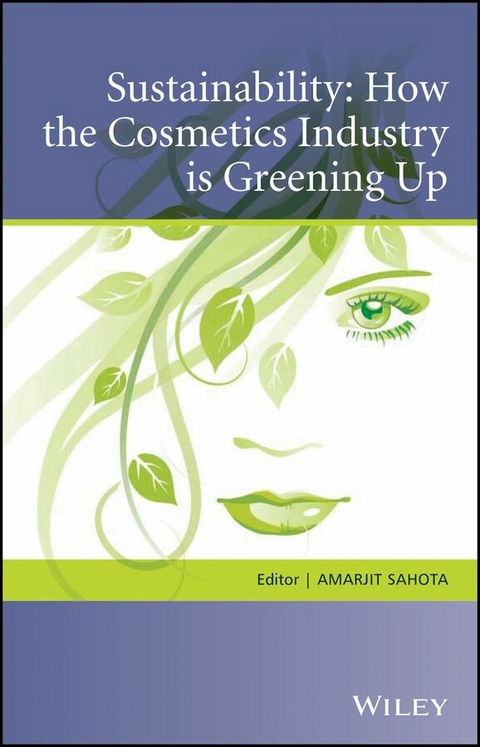
Sustainability (eBook)
John Wiley & Sons (Verlag)
978-1-118-67648-6 (ISBN)
Sustainability has come to the fore in the cosmetics and personal care industry. Rising ethical consumerism and the need for resource efficiency are making cosmetic companies – small, independent firms to global giants – take steps towards sustainable development.
Sustainability: How the Cosmetics Industry is Greening Up discusses the growing importance of sustainability in the cosmetics industry, highlighting the various ways organisations can address the economic, environmental and social aspects. How can the cosmetics industry make a difference in terms of ingredients, formulations, packaging, CSR, operations, and green marketing?
Topics covered include:
- Environmental and social impacts of cosmetic products
- Ethical sourcing and biodiversity
- Renewable energy and waste management
- Green formulations and ingredients
- Green marketing issues and consumer behaviour
- Green standards, certification schemes and indices in the cosmetics industry
Industry experts share their experiences on how they are tackling the challenges of sustainability: from raw material procurements, manufacturing, business processes, to distribution and marketing to consumers. The book concludes with some future growth projections; what are some of the shortcomings in sustainability in the cosmetics industry and what can we expect to see in the future?
Sustainability: How the Cosmetics Industry is Greening Up discusses business and technical issues in all areas of sustainable product development, from sourcing ingredients, to formulation, manufacture and packaging.
Covering a diverse range of subjects, this book appeals to professionals in many key sectors of the cosmetics and personal care industry; cosmetic chemists, formulation scientists, R&D directors, policy makers, business and marketing executives. It is also of relevance to academic researchers working in cosmetic chemistry and sustainable process development.
Editor
Amarjit Sahota
President, Organic Monitor, London, UK
Sustainability has come to the fore in the cosmetics and personal care industry. Rising ethical consumerism and the need for resource efficiency are making cosmetic companies small, independent firms to global giants take steps towards sustainable development. Sustainability: How the Cosmetics Industry is Greening Up discusses the growing importance of sustainability in the cosmetics industry, highlighting the various ways organisations can address the economic, environmental and social aspects. How can the cosmetics industry make a difference in terms of ingredients, formulations, packaging, CSR, operations, and green marketing? Topics covered include: Environmental and social impacts of cosmetic products Ethical sourcing and biodiversity Renewable energy and waste management Green formulations and ingredients Green marketing issues and consumer behaviour Green standards, certification schemes and indices in the cosmetics industry Industry experts share their experiences on how they are tackling the challenges of sustainability: from raw material procurements, manufacturing, business processes, to distribution and marketing to consumers. The book concludes with some future growth projections; what are some of the shortcomings in sustainability in the cosmetics industry and what can we expect to see in the future? Sustainability: How the Cosmetics Industry is Greening Up discusses business and technical issues in all areas of sustainable product development, from sourcing ingredients, to formulation, manufacture and packaging. Covering a diverse range of subjects, this book appeals to professionals in many key sectors of the cosmetics and personal care industry; cosmetic chemists, formulation scientists, R&D directors, policy makers, business and marketing executives. It is also of relevance to academic researchers working in cosmetic chemistry and sustainable process development.
Editor Amarjit Sahota President, Organic Monitor, London, UK
"Amarjit Sahota's book is a well-researched and
comprehensive snapshot on the different facets of sustainability in
cosmetics today. This is the first, and currently, the only book on
this hot topic; it's a must read." (Chemistry
& Industry, 14 July 2014)
"This publication from Wiley collects a wide number of
articles focusing on sustainability in cosmetics, 14 chapters,
which represents a road map in this so sensitive issue. The authors
are key experts from organizations involved in sustainability in
the cosmetics industry issue with a relevant long
experience." (H & PC Today,
March/April 2014)
About the Contributors
Paula Alexander is Director, Sustainable Business for BURT'S BEES® (USA). Since joining BURT'S BEES® in 2006, she has served a variety of roles in Brand Development, Marketing and Global Insights; she has been on BURT'S BEES® Leadership Team since 2011. Paula takes a whole systems approach to sustainability, focusing on source to disposal and ensures that BURT'S BEES® prioritises sustainability in all business functions at all levels. As President of The BURT'S BEES® Greater Good Foundation, she leads the giving programmes that promote community development and environmental health while reinforcing the brand mission.
Paula began her career at Unilever, where she spent eight years in brand management, working on the Dove, Suave, Lever 2000 and Snuggle brands. She holds a BBA from Texas A&M University and an MBA from Duke University's Fuqua School of Business.
Frédéric Anklin is Corporate Communications Manager at Weleda Group (Switzerland). In this position, he helps communicate his company's approach to social issues and sustainability through a variety of internal and external channels, including Weleda's annual and sustainability reports (as co-editor) and its international management newsletter (as editor-in-chief). He has eight years experience in communications and international relations. His last position was Programme Assistant for the Human Security division of the Swiss Federal Department of Foreign Affairs.
Frédéric has an MA in History, Political Science and Scandinavian Languages from the University of Basel, Switzerland. A Swiss and Norwegian national, he grew up in the Philippines and Singapore.
Judi Beerling is Technical Research Manager at Organic Monitor (UK). In this capacity, Judi provides technical consulting, advice and training on natural and organic raw material selection and product formulation techniques. She has over 30 years experience in cosmetic formulations, much of which was at Quest International; her last position was Global Sensory Applications and Product Innovation Manager.
Judi has an MBA from the Open University Business School and is a Chartered Chemist. She is an active member of a number of industry associations. She was past President of the UK Society of Cosmetic Scientists (SCS) and was the treasurer of the International Federation of Societies of Cosmetic Chemists (IFSCC). She has also been a visiting lecturer at the University of the Arts (London College of Fashion) where she taught skin care formulation and product development.
Charles J. ‘Chuck' Bennett is Vice President, Aveda Earth and Community Care (USA), responsible for leading the company in realising its commitment to the Aveda Mission. He has over 35 years of experience working in varied areas of environmental and social responsibility from teaching, research and writing, to corporate leadership in several businesses. He will be retiring from Aveda and the field in June 2013, however he looks forward to being engaged in meeting sustainability challenges.
Chuck received MA and PhD degrees in Geography from Syracuse University and an undergraduate degree from Middlebury College. He has taught in the State University of New York, written extensively about sustainability issues for The Conference Board in New York and held lead sustainability roles at Adolph Coors Company and Nabisco Foods. Married for over 40 years, Chuck has two adult children and four grandchildren who will become an increasing focus of his life.
David Bronner is President of Dr. Bronner's Magic Soaps (USA). The company is based in Escondido, California, where it is run by him and his brother Mike Bronner. It was established in 1948 by their grandfather, Dr. Emanuel Bronner, who was a third-generation master soap maker from a Jewish soap making family in Germany that began production in 1858.
Dr. Bronner's makes soaps and personal care products certified under the USDA National Organic Program. All major ingredients are from certified Fair Trade sources, such as coconut oil and palm oil. The company's fair trade organic olive oil is sourced from projects in Israel and Palestine as testament to Dr. Bronner's vision of peace, as reflected on all product labels. David runs the company much like a charitable engine in honour of his grandfather and father's ideals. A share of profits are donated to worthwhile causes and charities. Areas of particular focus are youth programmes, fair trade and organic agriculture and drug policy reform.
Michael S. Brown is a partner in the sustainability consulting firm, Brown and Wilmanns Environmental, LLC (USA). At this company, he helps clients with sustainability strategy, goals and metrics, benchmarking and multi-dimensional life-cycle evaluations of materials and products, including the Nike Materials Sustainability Index. Mike's 30 years' experience includes establishing the internal environmental program at Patagonia where he led a number of state-of-the-art initiatives.
Mike received MRP and PhD degrees from Cornell University, specialising in environmental management and health policy. He has taught Industrial Ecology at UC Santa Barbara. He is co-author of the book Workers at Risk and serves as an Assistant Editor for the Journal of Industrial Ecology and is a Public Member of the California Ocean Protection Council. He is married and has three kids scattered across the globe with whom he occasionally gets to share riding waves.
Jean-Florent Campion is Sustainable Development Manager in the Research and Innovation division of L'Oréal (France). In this capacity, he is in charge of products' eco-conception and international coordination, as well as the environmental footprint experiment project from the French initiative ‘Grenelle de l’Environnement'.
Prior to joining L'Oréal, he worked at Rhone-Poulenc and Alcatel. At the former company, he developed Sol-gel processes for the semiconductor industry at the Beckman Institute for Advanced Science in Champaign-Urbana Illinois (USA). At the Alcatel-Alstom Research Center (France), he co-developed various processes for optical fibre manufacturing; he is a co-inventor of one of the two optical fibre manufacturing processes: Advanced Plasma Vapor Deposition process (APVD). Jean-Florent holds 21 patents and has written 8 research papers. He is also associated professor in environmental law at the University of Paris 13 at the Galileo Institute. He also has a Master in chemistry and a Master in Law in intellectual property.
John A. Delfausse is the principle of Sustainable Packaging Solutions, LLC (USA). He was previously Vice President – Global Package Development, and Chief Environmental Officer for Estee Lauder Corporate Packaging. In this role, he was responsible for implementing the company's commitment to responsible packaging. Under his leadership, Aveda (an Estee Lauder Company) won several packaging awards, including the HBA 2003 International Package Design Award, the CPC Editor's Choice Award, and both the Ameristar Award and 3M Integrity Award for the 2006 Earth Month Candle packaging. John was honoured in 2008 as one of Packaging Strategies' Most Influentials in Packaging.
John Delfausse is a founding member of the Sustainable Packaging Coalition. He is also as a member of the IOPP Packaging Executive Council, the Packaging World Sustainable Advisory Board and the FIT Packaging Design Department Industry Advisory Board. In 2011, John founded the Sustainable Packaging Cosmetic Roundtable in order to focus the industry on common opportunities.
Darrin C. Duber-Smith, MS, MBA, is president of Green Marketing, Inc (USA). He has over 25 years of expertise in the marketing and management profession, including extensive experience with natural, organic, and green/sustainable goods and services. He is a co-founder of the Lifestyles of Health and Sustainability (LOHAS) market concept and leader of the first US industry task force that helped frame an industry definition of ‘natural'. He has published over 60 articles in trade publications and has presented at scores of executive-level events.
Darrin is a Marketing Professor at the Metropolitan State University of Denver School of Business as well as the Affiliate Marketing Faculty at the Leeds School of Business at the University of Colorado-Boulder. He was the recipient of the Wall Street Journal's In-Education Distinguished Professor Award for 2009, and is author of Cengage Learning's Know Now Marketing blog.
Eduardo Escobedo is Director of Responsible Ecosystems Sourcing Platform, RESP (Switzerland). In this role, he supports the cosmetics, fashion and jewellery industries in promoting the sustainable use of natural resources and conservation of biodiversity through enhanced business models and tools.
Over the past 15 years, Eduardo has held a number of expert positions in international organisations, government and companies. Prior to founding RESP, Eduardo worked at the United Nations Conference on Trade and Development (UNCTAD) in the area of sustainable trade of biodiversity-based goods. He has also worked...
| Erscheint lt. Verlag | 19.5.2014 |
|---|---|
| Sprache | englisch |
| Themenwelt | Naturwissenschaften ► Chemie |
| Technik | |
| Wirtschaft | |
| Schlagworte | Amarjit Sahota • Aromastoffe, Riechstoffe, Kosmetika • biodiversity • Business & Management in Chemistry • Certification schemes • Chemie • Chemistry • energy and waste management • environmental and social impacts of cosmetic products • ethical sourcing of raw materials • ethics and certification organisms • Flavor, Perfume & Cosmetic Science • formulations • green formulations and ingredients • Green Standards • indices in the cosmetics industry • marketing green brands • Nachhaltige u. Grüne Chemie • Nachhaltige u. Grüne Chemie • Packaging • Sustainability: How the Cosmetics Industry is Greening Up • Sustainable Chemistry & Green Chemistry • Sustainable Packaging • Wirtschaft u. Management in der Chemischen Industrie |
| ISBN-10 | 1-118-67648-3 / 1118676483 |
| ISBN-13 | 978-1-118-67648-6 / 9781118676486 |
| Informationen gemäß Produktsicherheitsverordnung (GPSR) | |
| Haben Sie eine Frage zum Produkt? |
 EPUB (Adobe DRM)
Kopierschutz: Adobe-DRM
Adobe-DRM ist ein Kopierschutz, der das eBook vor Mißbrauch schützen soll. Dabei wird das eBook bereits beim Download auf Ihre persönliche Adobe-ID autorisiert. Lesen können Sie das eBook dann nur auf den Geräten, welche ebenfalls auf Ihre Adobe-ID registriert sind.
Details zum Adobe-DRM
Dateiformat: EPUB (Electronic Publication)
EPUB ist ein offener Standard für eBooks und eignet sich besonders zur Darstellung von Belletristik und Sachbüchern. Der Fließtext wird dynamisch an die Display- und Schriftgröße angepasst. Auch für mobile Lesegeräte ist EPUB daher gut geeignet.
Systemvoraussetzungen:
PC/Mac: Mit einem PC oder Mac können Sie dieses eBook lesen. Sie benötigen eine
eReader: Dieses eBook kann mit (fast) allen eBook-Readern gelesen werden. Mit dem amazon-Kindle ist es aber nicht kompatibel.
Smartphone/Tablet: Egal ob Apple oder Android, dieses eBook können Sie lesen. Sie benötigen eine
Geräteliste und zusätzliche Hinweise
Buying eBooks from abroad
For tax law reasons we can sell eBooks just within Germany and Switzerland. Regrettably we cannot fulfill eBook-orders from other countries.
aus dem Bereich