Zum Hauptinhalt springen
Nicht aus der Schweiz? Besuchen Sie lehmanns.de

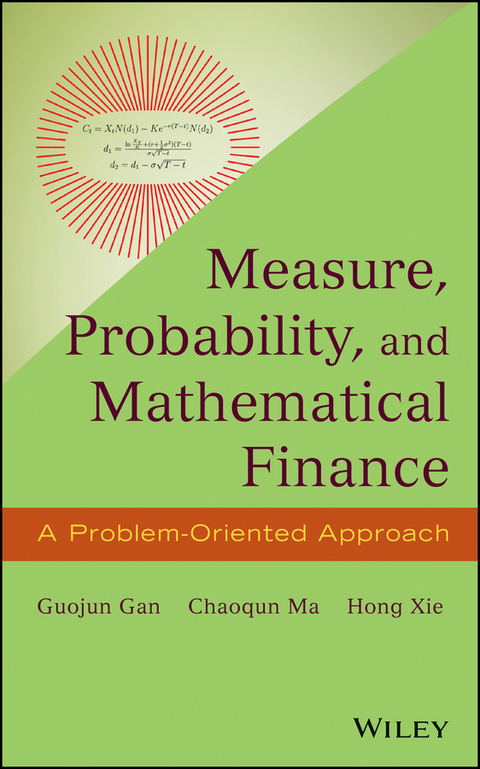
Measure, Probability, and Mathematical Finance (eBook)

A Problem-Oriented Approach
eBook Download: EPUB
2014
John Wiley & Sons (Verlag)
978-1-118-83198-4 (ISBN)

Lese- und Medienproben

Measure, Probability, and Mathematical Finance - Guojun Gan, Chaoqun Ma, Hong Xie
Systemvoraussetzungen
125,99 inkl. MwSt
(CHF 122,95)
Der eBook-Verkauf erfolgt durch die Lehmanns Media GmbH (Berlin) zum Preis in Euro inkl. MwSt.
  • Download sofort lieferbar
  • Zahlungsarten anzeigen

An introduction to the mathematical theory and financial models developed and used on Wall Street

Providing both a theoretical and practical approach to the underlying mathematical theory behind financial models, Measure, Probability, and Mathematical Finance: A Problem-Oriented Approach presents important concepts and results in measure theory, probability theory, stochastic processes, and stochastic calculus. Measure theory is indispensable to the rigorous development of probability theory and is also necessary to properly address martingale measures, the change of numeraire theory, and LIBOR market models. In addition, probability theory is presented to facilitate the development of stochastic processes, including martingales and Brownian motions, while stochastic processes and stochastic calculus are discussed to model asset prices and develop derivative pricing models.

The authors promote a problem-solving approach when applying mathematics in real-world situations, and readers are encouraged to address theorems and problems with mathematical rigor. In addition, Measure, Probability, and Mathematical Finance features:

  • A comprehensive list of concepts and theorems from measure theory, probability theory, stochastic processes, and stochastic calculus
  • Over 500 problems with hints and select solutions to reinforce basic concepts and important theorems
  • Classic derivative pricing models in mathematical finance that have been developed and published since the seminal work of Black and Scholes 
Measure, Probability, and Mathematical Finance: A Problem-Oriented Approach is an ideal textbook for introductory quantitative courses in business, economics, and mathematical finance at the upper-undergraduate and graduate levels. The book is also a useful reference for readers who need to build their mathematical skills in order to better understand the mathematical theory of derivative pricing models.

GUOJUN GAN, PHD, ASA, is Director of Quantitative Modeling and Model Efficiency at Manulife Financial, Canada. His research interests include empirical corporate finance, actuarial science, risk management, data mining, and big data analysis.

CHAOQUN MA, PHD, is Professor and Dean of the School of Business Administration at Hunan University, China. The recipient of First Prize in Outstanding Achievements in Teaching in 2009, Dr. Ma’s research interests include financial engineering, risk management, and data mining.

HONG XIE, PHD, is Adjunct Professor in the Department of Mathematics and Statistics at York University as well as Vice President of Models and Analytics at Manulife Financial, Canada. Dr. Xie is on the Board of Directors for the Canadian-Chinese Finance Association, and his research interests include financial engineering, mathematical finance, and partial differential equations.

GUOJUN GAN, PHD, ASA, is Director of Quantitative Modeling and Model Efficiency at Manulife Financial, Canada. His research interests include empirical corporate finance, actuarial science, risk management, data mining, and big data analysis. CHAOQUN MA, PHD, is Professor and Dean of the School of Business Administration at Hunan University, China. The recipient of First Prize in Outstanding Achievements in Teaching in 2009, Dr. Ma's research interests include financial engineering, risk management, and data mining. HONG XIE, PHD, is Adjunct Professor in the Department of Mathematics and Statistics at York University as well as Vice President of Models and Analytics at Manulife Financial, Canada. Dr. Xie is on the Board of Directors for the Canadian-Chinese Finance Association, and his research interests include financial engineering, mathematical finance, and partial differential equations.

Preface xvii

Financial Glossary xxii

Part I Measure Theory

1 Sets and Sequences 3

2 Measures 15

3 Extension of Measures 29

4 Lebesgue-Stieltjes Measures 37

5 Measurable Functions 47

6 Lebesgue Integration 57

7 The Radon-Nikodym Theorem 77

8 L¯P Spaces 85

9 Convergence 97

10 Product Measures 113

Part II Probability Theory

11 Events and Random Variables 127

12 Independence 141

13 Expectation 161

14 Conditional Expectation 173

15 Inequalities 189

16 Law of Large Numbers 199

17 Characteristic Functions 217

18 Discrete Distributions 227

19 Continuous Distributions 239

20 Central Limit Theorems 257

Part III Stochastic Processes

21 Stochastic Processes 271

22 Martingales 291

23 Stopping Times 301

24 Martingale Inequalities 321

25 Martingale Convergence Theorems 333

26 Random Walks 343

27 Poisson Processes 357

28 Brownian Motion 373

29 Markov Processes 389

30 Lévy Processes 401

Part IV Stochastic Calculus

31 The Wiener Integral 421

32 The Itô Integral 431

33 Extension of the Itô Integral 453

34 Martingale Stochastic Integrals 463

35 The Itô Formula 477

36 Martingale Representation Theorem 495

37 Change of Measure 503

38 Stochastic Differential Equations 515

39 Diffusion 531

40 The Feynman-Kac Formula 547

Part V Stochastic Financial Models

41 Discrete-Time Models 561

42 Black-Scholes Option Pricing Models 579

43 Path-Dependent Options 593

44 American Options 609

45 Short Rate Models 629

46 Instantaneous Forward Rate Models 647

47 LIBOR Market Models 667

References 687

List of Symbols 703

Subject Index 707

PREFACE

Mathematical finance, a new branch of mathematics concerned with financial markets, is experiencing rapid growth. During the last three decades, many books and papers in the area of mathematical finance have been published. However, understanding the literature requires that the reader have a good background in measure-theoretic probability, stochastic processes, and stochastic calculus. The purpose of this book is to provide the reader with an introduction to the mathematical theory underlying the financial models being used and developed on Wall Street. To this end, this book covers important concepts and results in measure theory, probability theory, stochastic processes, and stochastic calculus so that the reader will be in a position to understand these financial models. Problems as well as solutions are included to help the reader learn the concepts and results quickly.

In this book, we adopted the definitions and theorems from various books and presented them in a mathematically rigorous way. We tried to cover the most of the basic concepts and the important theorems. We selected the problems in this book in such a way that the problems will help readers understand and know how to apply the concepts and theorems. This book includes 516 problems, most of which are not difficult and can be solved by applying the definitions, theorems, and the results of previous problems.

This book is organized into five parts, each of which is further organized into several chapters. Each chapter is divided into five sections. The first section presents the definitions of important concepts and theorems. The second, third, and fourth sections present the problems, hints on how to solve the problems, and the full solutions to the problems, respectively. The last section contains bibliographic notes. Interdependencies between all chapters are shown in Table 0.1.

Table 0.1: Interdependencies between Chapters.

Chapter Related to Chapter(s)
1. Sets and Sequences  
2. Measures 1
3. Extension of Measures 1;2
4. Lebesgue-Stieltjes Measures 2;3
5. Measurable Functions 2
6. Lebesgue Integration 1;2;5
7. The Radon-Nikodym Theorem 2;6
8. Lp Spaces 2;6
9. Convergence 1;2;6;8
10. Product Measures 2;3;5;6
11. Events and Random Variables 1;2;4;5
12. Independence 2;3;5;11
13. Expectation 2;6;8;10;11;12
14. Conditional Expectation 1;2;5;6;7;8;10;11;12;13
15. Inequalities 8;11;14
16. Law of Large Numbers 2;8;9;10;12;13;15
17. Characteristic Functions 5;6;8;11;12;13;15
18. Discrete Distributions 12;14;17
19. Continuous Distributions 6;10;12;13;17
20. Central Limit Theorems 6;9;11
21. Stochastic Processes 2;5;10;11;12;19
22. Martingales 2;5;11;13;14;15
23. Stopping Times 2;5;9;11;14;21;22
24. Martingale Inequalities 2;6;8;13;14;15;23
25. Martingale Convergence Theorems 1;6;9;11;14;15;22
26. Random Walks 8;9;13;14;15;19;20;22;23;24
27. Poisson Processes 11;12;14;17;21;22
28. Brownian Motion 8;9;11;12;14;15;16;17;19
29. Markov Processes 2;6;11;14;21
30. Lévy Processes 1;5;6;11;12;14;17;19;22;27;28;29
31. The Wiener Integral 6;9;15;19;28
32. The Itô Integral 5;6;8;10;14;15;22;24;28
33. Extension of the Itô Integrals 9;10;14;22;23;32
34. Martingale Stochastic Integrals 14;15;19;27;32
35. The Itô Formula 6;8;9;22;24;32;34
36. Martingale Representation Theorem 9;14;25;28;32;33;35
37. Change of Measure 7;14;32;34;35
38. Stochastic Differential Equations 8;11;13;32;34;35
39. Diffusion 6;9;11;14;19;21;24;32;35;38
40. The Feynman-Kac Formula 6;14;32;35;38;39
41. Discrete-Time Models 7;12;14;22;23
42. Black-Scholes Option Pricing Models 9;14;19;24;32;33;35;36;37;38;41
43. Path-Dependent Options 10; 14;19;28;37;38;42
44. American Options 14; 15;21;22;23;32;35;36;37;42;43
45. Short Rate Models 11; 14;19;29;32;35;37;38;39;40
46. Instantaneous Forward Rate Models 10; 14;19;32;34;35;37;38;40;45
47. LIBOR Market Models 14; 32;37;45;46

In Part I, we present measure theory, which is indispensable to the rigorous development of probability theory. Measure theory is also necessary for us to discuss recently developed theories and models in finance, such as the martingale measures, the change of numeraire theory, and the London interbank offered rate (LIBOR) market models.

In Part II, we present probability theory in a measure-theoretic mathematical framework, which was introduced by A.N. Kolmogorov in 1937 in order to deal with David Hilbert’s sixth problem. The material presented in this part was selected to facilitate the development of stochastic processes in Part III.

In Part III, we present stochastic processes, which include martingales and Brownian motion. In Part IV, we discuss stochastic calculus. Both stochastic processes and stochastic calculus are important to modern mathematical finance as they are used to model asset prices and develop derivative pricing models.

In Part V, we present some classic models in mathematical finance. Many pricing models have been developed and published since the seminal work of Black and Scholes. This part covers only a small portion of many models.

In this book, we tried to use a uniform set of symbols and notation. For example, we used N, R, and to denote the set of natural numbers (i.e., nonnegative integers), the set of real numbers, and the empty set, respectively. A comprehensive list of symbols is also provided at the end of this book.

We have taken great pains to ensure the accuracy of the formulas and statements in this book. However, a few errors are inevitable in almost every book of this size. Please feel free to contact us if you spot errors or have any other constructive suggestions.

How to Use This Book


This book can be used by individuals in various ways:

(a) It can be used as a self-study book on mathematical finance. The prerequisite is linear algebra and calculus at the undergraduate level. This book will provide you with a series of concepts, facts, and problems. You should explore each problem and write out your solution in such a way that it can be shared with others. By doing this you will be able to actively develop an in-depth and comprehensive understanding of the concepts and principles that cannot be archived by passively reading or listening to comments of others.
(b) It can be used as a reference book. This book contains the most important concepts and theorems from mathematical finance. The reader can find the definition of a concept or the statement of a theorem in the book through the index at the end of this book.
(c) It can be used as a supplementary book for individuals who take advanced courses in mathematical finance. This book starts with measure theory and builds up to stochastic financial models. It provides necessary prerequisites for students who take advanced courses in mathematical finance without completing background courses.

Acknowledgments


We would like to thank all the academics and practitioners who have contributed to the knowledge of mathematical finance. In particular, we would like to thank the following academics and practitioners whose work constitutes the backbone of this book: Robert B. Ash, Krishna B. Athreya, Rabi Bhattacharya, Patrick Billingsley, Tomas Björk, Fischer Sheffey Black, Kai Lai Chung, Erhan Çinlar, Catherine A. Doléans-Dade, Darrell Duffie, Richard Durrett, Robert J. Elliott, Damir Filipović, Allan Gut, John Hull, Ioannis Karatzas, Fima C. Klebaner, P. Ekkehard Kopp, Hui-Hsiung Kuo, Soumendra N. Lahiri, Damien Lamberton, Bernard Lapeyre, Gregory F. Lawler, Robert C. Merton, Marek Musiela, Bernt Oksendal, Andrea Pascucci, Jeffrey S. Rosenthal, Sheldon M. Ross, Marek Rutkowski, Myron Scholes, Steven Shreve,...

Erscheint lt. Verlag 5.5.2014
Sprache englisch
Themenwelt Mathematik / Informatik Mathematik Angewandte Mathematik
Mathematik / Informatik Mathematik Statistik
Mathematik / Informatik Mathematik Wahrscheinlichkeit / Kombinatorik
Recht / Steuern Wirtschaftsrecht
Technik
Wirtschaft Betriebswirtschaft / Management Finanzierung
Schlagworte Business & Finance • Finance & Investments • Financial Engineering • financial models, measure theory, probability theory, stochastic processes, stochastic calculus, mathematical analysis, mathematical finance, martingale measures, numeraire theory, LIBOR market models • Finanztechnik • Finanz- u. Anlagewesen • Finanz- u. Wirtschaftsstatistik • Mathematics • Mathematik • Mathematik in Wirtschaft u. Finanzwesen • Statistics • Statistics for Finance, Business & Economics • Statistik
ISBN-10 1-118-83198-5 / 1118831985
ISBN-13 978-1-118-83198-4 / 9781118831984
Informationen gemäß Produktsicherheitsverordnung (GPSR)
Haben Sie eine Frage zum Produkt?
EPUBEPUB (Adobe DRM)

Kopierschutz: Adobe-DRM
Adobe-DRM ist ein Kopierschutz, der das eBook vor Mißbrauch schützen soll. Dabei wird das eBook bereits beim Download auf Ihre persönliche Adobe-ID autorisiert. Lesen können Sie das eBook dann nur auf den Geräten, welche ebenfalls auf Ihre Adobe-ID registriert sind.
Details zum Adobe-DRM

Dateiformat: EPUB (Electronic Publication)
EPUB ist ein offener Standard für eBooks und eignet sich besonders zur Darstellung von Belle­tristik und Sach­büchern. Der Fließ­text wird dynamisch an die Display- und Schrift­größe ange­passt. Auch für mobile Lese­geräte ist EPUB daher gut geeignet.

Systemvoraussetzungen:
PC/Mac: Mit einem PC oder Mac können Sie dieses eBook lesen. Sie benötigen eine Adobe-ID und die Software Adobe Digital Editions (kostenlos). Von der Benutzung der OverDrive Media Console raten wir Ihnen ab. Erfahrungsgemäß treten hier gehäuft Probleme mit dem Adobe DRM auf.
eReader: Dieses eBook kann mit (fast) allen eBook-Readern gelesen werden. Mit dem amazon-Kindle ist es aber nicht kompatibel.
Smartphone/Tablet: Egal ob Apple oder Android, dieses eBook können Sie lesen. Sie benötigen eine Adobe-ID sowie eine kostenlose App.
Geräteliste und zusätzliche Hinweise

Buying eBooks from abroad
For tax law reasons we can sell eBooks just within Germany and Switzerland. Regrettably we cannot fulfill eBook-orders from other countries.

Mehr entdecken
aus dem Bereich
Trigonometrie, Analytische Geometrie, Algebra, Wahrscheinlichkeit

von Walter Strampp

eBook Download (2024)
De Gruyter (Verlag)
CHF 89,95
Angewandte Analysis im Bachelorstudium

von Michael Knorrenschild

eBook Download (2022)
Carl Hanser Verlag GmbH & Co. KG
CHF 34,15