


David Colander is professor of economics at Middlebury College and the author of The Making of an Economist, Redux (Princeton). Roland Kupers is an associate fellow in the Smith School of Enterprise and the Environment at the University of Oxford. He is the coauthor of The Essence of Scenarios: Learning from the Shell Experience.
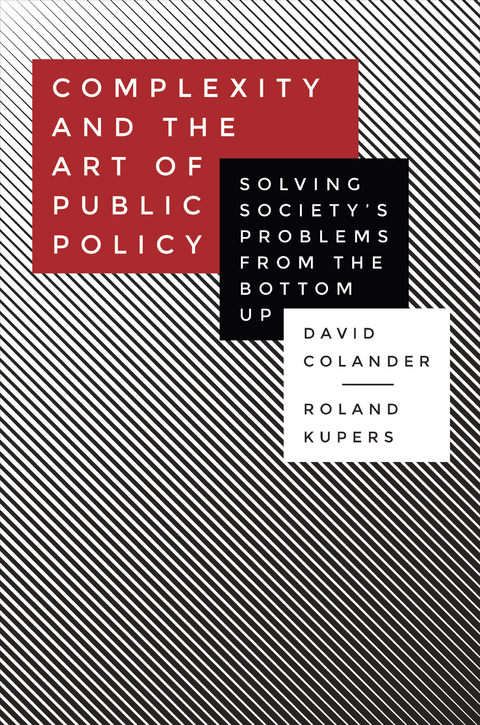
How ideas in complexity can be used to develop more effective public policyComplexity science-made possible by modern analytical and computational advances-is changing the way we think about social systems and social theory. Unfortunately, economists' policy models have not kept up and are stuck in either a market fundamentalist or government control narrative. While these standard narratives are useful in some cases, they are damaging in others, directing thinking away from creative, innovative policy solutions. Complexity and the Art of Public Policy outlines a new, more flexible policy narrative, which envisions society as a complex evolving system that is uncontrollable but can be influenced.David Colander and Roland Kupers describe how economists and society became locked into the current policy framework, and lay out fresh alternatives for framing policy questions. Offering original solutions to stubborn problems, the complexity narrative builds on broader philosophical traditions, such as those in the work of John Stuart Mill, to suggest initiatives that the authors call "e;activist laissez-faire"e; policies. Colander and Kupers develop innovative bottom-up solutions that, through new institutional structures such as for-benefit corporations, channel individuals' social instincts into solving societal problems, making profits a tool for change rather than a goal. They argue that a central role for government in this complexity framework is to foster an ecostructure within which diverse forms of social entrepreneurship can emerge and blossom.
David Colander is professor of economics at Middlebury College and the author of The Making of an Economist, Redux (Princeton). Roland Kupers is an associate fellow in the Smith School of Enterprise and the Environment at the University of Oxford. He is the coauthor of The Essence of Scenarios: Learning from the Shell Experience.
| Erscheint lt. Verlag | 25.5.2014 |
|---|---|
| Zusatzinfo | 3 halftones. |
| Verlagsort | Princeton |
| Sprache | englisch |
| Themenwelt | Sozialwissenschaften ► Politik / Verwaltung ► Staat / Verwaltung |
| Sozialwissenschaften ► Soziologie ► Allgemeines / Lexika | |
| Wirtschaft ► Allgemeines / Lexika | |
| Wirtschaft ► Volkswirtschaftslehre | |
| Schlagworte | activism • activist laissez-faire policy • Advertising • Behavioral Economics • bottom-up solutions • Brian Arthur • Capitalism • Career • choice architecture • Classical Economics • climate change • Collective Action • Competition • complex adaptive system • Complexity • Complexity Economics • complexity frame • Complexity Models • complexity policy • Complexity Science • Complexity theory • Complex Systems • Computational tools • Consideration • Consumption (Economics) • Cost–benefit analysis • credibility • dichotomy • Economic equilibrium • economic interventionism • economic models • Economic Policy • economic problem • Economics • economist • economy • ecostructure • ecosystem • Education • Emergence • Emerging Technologies • Employment • Engineering • Entrepreneurship • evolutionary game theory • Externality • Financial Crisis • Financial crisis of 2007–08 • Free Market • Functional finance • Funding • Game Theory • General Equilibrium Theory • Governance • Government • government policy • Incentive • income • inefficiency • ingredient • Institution • Interconnection • interdependence • Investment • Investor • I Pencil • I, Pencil • John Maynard Keynes • John Stuart Mill • Keynesian Economics • Laissez-faire • Leonard Reed • Liberalism • Lock-in (decision-making) • Macroeconomics • market duality • Market Economy • market fundamentalism • Mathematical economics • mathematician • Mathematics • Microeconomics • Milton Friedman • narrative • Neoclassical Economics • New Institutionalism • nonlinear system • Nonprofit Organization • Norm (social) • norms policy • Nudge (book) • path dependence • Paul Krugman • Policy • policy debate • policy framework • policymakers • policymaking • Political Economy • Politician • Politics • Public Policy • Rationality • Regulation • Requirement • result • Santa Fe Institute • Science Policy • scientific theory • Scientist • Self-Organization • Simulation • Social Entrepreneurship • social issue • Social Policy • Social Science • Social Systems • Social Theory • Society • Stephen Wolfram • Subsidy • Supporter • Tax • Technology • Textbook • Thought • Top-down and bottom-up design • Trade-off • Wealth • welfare • Writing |
| ISBN-10 | 1-4008-5013-4 / 1400850134 |
| ISBN-13 | 978-1-4008-5013-6 / 9781400850136 |
| Informationen gemäß Produktsicherheitsverordnung (GPSR) | |
| Haben Sie eine Frage zum Produkt? |
 PDF (Wasserzeichen)
Größe: 1,1 MB
DRM: Digitales Wasserzeichen
Dieses eBook enthält ein digitales Wasserzeichen und ist damit für Sie personalisiert. Bei einer missbräuchlichen Weitergabe des eBooks an Dritte ist eine Rückverfolgung an die Quelle möglich.
Dateiformat: PDF (Portable Document Format)
Mit einem festen Seitenlayout eignet sich die PDF besonders für Fachbücher mit Spalten, Tabellen und Abbildungen. Eine PDF kann auf fast allen Geräten angezeigt werden, ist aber für kleine Displays (Smartphone, eReader) nur eingeschränkt geeignet.
Systemvoraussetzungen:
PC/Mac: Mit einem PC oder Mac können Sie dieses eBook lesen. Sie benötigen dafür einen PDF-Viewer - z.B. den Adobe Reader oder Adobe Digital Editions.
eReader: Dieses eBook kann mit (fast) allen eBook-Readern gelesen werden. Mit dem amazon-Kindle ist es aber nicht kompatibel.
Smartphone/Tablet: Egal ob Apple oder Android, dieses eBook können Sie lesen. Sie benötigen dafür einen PDF-Viewer - z.B. die kostenlose Adobe Digital Editions-App.
Buying eBooks from abroad
For tax law reasons we can sell eBooks just within Germany and Switzerland. Regrettably we cannot fulfill eBook-orders from other countries.
 EPUB (Adobe DRM)
Kopierschutz: Adobe-DRM
Adobe-DRM ist ein Kopierschutz, der das eBook vor Mißbrauch schützen soll. Dabei wird das eBook bereits beim Download auf Ihre persönliche Adobe-ID autorisiert. Lesen können Sie das eBook dann nur auf den Geräten, welche ebenfalls auf Ihre Adobe-ID registriert sind.
Details zum Adobe-DRM
Dateiformat: EPUB (Electronic Publication)
EPUB ist ein offener Standard für eBooks und eignet sich besonders zur Darstellung von Belletristik und Sachbüchern. Der Fließtext wird dynamisch an die Display- und Schriftgröße angepasst. Auch für mobile Lesegeräte ist EPUB daher gut geeignet.
Systemvoraussetzungen:
PC/Mac: Mit einem PC oder Mac können Sie dieses eBook lesen. Sie benötigen eine
eReader: Dieses eBook kann mit (fast) allen eBook-Readern gelesen werden. Mit dem amazon-Kindle ist es aber nicht kompatibel.
Smartphone/Tablet: Egal ob Apple oder Android, dieses eBook können Sie lesen. Sie benötigen eine
Geräteliste und zusätzliche Hinweise
Buying eBooks from abroad
For tax law reasons we can sell eBooks just within Germany and Switzerland. Regrettably we cannot fulfill eBook-orders from other countries.
aus dem Bereich


