Food Processing (eBook)
John Wiley & Sons (Verlag)
978-1-118-84628-5 (ISBN)
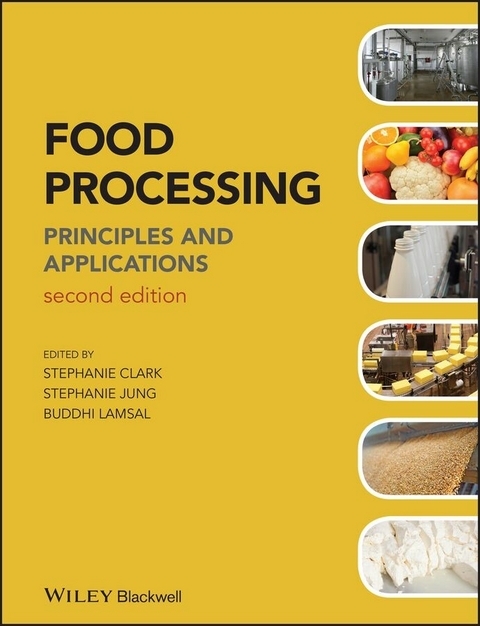
Food Processing: Principles and Applications second edition is the fully revised new edition of this best-selling food technology title.Advances in food processing continue to take place as food scientists and food engineers adapt to the challenges imposed by emerging pathogens, environmental concerns, shelf life, quality and safety, as
well as the dietary needs and demands of humans. In addition to covering food processing principles that have long been essential to food quality and safety, this edition of Food Processing: Principles and Applications, unlike the former edition, covers microbial/enzyme inactivation kinetics, alternative food processing technologies
as well as environmental and sustainability issues currently facing the food processing industry.
The book is divided into two sections, the first focusing on principles of food processing and handling, and
the second on processing technologies and applications. As a hands-on guide to the essential processing principles and their applications, covering the theoretical and applied aspects of food processing in one accessible volume, this book is a valuable tool for food industry professionals across all manufacturing sectors, and serves as a relevant primary or supplemental text for students of food science.
About the Authors
Dr Stephanie Clark is Associate Director of the Midwest Dairy Foods Research Center and Associate Professor Food Science & Human Nutrition at Iowa State University.
Dr Stephanie Jung is Associate Professor in the Department of Food Science and Human Nutrition at Iowa State University.
Dr Buddhi Lamsal is Assistant Professor, Food Science and Human Nutrition, Iowa State University.
FOOD PROCESSING Food Processing: Principles and Applications, Second Edition is the fully revised new edition of this best-selling food technology title. Advances in food processing continue to take place as food scientists and food engineers adapt to the challenges imposed by emerging pathogens, environmental concerns, shelf life, quality and safety, as well as the dietary needs and demands of humans. In addition to covering food processing principles that have long been essential to food quality and safety, this edition of Food Processing: Principles and Applications, unlike the former edition, covers microbial/enzyme inactivation kinetics, alternative food processing technologies as well as environmental and sustainability issues currently facing the food processing industry. The book is divided into two sections, the first focusing on principles of food processing and handling, and the second on processing technologies and applications. As a hands-on guide to the essential processing principles and their applications, covering the theoretical and applied aspects of food processing in one accessible volume, this book is a valuable tool for food industry professionals across all manufacturing sectors, and serves as a relevant primary or supplemental text for students of food science.
ABOUT THE EDITORS Dr Stephanie Clark is Associate Director of the Midwest Dairy Foods Research Center and Associate Professor in the Department of Food Science and Human Nutrition at Iowa State University. Dr Stephanie Jung is Associate Professor in the Department of Food Science and Human Nutrition at Iowa State University. Dr Buddhi Lamsal is Assistant Professor in the Department of Food Science and Human Nutrition at Iowa State University.
"As a hands-on guide to the essential processing
principles and their applications, covering the theoretical and
applied aspects of food processing in one accessible volume, this
book is a valuable tool for food industry professionals across all
manufacturing sectors, and serves as a relevant primary or
supplemental text for students of food science."
(Biotechnology, Agronomy, Society and Environment, 1
October 2014)
1
Principles of Food Processing
Sung Hee Park,1 Buddhi P. Lamsal,2 and V.M. Balasubramaniam1,3
1Department of Food Science and Technology, The Ohio State University, Columbus, Ohio, USA
2Department of Food Science and Human Nutrition, Iowa State University, Ames, Iowa, USA
3Department of Food Agricultural and Biological Engineering, The Ohio State University, Columbus, Ohio, USA
1.1 Processing of foods: an introduction
Processing of foods is a segment of manufacturing industry that transforms animal, plant, and marine materials into intermediate or finished value-added food products that are safer to eat. This requires the application of labor, energy, machinery, and scientific knowledge to a step (unit operation) or a series of steps (process) in achieving the desired transformation (Heldman & Hartel, 1998). Value-added ingredients or finished products that satisfy consumer needs and convenience are obtained from the raw materials.
The aims of food processing could be considered four-fold (Fellows, 2009): (1) extending the period during which food remains wholesome (microbial and biochemical), (2) providing (supplementing) nutrients required for health, (3) providing variety and convenience in diet, and (4) adding value.
Food materials’ shelf life extension is achieved by preserving the product against biological, chemical, and physical hazards. Bacteria, viruses, and parasites are the three major groups of biological hazards that may pose a risk in processed foods. Biological hazards that may be present in the raw food material include both pathogenic microorganisms with public health implications and spoilage microorganisms with quality and esthetic implications. Mycotoxin, pesticide, fungicide, and allergens are some examples of chemical hazards that may be present in food. Physical hazards may involve the presence of extraneous material (such as stones, dirt, metal, glass, insect fragments, hair). These hazards may accidentally or deliberately (in cases of adulteration) become part of the processed product. Food processing operations ensure targeted removal of these hazards so that consumers enjoy safe, nutritious, wholesome foods. With the possibility of extending shelf life of foods and advances in packaging technology, food processing has been catering to consumer convenience by creating products, for example, ready-to-eat breakfast foods and TV dinners, on-the-go beverages and snacks, pet foods, etc. Food processing, as an industry, has also responded to changes in demographics by bringing out ethnic and specialty foods and foods for elderly people and babies. Nutrition fortification, for example, folic acid supplementation in wheat flour, is another function of processing food.
The scope of food processing is broad; unit operations occurring after harvest of raw materials until they are processed into food products, packaged, and shipped for retailing could be considered part of food processing. Typical processing operations may include raw material handling, ingredient formulation, heating and cooling, cooking, freezing, shaping, and packaging (Heldman & Hartel, 1998). These could broadly be categorized into primary and secondary processing. Primary processing is the processing of food that occurs after harvesting or slaughter to make food ready for consumption or use in other food products. Primary processing ensures that foods are easily transported and are ready to be sold, eaten or processed into other products (e.g. after the primary processing of peeling and slicing, an apple can be eaten fresh or baked into a pie). Secondary processing turns the primary-processed food or ingredient into other food products. It ensures that foods can be used for a number of purposes, do not spoil quickly, are healthy and wholesome to eat, and are available all year (e.g. seasonal foods). In the previous example, baking of the pie is a secondary processing step, which utilizes ingredient from primary processing (sliced apple).
The food and beverage manufacturing industry is one of the largest manufacturing sectors in the US. In 2011, these plants accounted for 14.7% of the value of shipments from all US manufacturing plants. Meat processing is the largest single component of food and beverage manufacturing, with 24% of shipments in 2011. Other important components include dairy (13%), beverages (12%), grains and oilseeds (12%), fruits and vegetables (8%), and other food products (11%). Meat processing is also the largest component (17%) of the food sector's total value added, followed by beverage manufacturing (16%) (Anonymous, 2012; USDA Economic Research Service, 2013). California has the largest number of food manufacturing plants (www.ers.usda.gov/topics/food-markets-prices/processing-marketing.aspx), followed by New York and Texas. Demand for processed foods tend to be less susceptible to fluctuating economic conditions than other industries.
Some basic principles associated with processing and preservation of food are summarized in this chapter. In-depth discussion can be found elsewehwere (Earle & Earle, 2012; Fellows, 2009; Gould, 1997; Heldman & Hartel, 1998; Saravacos & Kostaropoulos, 2002; Smith, 2003; Toledo, 2007; Zhang et al., 2011), including various chapters in this book.
1.2 Unit operations in food processing
Most food processes utilize six different unit operations: heat transfer, fluid flow, mass transfer, mixing, size adjustment (reduction or enlargement), and separation. A brief introduction to these principles is given in this chapter; more detailed information about the theory behind the principles and applications can be found in standard food or chemical engineering textbooks, including Singh and Heldman (2009), Welti-Chanes et al. (2005), and McCabe et al. (2001).
During food processing, food material may be combined with a variety of ingredients (sugar, preservatives, acidity) to formulate the product and then subjected to different unit operations either sequentially or simultaneously. Food processors often use process flow charts to visualize the sequence of operations needed to transform raw materials into final processed product. The process flow diagrams often include quality control limits and/or adjustment and description of any hazards. Figure 1.1 shows a sample process flow diagram for making Frankfurter comminuted sausage.
Figure 1.1 Process flow diagram of Frankfurter comminuted sausage manufacturing.
1.2.1 Heat transfer
Heat transfer is one of the fundamental processing principles applied in the food industry and has applications in various unit operations, thermal processing, evaporation (concentration) and drying, freezing and thawing, baking, and cooking. Heating is used to destroy microorganisms to provide a healthy food, prolong shelf life through the destruction of certain enzymes, and promote a product with acceptable taste, odor, and appearance. Heat transfer is governed by heat exchange between a product and its surrounding medium. The extent of heat transfer generally increases with increasing temperature difference between the product and its surrounding.
Conduction, convection, and radiation are the three basic modes of heat transfer. Conduction heat transfer occurs within solid foods, wherein a transfer of energy occurs from one molecule to another. Generally, heat energy is exchanged from molecules with greater thermal energy to molecules located in cooler regions. Heat transfer within a potato slice is an example of conduction heat transfer.
Heat is transferred in fluid foods by bulk movement of fluids as a result of a temperature gradient, and this process is referred to as convective heat transfer. Convective heat transfer can be further classified as natural convection and forced convection. Natural convection is a physical phenomenon wherein a thermal gradient due to density difference in a heated product causes bulk fluid movement and heat transfer. Movement of liquids inside canned foods during thermal sterilization is an example of natural convection. If the movement and heat transfer are facilitated by mechanical agitation (such as use of mixers), this is called forced convection.
Radiation heat transfer occurs between two surfaces as a result of the transfer of heat energy by electromagnetic waves. This mode of heat transfer does not require a physical medium and can occur in a vacuum. Baking is one example of heat transfer via radiation from the heat source in the oven to the surface of bread. However, heat propagates via conduction within the body of the bread.
1.2.2 Mass transfer
Mass transfer involves migration of a constituent of fluid or a component of a mixture (Singh & Heldman, 2009) in or out of a food product. Mass transfer is controlled by the diffusion of the component within the mixture. The mass migration occurs due to changes in physical equilibrium of the system caused by concentration or vapor pressure differences. The mass transfer may occur within one phase or may involve transfer from one phase to another. Food process unit operations that utilize mass transfer include distillation, gas absorption, crystallization, membrane processes, evaporation, and drying.
1.2.3 Fluid flow
Fluid flow involves transporting liquid food through pipes during processing. Powders and small-particulate foods are handled by pneumatic conveying, whereas fluids are transported by gravity flow or through the use of pumps. The centrifugal pump and the positive displacement pump are...
| Erscheint lt. Verlag | 3.4.2014 |
|---|---|
| Sprache | englisch |
| Themenwelt | Naturwissenschaften ► Biologie |
| Technik ► Lebensmitteltechnologie | |
| Wirtschaft ► Betriebswirtschaft / Management | |
| Weitere Fachgebiete ► Land- / Forstwirtschaft / Fischerei | |
| Schlagworte | Adapt • Addition • Advances • Applications • bestselling • challenges • continue • demands • Dietary • Edition • engineers • Essential • Food • food engineering • Food Management • Food Processing • Food Processing, Production & Manufacture • Food Science & Technology • Fully • Herstellung u. Verarbeitung von Lebensmitteln • humans • Lebensmittelforschung u. -technologie • Lebensmittel-Management • Lebensmitteltechnik • New • Place • Principles • Revised • Safety • scientists • Technology • title |
| ISBN-10 | 1-118-84628-1 / 1118846281 |
| ISBN-13 | 978-1-118-84628-5 / 9781118846285 |
| Informationen gemäß Produktsicherheitsverordnung (GPSR) | |
| Haben Sie eine Frage zum Produkt? |
 EPUB (Adobe DRM)
Kopierschutz: Adobe-DRM
Adobe-DRM ist ein Kopierschutz, der das eBook vor Mißbrauch schützen soll. Dabei wird das eBook bereits beim Download auf Ihre persönliche Adobe-ID autorisiert. Lesen können Sie das eBook dann nur auf den Geräten, welche ebenfalls auf Ihre Adobe-ID registriert sind.
Details zum Adobe-DRM
Dateiformat: EPUB (Electronic Publication)
EPUB ist ein offener Standard für eBooks und eignet sich besonders zur Darstellung von Belletristik und Sachbüchern. Der Fließtext wird dynamisch an die Display- und Schriftgröße angepasst. Auch für mobile Lesegeräte ist EPUB daher gut geeignet.
Systemvoraussetzungen:
PC/Mac: Mit einem PC oder Mac können Sie dieses eBook lesen. Sie benötigen eine
eReader: Dieses eBook kann mit (fast) allen eBook-Readern gelesen werden. Mit dem amazon-Kindle ist es aber nicht kompatibel.
Smartphone/Tablet: Egal ob Apple oder Android, dieses eBook können Sie lesen. Sie benötigen eine
Geräteliste und zusätzliche Hinweise
Buying eBooks from abroad
For tax law reasons we can sell eBooks just within Germany and Switzerland. Regrettably we cannot fulfill eBook-orders from other countries.
aus dem Bereich