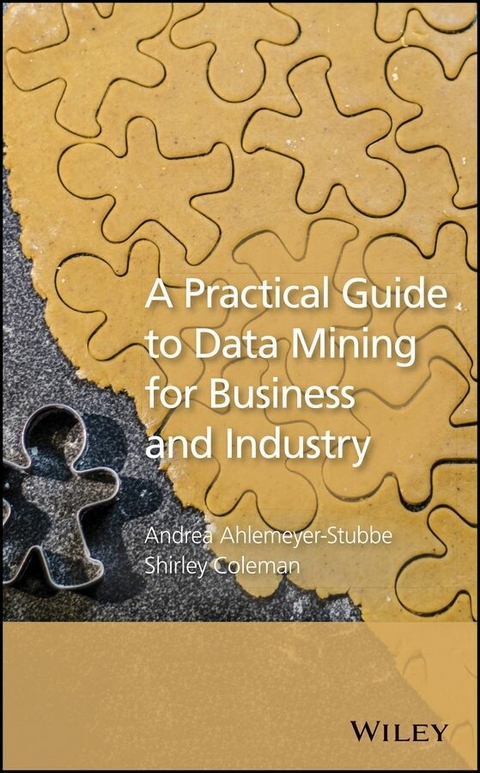
A Practical Guide to Data Mining for Business and Industry (eBook)
John Wiley & Sons (Verlag)
978-1-118-76337-7 (ISBN)
Data mining is well on its way to becoming a recognized discipline in the overlapping areas of IT, statistics, machine learning, and AI. Practical Data Mining for Business presents a user-friendly approach to data mining methods, covering the typical uses to which it is applied. The methodology is complemented by case studies to create a versatile reference book, allowing readers to look for specific methods as well as for specific applications. The book is formatted to allow statisticians, computer scientists, and economists to cross-reference from a particular application or method to sectors of interest.
Data mining is well on its way to becoming a recognized discipline in the overlapping areas of IT, statistics, machine learning, and AI. Practical Data Mining for Business presents a user-friendly approach to data mining methods, covering the typical uses to which it is applied. The methodology is complemented by case studies to create a versatile reference book, allowing readers to look for specific methods as well as for specific applications. The book is formatted to allow statisticians, computer scientists, and economists to cross-reference from a particular application or method to sectors of interest.
Andrea Ahlemeyer-Stubbe, Director Strategic Analytics, DRAFTFCB München GmbH, Germany Shirley Coleman, Principal Statistician, Industrial Statistics Research Unit, School of Maths and Statistics, Newcastle University, UK
"A Practical Guide to Data Mining for Business and
Industrygives practical tools on how information can be extracted
from masses of data. The book is very well written, in a
conversational tone that makes it enjoyable to read. The authors
are excellent communicators. If you are interested in learning
about data mining, learning to do a particular task in data mining,
looking for a textbook to use in a data mining or analytics course,
or have a problem or data analytic task you are working on, this
book would be an excellent place to start."
(Mathematical Association of America, 23 August 2014)
Glossary of terms
- Accuracy
- | A measurement of the match (degree of closeness) between predictions and real values.
- Address
- | A unique identifier for a computer or site online, usually a URL for a website or marked with an @ for an email address. Literally, it is how your computer finds a location on the information highway.
- Advertising
- | Paid form of a non-personal communication by industry, business firms, non-profit organisations or individuals delivered through the various media. Advertising is persuasive and informational and is designed to influence the purchasing behaviour and thought patterns of the audience. Advertising may be used in combination with sales promotions, personal selling tactics or publicity. This also includes promotion of a product, service or message by an identified sponsor using paid-for media.
- Aggregation
- | Form of segmentation that assumes most consumers are alike.
- Algorithm
- | The process a search engine applies to web pages so it can accurately produce a list of results based on a search term. Search engines regularly change their algorithms to improve the quality of the search results. Hence, search engine optimisation tends to require constant research and monitoring.
- Analytics
- | A feature that allows you to understand (learn more) a wide range of activity related to your website, your online marketing activities and direct marketing activities. Using analytics provides you with information to help optimise your campaigns, ad groups and keywords, as well as your other online marketing activities, to best meet your business goals.
- API
- | Application Programming Interface, often used to exchange data, for example, with social networks.
- Attention
- | A momentary attraction to a stimulus, something someone senses via sight, sound, touch, smell or taste. Attention is the starting point of the perceptual process in that attention of a stimulus will either cause someone to decide to make sense of it or reject it.
- B2B
- | Business To Business – Business conducted between companies rather than between a company and individual consumers. For example, a firm that makes parts that are sold directly to an automobile manufacturer.
- B2C
- | Business To Consumer – Business conducted between companies and individual consumers rather than between two companies. A retailer such as Tesco or the greengrocer next door is an example of a B2C company.
- Banner
- | Banners are the 468-by-60 pixels ad space on commercial websites that are usually ‘hotlinked’ to the advertiser’s site.
- Banner ad
- | Form of Internet promotion featuring information or special offers for products and services. These small space ‘banners’ are interactive: when clicked, they open another website where a sale can be finalized. The hosting website of the banner ad often earns money each time someone clicks on the banner ad.
- Base period
- | Period of time applicable to the learning data.
- Behavioural targeting
- | Practice of targeting and ads to groups of people who exhibit similarities not only in their location, gender or age but also in how they act and react in their online environment: tracking areas they frequently visit or subscribe to or subjects or content or shopping categories for which they have registered. Google uses behavioural targeting to direct ads to people based on the sites they have visited.
- Benefit
- | A desirable attribute of goods or services, which customers perceive that they will get from purchasing and consuming or using them. Whereas vendors sell features (‘a high-speed 1cm drill bit with tungsten-carbide tip’), buyers seek the benefit (a 1cm hole).
- Bias
- | The expected value differs from the true value. Bias can occur when measurements are not calibrated properly or when subjective opinions are accepted without checking them.
- Big data
- | Is a relative term used to describe data that is so large in terms of volume, variety of structure and velocity of capture that it cannot be stored and analysed using standard equipment.
- Blog
- | A blog is an online journal or ‘log’ of any given subject. Blogs are easy to update, manage and syndicate, powered by individuals and/or corporations and enable users to comment on postings.
- BOGOF
- | Buy One, Get One Free. Promotional practice where on the purchase of one item, another one is given free.
- Boston matrix
- | A product portfolio evaluation tool developed by the Boston Consulting Group. The matrix categorises products into one of four classifications based on market growth and market share.
-
The four classifications are as follows:
- Cash cow – low growth, high market share
- Star – high growth, high market share
- Problem child – high growth, low market share
- Dog – low growth, low market share
- Brand
- | A unique design, sign, symbol, words or a combination of these, employed in creating an image that identifies a product and differentiates or positions it from competitors. Over time, this image becomes associated with a level of credibility, quality and satisfaction in the consumers’ minds. Thus, brands stand for certain benefits and value. Legal name for a brand is trademark, and when it identifies or represents a firm, it is called a brand name. (Also see Differentiation and Positioning.)
- Bundling
- | Combining products as a package, often to introduce other products or services to the customer. For example, AT&T offers discounts for customers by combining 2 or more of the following services: cable television, home phone service, wireless phone service and Internet service.
- Buttons
- | Objects that, when clicked once, cause something to happen.
- Buying behaviour
- | The process that buyers go through when deciding whether or not to purchase goods or services. Buying behaviour can be influenced by a variety of external factors and motivations, including marketing activities.
- Campaign
- | Defines the daily budget, language, geographic targeting and location of where the ads are displayed.
- Cash cow
- | See ‘Boston matrix’.
- Category management
- | Products are grouped and managed by strategic business unit categories. These are defined by how consumers view goods rather than by how they look to the seller, for example, confectionery could be part of either a ‘food’ or ‘gifts’ category and marketed depending on the category into which it is grouped.
- Channels
- | The methods used by a company to communicate and interact with its customers, like direct mail, telephone and email.
- Characteristic
- | Distinguishing feature or attribute of an item, person or phenomenon that usually falls into either a physical, functional or operational category.
- Churn rate
- | Rate of customers lost (stopped using the service) over a specific period of time, often over the course of a year. Used to compare against new customers gained.
- Click
- | The opportunity for a visitor to be transferred to a location by clicking on an ad, as recorded by the server.
- Clusters
- | Customer profiles based on lifestyle, demographic, shopping behaviour or appetite for fashion. For example, ready-to-eat meals may be heavily influenced by the ethnic make-up of a store’s shoppers, while beer, wine and spirits categories in the same store may be influenced predominantly by the shopper’s income level and education.
- Code
- | Anything written in a language intended for computers to interpret.
- Competitions
- | Sales promotions that allow the consumer the possibility of winning a prize.
- Competitors
- | Companies that sell products or services in the same marketplace as one another.
- Consumer
- | A purchaser of goods or services at retail, or an end user not necessarily a purchaser, in the distribution chain of goods or services (gift recipient).
- Contextual advertising
- | Advertising that is targeted to a web page based on the page’s content, keywords or category. Ads in most content networks are targeted contextually.
- Cookie
- | A file on your computer that records information such as where you have been on the World Wide Web. The browser stores this information which allows a site to remember the browser in future transactions or requests. Since the web’s protocol has no way to remember requests, cookies read and record a user’s browser type and IP address and store this information on the user’s own computer. The cookie can be read only by a server in the domain that stored it. Visitors can accept or deny cookies by changing a setting in their browser preferences.
- Coupon
- | A ticket that can be exchanged for a discount or rebate when procuring an item.
- CRM
- | Customer Relationship Management – Broad term that covers...
| Erscheint lt. Verlag | 31.3.2014 |
|---|---|
| Sprache | englisch |
| Themenwelt | Informatik ► Datenbanken ► Data Warehouse / Data Mining |
| Mathematik / Informatik ► Mathematik ► Finanz- / Wirtschaftsmathematik | |
| Mathematik / Informatik ► Mathematik ► Statistik | |
| Mathematik / Informatik ► Mathematik ► Wahrscheinlichkeit / Kombinatorik | |
| Technik | |
| Wirtschaft ► Betriebswirtschaft / Management | |
| Schlagworte | Computer Science • Database & Data Warehousing Technologies • Data Mining • Data Mining Statistics • Datenbanken u. Data Warehousing • Finanz- u. Wirtschaftsstatistik • Informatik • practical data mining, machine learning, business intelligence, applied data mining, data mining applications, data mining methods, data mining how to, data mining for business • Statistics • Statistics for Finance, Business & Economics • Statistik |
| ISBN-10 | 1-118-76337-8 / 1118763378 |
| ISBN-13 | 978-1-118-76337-7 / 9781118763377 |
| Informationen gemäß Produktsicherheitsverordnung (GPSR) | |
| Haben Sie eine Frage zum Produkt? |
 EPUB (Adobe DRM)
Kopierschutz: Adobe-DRM
Adobe-DRM ist ein Kopierschutz, der das eBook vor Mißbrauch schützen soll. Dabei wird das eBook bereits beim Download auf Ihre persönliche Adobe-ID autorisiert. Lesen können Sie das eBook dann nur auf den Geräten, welche ebenfalls auf Ihre Adobe-ID registriert sind.
Details zum Adobe-DRM
Dateiformat: EPUB (Electronic Publication)
EPUB ist ein offener Standard für eBooks und eignet sich besonders zur Darstellung von Belletristik und Sachbüchern. Der Fließtext wird dynamisch an die Display- und Schriftgröße angepasst. Auch für mobile Lesegeräte ist EPUB daher gut geeignet.
Systemvoraussetzungen:
PC/Mac: Mit einem PC oder Mac können Sie dieses eBook lesen. Sie benötigen eine
eReader: Dieses eBook kann mit (fast) allen eBook-Readern gelesen werden. Mit dem amazon-Kindle ist es aber nicht kompatibel.
Smartphone/Tablet: Egal ob Apple oder Android, dieses eBook können Sie lesen. Sie benötigen eine
Geräteliste und zusätzliche Hinweise
Buying eBooks from abroad
For tax law reasons we can sell eBooks just within Germany and Switzerland. Regrettably we cannot fulfill eBook-orders from other countries.
aus dem Bereich