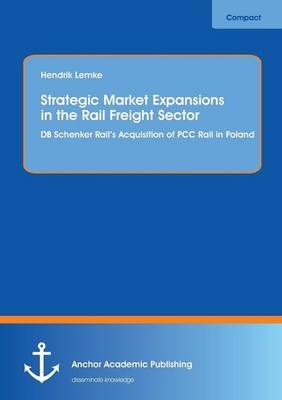
Strategic Market Expansions in the Rail Freight Sector: DB Schenker Rail's Acquisition of PCC Rail in Poland
Anchor Academic Publishing (Verlag)
9783954892501 (ISBN)
Hendrik Lemke, B.Sc., was born 1990 in Hamburg and studied International Business Administration at the European-University Viadrina. Throughout his Studies the author gained working experience in the context of two internships in in-house consulting units of a mobility service provider and a pharmaceutical/chemical company. Mr. Lemke gained long-term international experience in the USA, Canada, and Croatia and has research interest in the fields of corporate development and strategic management.
Chapter IV, Analysis of the Success of DB Schenker Rail s Market Expansion in Poland:
Hereinafter, the potential success of DB Schenker Rail s market expansion in Poland will be analyzed. Section 4.1 focusses on the assessment of the Polish rail freight industry structure. The analysis, based on the Five Forces framework, gives some indication of the Polish rail freight industry s average profitability that can be expected. However, this does not tell much about DB Schenker Rail s actual performance, because profitability of individual corporate players in an industry can vary considerably. Nevertheless, the elaborated assessment is expedient with respect to the subject matter of the thesis at hand because of two reasons. First, the analysis reveals the intensity and nature of forces acting upon DB Schenker Rail in this specific market. Second, it can be later shown whether the expected results regarding industry profitability are also valid for the DB subsidiary. In fact, the determination of the industry s profitability is indispensable because the profitability ratio for one firm itself would only tell little about its success. This is mainly the case because there are great disparities between the average profitability among different industries (cf. Porter 2008, p. 7). Only in context with its corresponding industry, a company s profitability ratio takes on greater significance. [ ].
Chapter 1.1.1, Bargaining Power of Buyers:
Customers are in a strong position if they can manage to play off industry players against one another or if they have bargaining power. This is the case if buyers order large volumes relative to individual vendors, if products are not differentiated, if switching costs for buyers are low, or in the event of buyers being in a position to possibly integrate backwards. (cf. Porter 2008, pp. 14 et seqq.) As already elaborated in the previous paragraph, coal and mining products are the predominant goods transported via rail in Poland. This information gives an indication concerning customer groups of RUs in this geographic region. Coal and metal ore producing mines can be expected to constitute the main customer base for non-specialized rail freight operators. This is true in case of DB SRP, which describes the shipments of coal and sand as dominant transport activities (cf. railways 2009b, pp. 42f). The Polish mining sector mainly consists of domestic competitors. The major players KGHM Polska Mied , a silver and copper producer, as well as the coal producers Jastrz bska Spó ka W glowa, Kompania W glowa, Katowicki Holding W glowy belong to the largest mining companies in Poland and worldwide. Many of these industry players are described as inefficient; all mines were state-owned up to the year 2009. The Polish government initiated a process towards the privatization of the entire sector which will probably lead to a dominance of privately owned and more efficiently working enterprises in the future. (cf. Eurocoal n.y.; cf. BMI 2011, pp. 51 et seqq.; cf. NWR 2012) Optimization processes, which often go along with privatization, are likely to reinforce the pursuit of low logistics costs and hence increase the pressure on RUs. The market is quite concentrated with a few major mining companies and consortia in an oligopoly position. RUs as suppliers do not have to fear backward integration from mining companies, because the past has shown that mining companies narrowed their focus to their core competencies. In fact, RUs which belonged to mining companies were separated and privatized in the past. (cf. Klimkiewicz 2006, pp. 44 et seqq.) The occurrence of bulk orders on the part of mining companies should also strengthen their negotiating position towards RUs. Furthermore, the service of coal transport does not seem to be much differentiated a characteristic that would allow price premiums and more bargaining power on the supplier side. All in all, mining companies should be in a strong position towa
| Erscheint lt. Verlag | 10.4.2014 |
|---|---|
| Zusatzinfo | 15 Abb. |
| Sprache | englisch |
| Maße | 155 x 220 mm |
| Gewicht | 122 g |
| Themenwelt | Wirtschaft |
| ISBN-13 | 9783954892501 / 9783954892501 |
| Zustand | Neuware |
| Informationen gemäß Produktsicherheitsverordnung (GPSR) | |
| Haben Sie eine Frage zum Produkt? |
aus dem Bereich