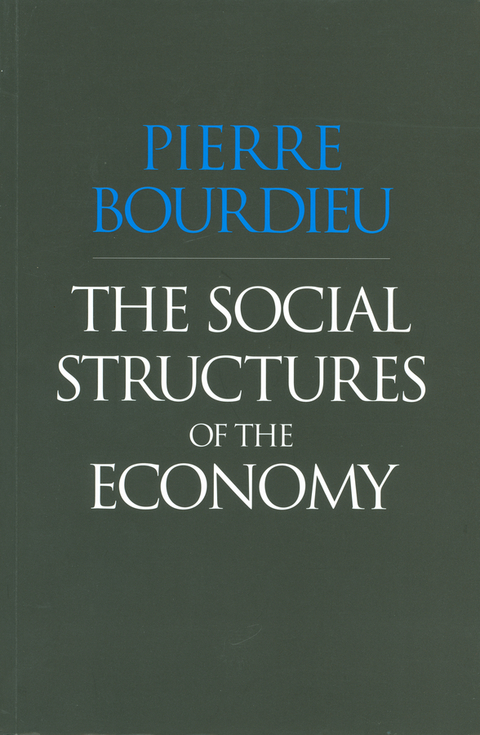
The Social Structures of the Economy (eBook)
John Wiley & Sons (Verlag)
978-0-7456-8165-8 (ISBN)
As Bourdieu shows, the market is constructed by the state, which can decide, for example, whether to promote private housing or collective provision. And the individuals involved in the transaction are immersed in symbolic constructions which constitute, in a strong sense, the value of houses, neighbourhoods and towns.
The abstract and illusory nature of the assumptions of orthodox economic theory has been criticised by some economists, but Bourdieu argues that we must go further. Supply, demand, the market and even the buyer and seller are products of a process of social construction, and so-called 'economic' processes can be adequately described only by calling on sociological methods. Instead of seeing the two disciplines in antagonistic terms, it is time to recognize that sociology and economics are in fact part of a single discipline, the object of which is the analysis of social facts, of which economic transactions are in the end merely one aspect.
This brilliant study by the most original sociologist of post-war France will be essential reading for students and scholars of sociology, economics, anthropology and related disciplines.
Much orthodox economic theory is based on assumptions which are treated as self-evident: supply and demand are regarded as independent entities, the individual is assumed to be a rational agent who knows his interests and how to make decisions corresponding to them, and so on. But one has only to examine an economic transaction closely, as Pierre Bourdieu does here for the buying and selling of houses, to see that these abstract assumptions cannot explain what happens in reality. As Bourdieu shows, the market is constructed by the state, which can decide, for example, whether to promote private housing or collective provision. And the individuals involved in the transaction are immersed in symbolic constructions which constitute, in a strong sense, the value of houses, neighbourhoods and towns. The abstract and illusory nature of the assumptions of orthodox economic theory has been criticised by some economists, but Bourdieu argues that we must go further. Supply, demand, the market and even the buyer and seller are products of a process of social construction, and so-called economic' processes can be adequately described only by calling on sociological methods. Instead of seeing the two disciplines in antagonistic terms, it is time to recognize that sociology and economics are in fact part of a single discipline, the object of which is the analysis of social facts, of which economic transactions are in the end merely one aspect. This brilliant study by the most original sociologist of post-war France will be essential reading for students and scholars of sociology, economics, anthropology and related disciplines.
Pierre Bourdieu was the Professor of Sociology at the Collège de France.
Introduction.
Part I The House Market.
Chapter 1 Dispositions of the Agents and the Structure of
the Field of Reproduction.
Chapter 2 -The State and the Construction of the
Market.
Chapter 3 - The Field of Local Powers.
Chapter 4 - A Contract under Duress.
Conclusion - The Foundations of Petit Bourgeois
Suffering.
Part II Principles of an Economic Anthropology.
Postscript - From the National to the International Field.
Notes.
Index.
"[T]he application of Bourdieu's ideas to the housing market is of
great interest and this book can contribute to the debates
surrounding alternative or complementary understandings of that
which is deemed 'economic', to the current hegemony of classical
economic approaches."
Housing Studies
Introduction
It takes centuries of culture to produce a utilitarian such as John Stuart Mill.
Henri Bergson
The science called ‘economics’ is based on an initial act of abstraction that consists in dissociating a particular category of practices, or a particular dimension of all practice, from the social order in which all human practice is immersed. This immersion, some aspects or effects of which one finds in Karl Polanyi’s notion of ‘embeddedness’, obliges us (even when, for the purposes of increasing knowledge, we are forced to treat it otherwise) to conceive every practice, beginning with the practice which presents itself, most obviously and in the strictest sense, as ‘economic’, as a ‘total social fact’ in Marcel Mauss’s sense.
The individual studies I carried out more than forty years ago in Algeria on the logic of the economy of honour and ‘good faith’ or on the economic and cultural determinants of practices of saving, credit or investment or, in the mid-1960s with Luc Boltanski and Jean-Claude Chamboredon, on banks and their customers or, more recently, with Salah Bouhedja, Rosine Christin, Claire Givry and Monique de Saint-Martin, on the production and marketing of single-family houses1 differ from economics in its commonest form in two essential respects: they attempt in each case to bring to bear all the available knowledge relating to the different dimensions of the social order – which we may list, in no particular order, as the family, the state, the school system, the trade unions, grassroots organizations, etc. – and not merely knowledge relating to banking, firms and the market; and they deploy a system of concepts, developed in response to observational data, which might be presented as an alternative theory for understanding economic action: the concept of habitus, which was developed as part of an attempt to account for the practices of men and women who found themselves thrown into a strange and foreign economic cosmos imported and imposed by colonialism, with cultural equipment and dispositions – particularly economic dispositions – acquired in a precapitalist world; the concept of cultural capital which, being elaborated and deployed at more or less the same time as Gary Becker was putting into circulation the vague and flabby notion of ‘human capital’ (a notion heavily laden with sociologically unacceptable assumptions), was intended to account for otherwise inexplicable differences in the academic performance of children with unequal cultural patrimonies and, more generally, in all kinds of cultural or economic practices; the concept of social capital which I had developed, from my earliest ethnological work in Kabylia or Béarn, to account for residual differences, linked, broadly speaking, to the resources which can be brought together per procurationem through networks of ‘relations’ of various sizes and differing density, and which – often associated today with the name of James Coleman, who was responsible for launching it on the highly protected market of American sociology – is frequently used to correct the implications of the dominant model through the effect of ‘social networks’;2 the concept of symbolic capital, which I had to construct to explain the logic of the economy of honour and ‘good faith’ and which I have been able to clarify and refine in, by and for the analysis of the economy of symbolic goods, particularly of works of art; and lastly, and most importantly, the concept of field, which has met with some success, in an unattributed and often rather watered-down form, in the ‘New Economic Sociology’.3 The introduction of these notions is merely one aspect of a more general shift of language (marked, for example, by the substitution of the lexicon of dispositions for the language of decision-making, or of the term ‘reasonable’ for ‘rational’), which is essential to express a view of action radically different from that which – most often implicitly – underlies neoclassical theory.
In having recourse to concepts that have been developed and applied to objects as diverse as ritual practices, economic behaviours, education, art or literature, I would not wish to appear to be indulging in that kind of reductionist annexationism, ignorant of the specificities and particularities of each social microcosm, to which certain economists are increasingly addicted today, in the conviction that the most general concepts of the most highly refined economic thought are adequate for the analysis, outside of any reference to the work of historians or social anthropologists, of social realities as complex as the family, intergenerational exchanges, corruption or marriage. In fact, I start out with quite the opposite conviction: because the social world is present in its entirety in every ‘economic’ action, we have to equip ourselves with instruments of knowledge which, far from bracketing out the multidimensionality and multi-functionality of practices, enable us to construct historical models capable of accounting, with rigour and parsimony, for economic actions and institutions as they present themselves to empirical observation. Clearly, this is achieved at the expense of a prior suspension of one’s ordinary commitment to the preformed notions and assumptions of common sense. As is shown by so many deductive models produced by economists, which are mere mathematical formalizations – and formularizations – of a commonsense insight, this break with ordinary practice is perhaps never so difficult as when what is to be questioned, such as the principles underlying economic practices, is inscribed in the most ordinary routines of everyday experience.
I can give an idea of the labour of conversion needed to break with the primal vision of economic practices only by referring to the long string of surprised, astonished and disconcerted reactions that led me to experience quite tangibly the contingent character of so many behaviours which form part of our normal daily round: calculation of cost and profit, lending at interest, saving, credit, the creation of a reserve, investment or even work. I remember spending many an hour peppering with questions a Kabyle peasant who was trying to explain a traditional form of the loan of livestock, because it had not occurred to me that, contrary to all ‘economic’ reason, the lender might feel an obligation to the borrower on the grounds that the borrower was providing for the upkeep of an animal that would have had to have been fed in any case. I also remember all the tiny anecdotal observations or statistical findings I had to put together before gradually realizing that I, like everyone else, had an implicit philosophy of work, based on an equivalence between work and money: the behaviour, deemed highly scandalous, of the mason who, after a long stay in France, asked that a sum corresponding to the cost of the meal laid on for the workers at the end of the job – a meal he had refused to attend – should be added to his wages or the fact that, despite working an objectively identical number of hours or days, the peasants of the southern regions of Algeria, where emigration has had less of an impact, were more likely to say they were ‘working’ than the Kabyles, who tended to describe themselves as unemployed or jobless. This philosophy which to me (and all those like me) seemed self-evident was something that some of those observed, in particular the Kabyles, were just discovering, wrenching themselves with enormous effort from a vision, which I found very difficult to conceive, of activity as social occupation.4 And I can also remember feeling a kind of amused stupefaction at the extraordinary story of the children of Lowestoft in Norfolk, England, who, as the French newspapers of 29 October 1959 reported, had set up a scheme of insurance against punishment which meant that for a beating the insured party received four shillings and who, in response to attempts to abuse the system, had gone so far as to add a supplementary clause to the effect that no payment would be made to those incurring punishment deliberately.
Since they lacked these ‘predispositions’, which the spontaneously Millian schoolchildren of Lowestoft had imbibed with their mother’s milk, the economic agents I was able to observe in Algeria in the 1960s had to learn or, more exactly, reinvent, with greater or lesser success depending on their economic and cultural resources, everything economic theory considers (at least tacitly) as a given, that is to say, everything it regards as an innate, universal gift, forming part of human nature: the idea of work as an activity procuring a monetary income, as opposed to mere occupation on the lines of the traditional division of activities or the traditional exchange of services; the very possibility of impersonal transactions between strangers, linked to a market situation, as opposed to all the exchanges of the economy of ‘good faith’, as the Kabyles call it, between relatives and acquaintances or between strangers, but strangers ‘domesticated’, so to speak, by the provision of guarantees from close relations and intermediaries capable of limiting and averting the risks associated with the market; the notion of long-term investment, as opposed to the practice of putting in reserve, or the simple anticipation that forms part of the directly felt unity of productive cycles;...
| Erscheint lt. Verlag | 10.3.2014 |
|---|---|
| Sprache | englisch |
| Themenwelt | Sozialwissenschaften ► Politik / Verwaltung |
| Sozialwissenschaften ► Soziologie ► Allgemeine Soziologie | |
| Wirtschaft ► Allgemeines / Lexika | |
| Wirtschaft ► Volkswirtschaftslehre | |
| Schlagworte | Abstract • Agent • Ãkonomische Soziologie • Assumptions • Bourdieu • cannot • closely • corresponding • Decisions • economic • explain • Gesellschaftstheorie • Houses • Independent • Individual • Interests • Ökonomische Soziologie • Orthodox • Pierre • Rational • Reality • selfevident • Selling • Social Theory • Sociology • Sociology of Economics • Soziologie • theory • Transaction |
| ISBN-10 | 0-7456-8165-4 / 0745681654 |
| ISBN-13 | 978-0-7456-8165-8 / 9780745681658 |
| Informationen gemäß Produktsicherheitsverordnung (GPSR) | |
| Haben Sie eine Frage zum Produkt? |
 EPUB (Adobe DRM)
Kopierschutz: Adobe-DRM
Adobe-DRM ist ein Kopierschutz, der das eBook vor Mißbrauch schützen soll. Dabei wird das eBook bereits beim Download auf Ihre persönliche Adobe-ID autorisiert. Lesen können Sie das eBook dann nur auf den Geräten, welche ebenfalls auf Ihre Adobe-ID registriert sind.
Details zum Adobe-DRM
Dateiformat: EPUB (Electronic Publication)
EPUB ist ein offener Standard für eBooks und eignet sich besonders zur Darstellung von Belletristik und Sachbüchern. Der Fließtext wird dynamisch an die Display- und Schriftgröße angepasst. Auch für mobile Lesegeräte ist EPUB daher gut geeignet.
Systemvoraussetzungen:
PC/Mac: Mit einem PC oder Mac können Sie dieses eBook lesen. Sie benötigen eine
eReader: Dieses eBook kann mit (fast) allen eBook-Readern gelesen werden. Mit dem amazon-Kindle ist es aber nicht kompatibel.
Smartphone/Tablet: Egal ob Apple oder Android, dieses eBook können Sie lesen. Sie benötigen eine
Geräteliste und zusätzliche Hinweise
Buying eBooks from abroad
For tax law reasons we can sell eBooks just within Germany and Switzerland. Regrettably we cannot fulfill eBook-orders from other countries.
aus dem Bereich