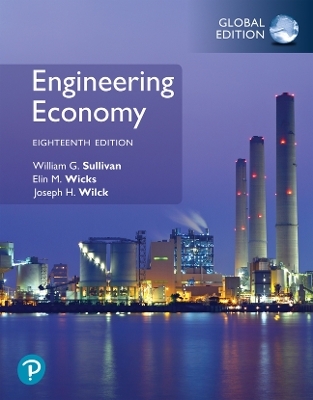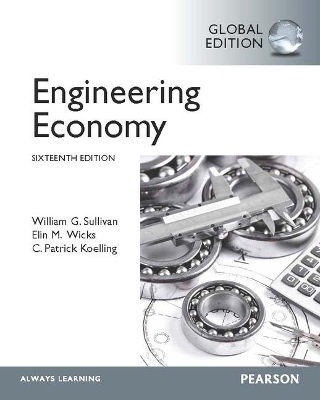
Engineering Economy, Global Edition
Pearson Education Limited
978-1-292-01949-9 (ISBN)
- Titel erscheint in neuer Auflage
- Artikel merken
Preface xi Green Content xviii
CHAPTER 1
Introduction to Engineering Economy 1
1.1 Introduction 2
1.2 The Principles of Engineering Economy 3
1.3 Engineering Economy and the Design Process 7
1.4 Using Spreadsheets in Engineering Economic Analysis 15
1.5 Try Your Skills 15
1.6 Summary 16
CHAPTER 2
Cost Concepts and Design Economics 20
2.1 Cost Terminology 21
2.2 The General Economic Environment 27
2.3 Cost-Driven Design Optimization 38
2.4 Present Economy Studies 43
2.5 Case Study–The Economics of Daytime Running Lights 49
2.6 Try Your Skills 51
2.7 Summary 52
Appendix 2-A Accounting Fundamentals 60
CHAPTER 3
Cost-Estimation Techniques 67
3.1 Introduction 68
3.2 An Integrated Approach 70
3.3 Selected Estimating Techniques (Models) 78
3.4 Parametric Cost Estimating 83
3.5 Case Study–Demanufacturing of Computers 94
3.6 Electronic Spreadsheet Modeling: Learning Curve 96
3.7 Try Your Skills 98
3.8 Summary 100
CHAPTER 4
The Time Value of Money 107
4.1 Introduction 108
4.2 Simple Interest 109
4.3 Compound Interest 110
4.4 The Concept of Equivalence 110
4.5 Notation and Cash-Flow Diagrams and Tables 113
4.6 Relating Present and Future Equivalent Values 123
4.7 Relating a Uniform Series (Annuity) to Its Present and Future Equivalent
4.8 Summary of Interest Formulas and Relationships for Discrete Compounding 133
4.9 Deferred Annuities (Uniform Series) 135
4.10 Equivalence Calculations Involving Multiple Interest Formulas 137
4.11 Uniform (Arithmetic) Gradient of Cash Flows 143
4.12 Geometric Sequences of Cash Flows 148
4.13 Interest Rates that Vary with Time 153
4.14 Nominal and Effective Interest Rates 155
4.15 Compounding More Often than Once per Year 157
4.16 Interest Formulas for Continuous Compounding and Discrete Cash Flows 160
4.17 Case Study–Understanding Economic “Equivalence” 163
4.18 Try Your Skills 166
4.19 Summary 169
CHAPTER 5
Evaluating a Single Project 186
5.1 Introduction 187
5.2 Determining the Minimum Attractive Rate of Return (MARR) 188
5.3 The PresentWorth Method 189
5.4 The Future Worth Method 196
5.5 The Annual Worth Method 197
5.6 The Internal Rate of Return Method 202
5.7 The External Rate of Return Method 213
5.8 The Payback (Payout) Period Method 215
5.9 Case Study–A Proposed Capital Investment to Improve Process Yield 218
5.10 Electronic Spreadsheet Modeling: Payback Period Method 220
5.11 Try Your Skills 222
5.12 Summary 224
Appendix 5-A The Multiple Rate of Return Problem with the IRR Method 236
CHAPTER 6
Comparison and Selection among Alternatives 240
6.1 Introduction 241
6.2 Basic Concepts for Comparing Alternatives 241
6.3 The Study (Analysis) Period 245
6.4 Useful Lives Are Equal to the Study Period 247
6.5 Useful Lives Are Unequal among the Alternatives 264
6.6 Personal Finances 277
6.7 Case Study–Ned and Larry’s Ice Cream Company 281
6.8 Postevaluation of Results 284
6.9 Project Postevaluation Spreadsheet Approach 284
6.10 Try Your Skills 287
6.11 Summary 291
CHAPTER 7
Depreciation and Income Taxes 308
7.1 Introduction 309
7.2 Depreciation Concepts and Terminology 309
7.3 The Classical (Historical) Depreciation Methods 312
7.4 The Modified Accelerated Cost Recovery System 317
7.5 A Comprehensive Depreciation Example 326
7.6 Introduction to Income Taxes 330
7.7 The Effective (Marginal) Corporate Income Tax Rate 333
7.8 Gain (Loss)
| Erscheint lt. Verlag | 15.5.2014 |
|---|---|
| Verlagsort | Harlow |
| Sprache | englisch |
| Maße | 189 x 234 mm |
| Gewicht | 1108 g |
| Themenwelt | Wirtschaft ► Volkswirtschaftslehre |
| ISBN-10 | 1-292-01949-2 / 1292019492 |
| ISBN-13 | 978-1-292-01949-9 / 9781292019499 |
| Zustand | Neuware |
| Informationen gemäß Produktsicherheitsverordnung (GPSR) | |
| Haben Sie eine Frage zum Produkt? |
aus dem Bereich