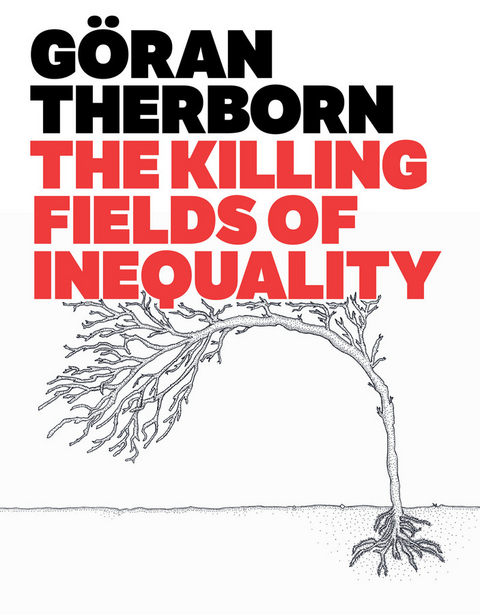
The Killing Fields of Inequality (eBook)
John Wiley & Sons (Verlag)
978-0-7456-7989-1 (ISBN)
But this book is about experiences of equalization too, highlighting moments and processes of equalization in different parts of the world - from India and other parts of Asia, from the Americas, as well as from Europe. South Africa illustrates the toughest challenges. The killing fields of inequality can be avoided: this book shows how.
Clear, succinct, wide-ranging in scope and empirical in its approach, this timely book by one of the world’s leading social scientists will appeal to a wide readership.
Göran Therborn is Professor Emeritus of Sociology at the University of Cambridge and author of The World: A Beginner’s Guide.
Göran Therborn is Professor Emeritus of Sociology at the University of Cambridge and author of The World: A Beginner's Guide.
Figures page vi
Tables vii
Introduction 1
I. The Fields 5
1. Human, Nasty and Short: Life under Inequality 7
2. Behind the Doors of Exclusion 20
II. Theory 35
3. Theoretical Cross-Draught 37
4. Three Kinds of (In)Equality and Their Production 48
III. History 69
5. Inequality and the Rise of Modernity 71
6. A Historical Six-Pack: Three Inequalities in
Global and National History 79
IV. Today's Unequal World 101
7. Current World Patterns and Dynamics of Inequalities 103
8. Three Puzzles of Contemporary Inequalities 132
V. Possible Futures 151
9. Overcoming Inequality - Yesterday and Tomorrow 153
10. The Decisive Battlefields of Future (In)Equality 166
References 185
Index 202
"Covering the world, Göran Therborn shows how devastating are his three types of inequality (vital, existential and resource) and their mechanisms of reproduction (distanciation, exclusion and exploitation). Lucid, persuasive and learned The Killing Fields of Inequality is a must-read for those concerned about the most pressing topic of our time."
Michael Burawoy, University of California, Berkeley
"A great book. With a light touch, it provides a brief but comprehensive survey of all the main dimensions of inequality. Written with insight, commitment to social justice, and ability to see what matters, it becomes a book about social progress itself. It ends with a perceptive discussion of the next steps towards a more egalitarian future."
Richard Wilkinson, University of Nottingham
"[A]lways favouring a comparative and global perspective, Therborn's book presents us with a wide and insightful examination of the various dimensions of inequality in a rare combination of theoretical developments, historical substantiation, and empirical evidence [...and...] compelling answers to a few of the most inescapable questions about inequalities."
Análise Social
1
Human, Nasty and Short: Life under Inequality
The Short Lives of the Unequalized
Inequality kills. Between 1990 and 2008, life expectancy for White American men without a college degree fell by three years, and White low-educated women had their lives shortened by more than five years (Olshansky et al. 2012: exhibit 2). Only AIDS in southern Africa and the restoration of capitalism in Russia have had a more lethal impact than the US social polarization in the boom years of Clinton and Bush. African Americans have shorter lives than White Americans, but here the gap has actually narrowed in the last two decades – after an early twentieth-century widening – between 1990 and 2009 (National Vital Statistics Reports 60:3, 2011, table 8). Inequalities of race and education together – Blacks with less than twelve years of education vs Whites with more than sixteen – cut the lives of the disadvantaged by twelve years in 2008 (Olshansky et al. 2012: 1805). That is the same as the national difference between the USA and Bolivia (UNICEF 2012: table 1).
The return of capitalism to the former Soviet Union meant a dramatic unequalization and mass impoverishment. In Russia, the Gini coefficient2 of income inequality was hoisted from 27 in 1990 to 46 in 1993, in the Ukraine from 25 in 1992 to 41 in 1996 – then continuing to rise, to 52 and 46 in 2001, respectively (UNICEF 2004: 117, 123). By 1995 the restoration processes had generated 2.6 million extra deaths in Russia and the Ukraine alone (Cornia and Paniccià 2000: 5). For the 1990s and the whole of the former USSR, the death toll amounted to 4 million, according to the British epidemiologist Sir Michael Marmot (2004: 196; cf. Stuckler et al. 2009).
After a catch-up in the 1950s and early 1960s, the health situation in the Soviet Union and Eastern Europe had stagnated, even deteriorating in some countries, including Russia. But the restoration of capitalism meant a sudden jump in mortality, with the standardized death rate among Russian men (aged 16 and over) increasing by 49 per cent between 1988–9 and 1993–4, and among Russian women by 24 per cent (Shkolnikov and Cornia 2000: 267).
The Marmot estimate of 4 million excess deaths in the 1990s is considerably lower than the mortal effects of the Stalinist collectivization of the 1930s, of which the best estimate for the 1927–36 period seems to be circa 9 million (Livi-Bacci 1993: 751ff., 2000: 50), with a particularly devastating impact in Kazakhstan and Ukraine (Ó Gráda 2009: 237). However, with respect to Russia, the collectivization tragedy of the 1930s and the privatization one of the 1990s are not incomparable. From 1930–1 to 1933 the (crude) Russian death rate increased by 49.5 per cent (Livi-Bacci 1993: 757), i.e., almost exactly the same increase as sixty years later. Russian and Ukrainian extra deaths in the 1990s, through mass unemployment, mass impoverishment and degradations, may well be argued to have been less brutal than those from the requisitions, famine and deportations of the Stalinist collectivization. But the silent acceptance of new systemic deaths by the world's liberals and conservatives is more amazing in the mediatic, ‘information age’ 1990s, than the starry-eyed disbelief among the Communists and Soviet admirers of the insulated 1930s.
By 2009, life expectancy in Russia and the Ukraine is still below what it was in 1990 (WHO 2012: part III, table 1). The educational gap in life length widened in Russia while death rates rose in all educational groups (Shkolnikov and Cornia 2000: 267). But in Estonia and Lithuania in the 1990s, a dramatic increase in dying among people with, at most, upper secondary education accompanied a mortality decline among the highly educated (Leinsalu et al. 2009).
The main Western European pattern of unequal life possibilities is a stagnation or a slow lengthening of the lifespan of the poor and the low-educated, while the life horizon of the rest is being extended. This seems to be the trend of the last half-century or more (Valkonen 1998) – in the UK, roughly since the introduction of the National Health Service (no causal connection implied) (Fitzpatrick and Chandola 2000: table 3.8). After a spike in the mid-1990s, the English gap between occupational classes I and V has decreased somewhat, while differences in life prospects between territorial areas have continued to grow, and the inequality coefficient of age at death has risen (Sassi 2009). Just between 2004–6 and 2009–10, the lifespan gap between Glasgow and Kensington–Chelsea increased by more than a year (Office of National Statistics 2011). The American pattern is similar, but includes a growing mortality gap, in relation to the richest quartile of the population, in the second and the third quartiles as well (Evans et al. 2012: 15).
Some recent changes elsewhere in Western Europe are rather dramatic too. For example in Finland, the life expectancy gap at the age of 35, between the richest and the poorest fifth (quintile) of the population, widened by 5 years for men and 3 years for women in the period from 1988 to 2007. It is now 12.5 years between the top and the bottom male quintile, and 6.8 between the female ones (Tarkiainen et al. 2011). Another Finnish study by the same group of researchers found that the (age-standardized) death rate at ages 35–64 among the poorest fifth of women increased strongly from 2004 to 2007, leaving it well above the level of the late 1980s. Premature deaths among the unemployed and among people living alone also soared between 1988 and 2007, among both men and women (Tarkiainen et al. 2012: tables 1–2).
A number of large longitudinal studies have established that unemployment produces extra deaths, even when controlling for stress palliatives like tobacco and alcohol, as well as for pre-unemployment health (e.g. Bethune 1997; Gerdtham and Johannesson 2003; Moser et al. 1994; Nylén et al. 2001). Even the wives of unemployed men have been found pushed into the grave before other married women (Moser et al. 1994). One of the direst consequences of the ongoing financial crisis is its generation of mass unemployment. The megalomania of a few hundred recklessly gambling bankers has thrust millions of workers into unemployment. From early 2008 to January 2013, the unemployed in the EU increased by 8 million, to 26 million, and in the USA by 4.6 million to 13 million. How many of these unemployed will die a premature death? We don't know yet, but they are likely to be numbered in tens of thousands. At the International Court in The Hague, people are convicted of ‘crimes against humanity’ with smaller mortal dimensions.
Level of education is in some sense the sharpest and most comparable instrument for measuring social inequality of premature adult death. It doesn't in itself explain mortality, although it does indicate life-long effects of childhood and youth experiences – we shall return to this below – but it is relatively precise and internationally comparable, and it does point to something important: the early shaping of people's life-chances. It is often more powerful than income or wealth. For instance, in USA a college-educated White man at age 50 has 6 more years to live than a college drop-out. Wealth among the highest quintile gives a life premium of 4 years, full-time employment 3.4 years more than unemployment, and marriage a 2.5-year life advantage (Pijoan-Mas and Rios-Rull 2012). A recent European study of mortality also found (three-layered) education making larger differences than manual vs non-manual occupation. Self-assessed health, on the other hand, was more strongly differentiated by income, especially in England and Norway (Mackenbach et al. 2008: 2473, 2477).
Where is there most inequality of life and death in Europe? A Dutch research group at the Erasmus University provides an answer, referring to (standardized) rates of death between the ages of 30 and 74 in the 1990s. The answer is: East-Central Europe (Russia and the Ukraine were not included). Compared to people with tertiary education, every year 2,580 more people out of 100,000 with only primary education died before the age of 75 in Hungary, 2,539 in Lithuania, 2,349 in Estonia, 2,192 in Poland, and 2,130 in the Czech Republic. In (conventionally) Western Europe, Finland had the steepest slope of inequality: 1,255 annual extra deaths among the low-educated; France had 1,042, Switzerland 1,012, and England-cum-Wales 862. Least lethal inequality was found in Sweden – 625 excess deaths – and areas in Spain (from 384 in the Basque country to 662 in Barcelona) and the Italian city of Turin (639). The above are male data, female deaths exhibit similar social and national patterns, but differentials are smaller, less than half the male average. In the women's league, the Nordic women come out relatively more unequal than the men. Swedish women are more unequal than French and Swiss women, and Norwegian and Danish women are even more unequal than the European average, whereas Finnish women, in contrast to Finnish men, are below the study's European average (Mackenbach et al 2008: table 2).
Not only death comes earlier to the poor and the little-educated. Common chronic diseases also start...
| Erscheint lt. Verlag | 15.1.2014 |
|---|---|
| Sprache | englisch |
| Themenwelt | Geschichte ► Allgemeine Geschichte ► Zeitgeschichte |
| Sozialwissenschaften ► Politik / Verwaltung | |
| Sozialwissenschaften ► Soziologie ► Makrosoziologie | |
| Wirtschaft ► Volkswirtschaftslehre ► Makroökonomie | |
| Schlagworte | Ãkonomie der Globalisierung • Economics • Economics of Globalization • Globalisierung • Inequality, class, mortality, dignity • Ökonomie der Globalisierung • Sociology • Sociology of Globalization • Soziologie • Soziologie der Globalisierung • Volkswirtschaftslehre • Wirtschaftssoziologie |
| ISBN-10 | 0-7456-7989-7 / 0745679897 |
| ISBN-13 | 978-0-7456-7989-1 / 9780745679891 |
| Informationen gemäß Produktsicherheitsverordnung (GPSR) | |
| Haben Sie eine Frage zum Produkt? |
 EPUB (Adobe DRM)
Größe: 1,2 MB
Kopierschutz: Adobe-DRM
Adobe-DRM ist ein Kopierschutz, der das eBook vor Mißbrauch schützen soll. Dabei wird das eBook bereits beim Download auf Ihre persönliche Adobe-ID autorisiert. Lesen können Sie das eBook dann nur auf den Geräten, welche ebenfalls auf Ihre Adobe-ID registriert sind.
Details zum Adobe-DRM
Dateiformat: EPUB (Electronic Publication)
EPUB ist ein offener Standard für eBooks und eignet sich besonders zur Darstellung von Belletristik und Sachbüchern. Der Fließtext wird dynamisch an die Display- und Schriftgröße angepasst. Auch für mobile Lesegeräte ist EPUB daher gut geeignet.
Systemvoraussetzungen:
PC/Mac: Mit einem PC oder Mac können Sie dieses eBook lesen. Sie benötigen eine
eReader: Dieses eBook kann mit (fast) allen eBook-Readern gelesen werden. Mit dem amazon-Kindle ist es aber nicht kompatibel.
Smartphone/Tablet: Egal ob Apple oder Android, dieses eBook können Sie lesen. Sie benötigen eine
Geräteliste und zusätzliche Hinweise
Zusätzliches Feature: Online Lesen
Dieses eBook können Sie zusätzlich zum Download auch online im Webbrowser lesen.
Buying eBooks from abroad
For tax law reasons we can sell eBooks just within Germany and Switzerland. Regrettably we cannot fulfill eBook-orders from other countries.
 PDF (Adobe DRM)
Kopierschutz: Adobe-DRM
Adobe-DRM ist ein Kopierschutz, der das eBook vor Mißbrauch schützen soll. Dabei wird das eBook bereits beim Download auf Ihre persönliche Adobe-ID autorisiert. Lesen können Sie das eBook dann nur auf den Geräten, welche ebenfalls auf Ihre Adobe-ID registriert sind.
Details zum Adobe-DRM
Dateiformat: PDF (Portable Document Format)
Mit einem festen Seitenlayout eignet sich die PDF besonders für Fachbücher mit Spalten, Tabellen und Abbildungen. Eine PDF kann auf fast allen Geräten angezeigt werden, ist aber für kleine Displays (Smartphone, eReader) nur eingeschränkt geeignet.
Systemvoraussetzungen:
PC/Mac: Mit einem PC oder Mac können Sie dieses eBook lesen. Sie benötigen eine
eReader: Dieses eBook kann mit (fast) allen eBook-Readern gelesen werden. Mit dem amazon-Kindle ist es aber nicht kompatibel.
Smartphone/Tablet: Egal ob Apple oder Android, dieses eBook können Sie lesen. Sie benötigen eine
Geräteliste und zusätzliche Hinweise
Buying eBooks from abroad
For tax law reasons we can sell eBooks just within Germany and Switzerland. Regrettably we cannot fulfill eBook-orders from other countries.
aus dem Bereich