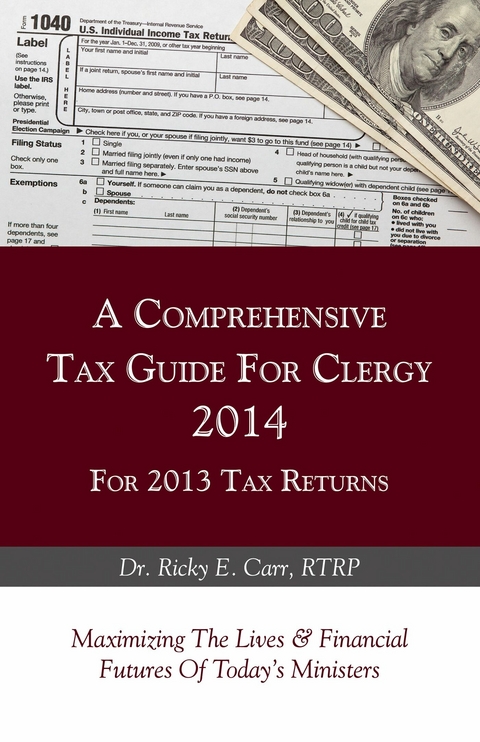
Comprehensive Tax Guide For Clergy 2014 for 2013 Tax Returns (eBook)
112 Seiten
First Edition Design Publishing (Verlag)
978-1-62287-461-3 (ISBN)
The IRS has extended multiple opportunities for ministers to save money on their taxes. Unfortunately, however, not all CPAs know about the tax-saving opportunities available for clergy. If your CPA is not up-to-date on all of the unique tax benefits available to clergy, you might be over-paying your taxes.
Form 1040
This is the standard Internal Revenue Service (IRS) form that individuals use to file their annual income tax returns. The form contains sections that require taxpayers to disclose their financial income status for the year in order to ascertain whether additional taxes are owed or whether the taxpayer is due for a tax refund. 1040 forms must be filed with the IRS by April 15.
While the 1040 form is composed of only a couple of pages, taxpayers may need to fill out extra sections called schedules.
For example, if a taxpayer received dividends that totaled more than $1,500, he or she will need to fill out Schedule B, which is the section for reporting interest and ordinary dividends.
There are several variations of the 1040, depending on your individual tax situation.
For example, taxpayers that possess very simple taxation circumstances can fill out the Form 1040EZ, which is a less comprehensive form.
Filing Status
You get five choices, one each on lines 1 through 5: single, married filing jointly, married filing separately, head of household and qualifying widow, or widower with a dependent child.
Exemptions
The exemptions section of the form, line 6, lets the IRS know how many people depend on you for support. Technically, if you’re married and filing jointly, your spouse is not your dependent. But, when you file, each of you is counted as an exemption, so check boxes 6a and 6b.
Your other dependents are, in most cases, people who live with you. But there are instances in which you can provide substantial support and claim a person as a dependent even if that person lives elsewhere.
To ensure that your dependents are valid, the IRS requires you to enter their names on line 6c, along with their Social Security numbers and relationships to you.
Income
To make these monetary entries a little easier, the IRS allows you to round off cents to whole dollars.
Wages
Most people will enter on line 7 the amount shown in box 1 of the W-2 wage statement they got from their employers. If you had more than one job, you should have multiple W-2s.
If you earned other types of income, such as tips or money for household work you did, that goes on line 7, too, even if you didn’t get an official statement. Attach copy B of all your W-2s here.
Interest Income
Report what you earned in interest. The IRS wants to know about all of it, even if you don’t owe taxes on it.
Taxable interest amounts, generally from bank accounts and similar savings instruments, go on line 8a. This money usually is reported to you (and the IRS) in box 1 of the 1099-INT form sent by your financial institution. If your total exceeds $1,500, then you’ll have some more paperwork to complete: detailing your earnings on part 1 of Schedule B. But if the interest is less than that, just enter it on line 8a.
Dividend Income
If you received ordinary dividends, you’ll get a 1099-DIV showing the amount, which goes on line 9. If the total is more than $1,500, or if you received ordinary dividends as a nominee (that is, they were registered in your name but the actual money belonged to someone else), you must fill in and attach part 2 of Schedule B.
Taxable Refunds
Did you get any 1099-G forms? These statements are issued by governments to report money you received. The most common example is a state tax refund. If you used your state income tax payments as an itemized deduction to lower your federal tax bill, any state refund you get usually is taxable. Enter the amount on line 10.
Alimony
Divorce has many financial implications, including taxes, for both parties. If you receive alimony payments, they are taxable and you need to enter the amount you received.
Business Income
Self-employed taxpayers, whether it’s a main job or a little freelance work on the side, must report that income (and expenses) on either Schedule C or C-EZ. The profit reflected on either of those forms is entered on line 12 of Form 1040.
Capital Gain (or Loss)
If you sold a stock, regardless of whether you made or lost money on it, you have to file Schedule D. After you figure your gain or loss on Schedule D, transfer the final amount from there to your 1040.
Investors who received capital gains distributions from mutual funds but had no other capital gains transactions to report don’t have to worry about Schedule D. These distributions are reported on the 1099-DIV statements you get from your fund managers.
Other Gains (or Losses)
Taxpayers who sold or exchanged assets they used in their trade or business also have to file Form 4797, along with the 1040.
Individual Retirement Account Money
If you took money from an individual retirement arrangement, you need to report it. This is from any IRA -- traditional, Roth or a self-employed IRA plan. This also applies to retirement money you rolled over into another tax-deferred account.
List the total distribution (money you took out or rolled over) on 15a and the taxable amount on 15b. You should have a 1099-R showing the amount distributed and whether it was taxable or non-taxable.
Pensions and Annuities
Similarly, you should have a 1099-R if you received any pension money. This includes transfers of 401(k) accounts from one employer to another.
If your pension or annuity is partially taxable and your Form 1099-R doesn’t show the taxable part, it’s up to you to figure the taxable part. The IRS provides details on how to do this in Publication 939. Also, if any tax was withheld from your pension or IRA, attach the 1099-R forms that show that amount, along with your W-2s.
Rent, Royalties and Other Income
Income from the house you rent out goes on Form 1040, after you’ve figured the exact amount by completing Schedule E. Earnings from royalties, partnerships, S corporations or trusts also are reported on this schedule and 1040 line.
Farm Income (or Loss)
Farmers must use Schedule F to report income gained or lost from a farm operation.
Unemployment Compensation
Unemployment compensation is subject to taxing. If you received these benefits, you should have received a Form 1099-G.
Social Security Benefits
Did you reap some of your well-earned federal retirement benefits last year? Then you should have received a Form SSA-1099. Railroad retirement benefits treated as Social Security are reported on the similar RRB-1099.
Other Income
Enter any other taxable income you’ve not yet told the IRS about. This is not self-employment earnings. Rather, it includes prizes and awards, gambling winnings, jury duty fees, Alaska Permanent Fund dividends, qualified state tuition program earnings and reimbursements or other amounts received for items deducted in an earlier year. List the type and amount of income, using a separate sheet if necessary, and attach it to your return.
Not all income is taxable. Child support, money or property you inherit or receive as a gift and life insurance proceeds you receive as a beneficiary are some of the few items that escape IRS attention.
Total Income
Enter the sum of your total income.
Now let’s get to work cutting that amount!
This next section of the 1040 allows you to adjust your income by taking several above-the-line deductions. By taking all these deductions you can, you’ll cut your adjusted gross income. That, in turn, cuts your overall bill because figuring your AGI is the first step in arriving at your final taxable income amount.
Educator Expenses
Tax breaks exist for teachers and other public and private school employees who spend their own money on classroom materials and supplies. Up to $250 of qualifying purchases may be claimed here. If both you and your spouse are teachers, you can claim up to $500, but only if each of you spent the maximum credit amount.
Certain Business Expenses of reservist, Performing Artist
If you are a qualified performing artist or other professional, and you paid for...
| Erscheint lt. Verlag | 18.11.2013 |
|---|---|
| Sprache | englisch |
| Themenwelt | Recht / Steuern ► EU / Internationales Recht |
| Recht / Steuern ► Steuern / Steuerrecht | |
| Recht / Steuern ► Wirtschaftsrecht | |
| Wirtschaft ► Volkswirtschaftslehre ► Wirtschaftspolitik | |
| ISBN-10 | 1-62287-461-7 / 1622874617 |
| ISBN-13 | 978-1-62287-461-3 / 9781622874613 |
| Informationen gemäß Produktsicherheitsverordnung (GPSR) | |
| Haben Sie eine Frage zum Produkt? |
 EPUB (Wasserzeichen)
Größe: 2,9 MB
DRM: Digitales Wasserzeichen
Dieses eBook enthält ein digitales Wasserzeichen und ist damit für Sie personalisiert. Bei einer missbräuchlichen Weitergabe des eBooks an Dritte ist eine Rückverfolgung an die Quelle möglich.
Dateiformat: EPUB (Electronic Publication)
EPUB ist ein offener Standard für eBooks und eignet sich besonders zur Darstellung von Belletristik und Sachbüchern. Der Fließtext wird dynamisch an die Display- und Schriftgröße angepasst. Auch für mobile Lesegeräte ist EPUB daher gut geeignet.
Systemvoraussetzungen:
PC/Mac: Mit einem PC oder Mac können Sie dieses eBook lesen. Sie benötigen dafür die kostenlose Software Adobe Digital Editions.
eReader: Dieses eBook kann mit (fast) allen eBook-Readern gelesen werden. Mit dem amazon-Kindle ist es aber nicht kompatibel.
Smartphone/Tablet: Egal ob Apple oder Android, dieses eBook können Sie lesen. Sie benötigen dafür eine kostenlose App.
Geräteliste und zusätzliche Hinweise
Buying eBooks from abroad
For tax law reasons we can sell eBooks just within Germany and Switzerland. Regrettably we cannot fulfill eBook-orders from other countries.
EPUB (Adobe DRM)Kopierschutz: Adobe-DRM
Adobe-DRM ist ein Kopierschutz, der das eBook vor Mißbrauch schützen soll. Dabei wird das eBook bereits beim Download auf Ihre persönliche Adobe-ID autorisiert. Lesen können Sie das eBook dann nur auf den Geräten, welche ebenfalls auf Ihre Adobe-ID registriert sind.
Details zum Adobe-DRM
Dateiformat: EPUB (Electronic Publication)
EPUB ist ein offener Standard für eBooks und eignet sich besonders zur Darstellung von Belletristik und Sachbüchern. Der Fließtext wird dynamisch an die Display- und Schriftgröße angepasst. Auch für mobile Lesegeräte ist EPUB daher gut geeignet.
Systemvoraussetzungen:
PC/Mac: Mit einem PC oder Mac können Sie dieses eBook lesen. Sie benötigen eine
eReader: Dieses eBook kann mit (fast) allen eBook-Readern gelesen werden. Mit dem amazon-Kindle ist es aber nicht kompatibel.
Smartphone/Tablet: Egal ob Apple oder Android, dieses eBook können Sie lesen. Sie benötigen eine
Geräteliste und zusätzliche Hinweise
Buying eBooks from abroad
For tax law reasons we can sell eBooks just within Germany and Switzerland. Regrettably we cannot fulfill eBook-orders from other countries.
aus dem Bereich