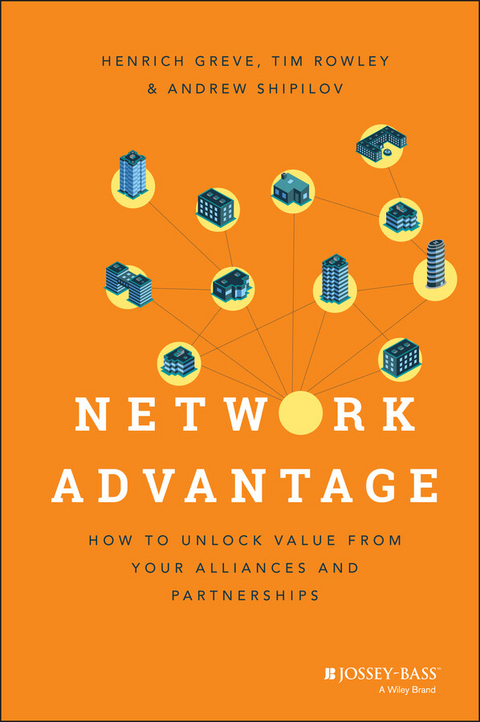
Network Advantage (eBook)
John Wiley & Sons (Verlag)
978-1-118-56138-6 (ISBN)
Companies made more than 42,000 alliances over the past decade worldwide, many of which failed to deliver strong results, This book explains why and how you can seize the benefits from your business's network of alliances with customers, suppliers and competitors,
This network can provide three key advantages:
· superior information
· better cooperation
· increased power
Network Advantage shows how awareness of these three advantages can help align your portfolio of alliances with your corporate strategy to maximize advantages from existing networks and to position your business as an industry leader,
This book is written by three leading authorities in the field of organizational management who work with many international corporate clients, Based on groundbreaking research and illustrative cases, it provides practical tools to help you think strategically about reconfiguring your alliances and partnerships, For business executives, consultants, and executive MBAs who want to get the most advantage from the combined power of their alliance portfolios, Network Advantage offers in-depth, practical guidance, Make it your first strategic connection to gaining competitive advantage!
Companies' connections to other firms-their network of alliances-matter for economic success, In this practical, jargon-free, evidence-based book, three experienced scholar/educators provide practical tools to understand your company's network positioning and what to do to build webs of relationships that provide competitive advantage and economic value,
-Jeffrey Pfeffer, professor, Graduate School of Business, Stanford University and co-author of The Knowing-Doing Gap,
The book, Network Advantage, presents compelling ideas and is a must-read, It articulates three different perspectives to think about a firm's network advantage and shows how a firm can maximize the value of its alliance network, The book is filled with theoretical and practical insights on the topic and offers captivating case studies to illustrate its key points, It is fun to read, I highly recommend this book,
-W, Chan Kim, The BCG Chair Professor of INSEAD and the Co-director of the INSEAD Blue Ocean Strategy Institute
In this eminently researched book, the authors show how executives and entrepreneurs alike can unlock the value of alliances, And the book comes with some 'secrets' to success that most managers overlook, Every CEO, executive and entrepreneur who are collaborating with other firms ought to read this book,
-Morten T, Hansen, Professor at University of California at Berkeley, author of Collaboration and co-author of Great by Choice,
Don't compete alone! 'Network Advantage' provides a fresh perspective on how all firms can benefit from their alliances and partnerships, The authors seamlessly integrate academic research and real life examples into a practical step by step guide for unleashing the power, information and cooperation advantages available in networks, A must read for thoughtful executives and entrepreneurs alike,
-Stein Ove Fenne, President, Tupperware U,S, & Canada
Having the 'right' business network is everything for a company's success in Asia and worldwide, With its rich cases and practical tools, this book is an indispensable guide for a thoughtful executive on how to design, build and manage a network that will make your firm globally competitive,
-Yong-Kyung Lee, Former CEO of Ko
Henrich Greve is a Professor of Entrepreneurship and the INSEAD Chair of Organization and Management Theory, He holds a Ph,D, in Business Administration from Stanford University Graduate School of Business, He does research on organizational networks and learning, and he teaches strategy and organizational change for executives at the Singapore campus of INSEAD,
Tim Rowley is a Professor of Strategy and Organizations at the Rotman School of Management, University of Toronto, He teaches courses on competitive advantage and corporate governance, and his research is focused on how organizations are influenced by the network of relationships surrounding them,
Andrew Shipilov is Associate Professor of Strategy and Akzo Nobel Fellow at INSEAD, His research and teaching revolve around networks, innovation and competitive advantage, He holds a Ph,D, from the University of Toronto, Rotman School of Management,
Companies made more than 42,000 alliances over the past decade worldwide, many of which failed to deliver strong results. This book explains why and how you can seize the benefits from your business s network of alliances with customers, suppliers and competitors. This network can provide three key advantages: superior information better cooperation increased power Network Advantage shows how awareness of these three advantages can help align your portfolio of alliances with your corporate strategy to maximize advantages from existing networks and to position your business as an industry leader. This book is written by three leading authorities in the field of organizational management who work with many international corporate clients. Based on groundbreaking research and illustrative cases, it provides practical tools to help you think strategically about reconfiguring your alliances and partnerships. For business executives, consultants, and executive MBAs who want to get the most advantage from the combined power of their alliance portfolios, Network Advantage offers in-depth, practical guidance. Make it your first strategic connection to gaining competitive advantage! Companies connections to other firms their network of alliances matter for economic success. In this practical, jargon-free, evidence-based book, three experienced scholar/educators provide practical tools to understand your company s network positioning and what to do to build webs of relationships that provide competitive advantage and economic value. Jeffrey Pfeffer, professor, Graduate School of Business, Stanford University and co-author of The Knowing-Doing Gap. The book, Network Advantage, presents compelling ideas and is a must-read. It articulates three different perspectives to think about a firm s network advantage and shows how a firm can maximize the value of its alliance network. The book is filled with theoretical and practical insights on the topic and offers captivating case studies to illustrate its key points. It is fun to read. I highly recommend this book. W. Chan Kim, The BCG Chair Professor of INSEAD and the Co-director of the INSEAD Blue Ocean Strategy Institute In this eminently researched book, the authors show how executives and entrepreneurs alike can unlock the value of alliances. And the book comes with some "e;secrets"e; to success that most managers overlook. Every CEO, executive and entrepreneur who are collaborating with other firms ought to read this book. Morten T. Hansen, Professor at University of California at Berkeley, author of Collaboration and co-author of Great by Choice. Don t compete alone! Network Advantage provides a fresh perspective on how all firms can benefit from their alliances and partnerships. The authors seamlessly integrate academic research and real life examples into a practical step by step guide for unleashing the power, information and cooperation advantages available in networks. A must read for thoughtful executives and entrepreneurs alike. Stein Ove Fenne, President, Tupperware U.S. & Canada Having the "e;right"e; business network is everything for a company's success in Asia and worldwide. With its rich cases and practical tools, this book is an indispensable guide for a thoughtful executive on how to design, build and manage a network that will make your firm globally competitive. Yong-Kyung Lee, Former CEO of Korean Telecom, Member of the Korean National Assembly. Alliances and Partnerships, in their various formats and guises, are the bridges that allow businesses to thrive in their ecosystems by leveraging each other's strengths. The authors show how those bridges, when used appropriately, can help your firm create an alliance network to enhance your business power. The book contains many examples and models to help you shape your own alliance strategy in a world of ever increasing co-opetition. Ricardo T. Dias, Strategic Alliances Director, Hewlett Packard (HP) Software, Asia Pacific & Japan
HENRICH GREVE is a Professor of Entrepreneurship and the INSEAD Chair of Organization and Management Theory. He holds a Ph.D. in Business Administration from Stanford University Graduate School of Business. He does research on organizational networks and learning, and he teaches strategy and organizational change for executives at the Singapore campus of INSEAD. TIM ROWLEY is a Professor of Strategy and Organizations at the Rotman School of Management, University of Toronto. He teaches courses on competitive advantage and corporate governance, and his research is focused on how organizations are influenced by the network of relationships surrounding them. ANDREW SHIPILOV is Associate Professor of Strategy and Akzo Nobel Fellow at INSEAD. His research and teaching revolve around networks, innovation and competitive advantage. He holds a Ph.D. from the University of Toronto, Rotman School of Management.
Acknowledgments ix
Preface xi
Introduction All Roads Lead to London 1
Chapter 1 Network Advantage: Making the Stealth Bomber 23
Chapter 2 Comparing Network Advantage: Sony versus Samsung 49
Chapter 3 The First-Degree Perspective: Strengthening the Foundation of Network Advantage 73
Chapter 4 The Second-Degree Perspective: Understanding the Alliance Portfolio Configurations that Deliver Network Advantage 91
Chapter 5 Evaluating and Changing Your Alliance Portfolio Configuration 117
Chapter 6 The Third-Degree Perspective: Achieving the Status Advantage 143
Chapter 7 Assessing and Increasing Your Status: Extracting Energy from Waves 171
Chapter 8 Maximizing Network Advantage: Designing Your Alliance Portfolio Strategy 189
Chapter 9 Recognizing Patterns: Two Alliance Portfolio-Building Styles 207
Chapter 10 Management Practices to Sustain Network Advantage 225
Appendix One About Our Research 249
Appendix Two The Toolbox 257
Appendix Three Directory of Company Names 289
Glossary 291
Index 295
Preface
Between 2002 and 2011, companies around the world formed close to 42,000 alliances.1 That comes out to about 4,000 per year—a lot of time, energy, and money invested in collaboration. Clearly, executives and entrepreneurs believe that alliances, partnerships, and joint ventures—which we collectively refer to as “alliances”—are important tools for building competitive advantage.
As individual alliances have proliferated, firms in many industries have become connected in large “alliance networks.” These networks are like a system of roads connecting cities. Each city is like a potential alliance partner. In the same way you can get to far-off destinations by going either through selected major cities or minor hamlets, your firm can reach its goals by taking certain roads to reach different alliance partners. The route you pick gives you access to many combinations of new ideas, breakthrough technologies, unique resources, and smart people that may be available only in unexplored, perhaps distant, parts of the network.
Alliance networks come in different configurations. For some industries the network might resemble a dense spider web of highways connecting clusters of cities. In other industries, the network is very fragmented with highways linking many otherwise unconnected cities through one main city hub. The shape of the alliance network matters for innovation and competition in the industry.
Firms have different positions in the alliance network. Some firms are found in dense clusters of companies that all have ties to each other. Other firms exist at the center of a spider web of firms that connect to them but not to each other, others are at the edge of the web, and yet others are isolated. A firm's position in the alliance network matters greatly for its success. And the configuration of your network matters for the competitive future of your firm.
Bridging the Gap between Academics and Executives
We wrote this book as a result of an observation we made while collectively reflecting on our alliance research and our experiences teaching executives: there is a gap between how academics and managers see alliances. Extensive research by academics in management, sociology, and economics illustrates that alliance networks are conduits across which information, power, and cooperation flow. These studies show that firms extract competitive advantage from their positions in alliance networks. However, most managers are unaware of the competitive advantages available in alliance networks and are instead preoccupied with capitalizing on the advantages gained from single alliances. They see the individual roads (alliances) from their perspective, but they don't observe how all of the alliances their companies have formed actually work together (the alliance portfolio). And they certainly don't see the whole map (the alliance network).
This myopic focus on individual roads and not on exploring the broader map prevents countless executives from understanding how they can benefit from alliance networks. Having identified this gap, we want to share our research with managers to help them generate greater returns from collaboration by shifting their perspective from single alliances to the more comprehensive alliance network surrounding their companies. By reading this book you will see how your firm can achieve the network advantage: gaining more information, cooperation, and power from your alliances and your firm's position in the alliance network as compared to your competitors.
Our Perspectives
Collectively, the three of us have spent 40 years doing research on alliances. Together, we've published findings from nearly 30 studies on alliances in leading academic journals. We've interviewed numerous executives and taught hundreds of executive program participants at INSEAD (France/Singapore/Abu Dhabi) and the University of Toronto. Over several decades we've studied alliances in a variety of industries including investment banking, global shipping, steel, and semiconductor manufacturing. We're also familiar with research done by our colleagues who have studied alliances in many other contexts including telecommunications, pharmaceuticals, and information technology. And, as editors of academic journals that publish alliance research, we've also helped shape the evolution of the new knowledge on alliances.
Unfortunately, academics (ourselves included) don't usually do a good job translating what we know about the business world to the executives who operate in that business world and who need this knowledge to drive value. In turn, executives probably never read our journals, and rightly so. Most academic journals are not written for executives. In this book, we seek to do a better job translating and communicating the key insights academics have discovered about alliance networks that can help managers improve alliance success and their competitive advantage.
Increasing Your Network Advantage
This book is intended for managers who are concerned with generating competitive advantage and maximizing the benefits from their alliances. If you are a business executive whose company has alliances with customers, suppliers or competitors, then this book is for you. If you don't have such relationships but are considering forming them in the future, then this book is for you as well. Any executive thinking about how to build network advantage needs to understand the rationale behind his/her alliance portfolio, its position in the overall industry's network, and whether both of these are aligned with the firm's strategy. In this book, we refer to organizations as “firms,” but our advice is valuable for other organizations such as NGOs, hospitals, not-for-profits, or educational institutions. Finally, this book is for entrepreneurs. More than other types of companies, many young and/or small ventures succeed chiefly by accessing resources through alliances. Entrepreneurs lack deep pockets, sit outside established industries and need to do more with less. They have to be highly strategic about alliances, because their competitive advantage is directly related to alliance networks.
We know that many managers are frustrated by their experiences with alliances. Over 50% of alliances fail and these failures erode their companies' competitive advantage. It's common to place blame on the other alliance partners: those who must have had the wrong resources or culture, were not very trustworthy, or were not willing to cooperate fully. Some managers say they were just plain unlucky.
The somewhat myopic mentality of many managers masks a bigger issue. The firm's network advantage does not simply depend on each individual alliance in isolation. The benefits reaped from an individual alliance depend on the other alliances surrounding the firm—its alliances with other partners, its partners' alliances with other partners, and the overall network of alliances. So, despite a firm's best efforts to form a cooperative and mutually beneficial alliance, it may still not meet expectations. By understanding how each individual alliance fits into a broader alliance network, managers will reduce the failure rate of their alliances. It might not be bad luck or bad timing that takes you down, but a bad alliance portfolio and a bad position in your alliance network.
The Toolbox
This book is full of tools and concepts based on our own research published in academic journals as well as research done by colleagues we admire. We present an overview of each tool within the book and then collate them in Appendix Two for easy use and reference later on. The tools will help you evaluate whether you have the correct alliance portfolio and whether you have the right position in your industry's alliance network. We can help you understand where competitive advantages lie in your alliance network and how you can change both your portfolio and your network position if you find that they are not right for your strategy. The tools will also help you think through your existing alliances and see whether there are new sources of competitive advantage that you can discover by recombining your existing partners' knowledge, experience, and resources.
We tested and refined these tools in executive education classrooms in Europe, Asia, the Middle East, and North America. We collected many case studies through which we will translate the key academic findings. Some of these cases come from studies published in major academic journals or teaching case libraries, while others were shared with us by our executive program participants.
Benefits For You
By the time you finish reading this book, you may be challenging your assumptions about managing alliances and partnerships. If you're an executive in a firm that has never had a particular alliance strategy, you may have developed a foundation for one. If you're unsure of what your alliance portfolio should look like, you'll see that we've provided the tools to help you design it. If you're stuck in the wrong alliance portfolio, the book will provide you with ideas on how to change it. If you're suffering from lack of partners, you may be surprised to see that there are multiple ways to increase your attractiveness to them. If you run a large organization and think you're too busy to set up specialized operations for managing alliances, we'll show you that it's not that difficult to do.
From...
| Erscheint lt. Verlag | 22.11.2013 |
|---|---|
| Sprache | englisch |
| Themenwelt | Wirtschaft ► Betriebswirtschaft / Management ► Unternehmensführung / Management |
| Schlagworte | Andrew Shipilov • business alliances • Business & Management • Business & Management Special Topics • business partnerships • corporate alliances • corporate partnerships • guide to business alliances • guide to business partnerships • guide to corporate alliances • guide to corporate partnerships • Heinrich Greve • how to build business alliances • how to build business partnerships • network advantage • Spezialthemen Wirtschaft u. Management • Strategic Management • Strategisches Management • Tim Rowley • Wirtschaft u. Management |
| ISBN-10 | 1-118-56138-4 / 1118561384 |
| ISBN-13 | 978-1-118-56138-6 / 9781118561386 |
| Informationen gemäß Produktsicherheitsverordnung (GPSR) | |
| Haben Sie eine Frage zum Produkt? |
 EPUB (Adobe DRM)
Größe: 4,5 MB
Kopierschutz: Adobe-DRM
Adobe-DRM ist ein Kopierschutz, der das eBook vor Mißbrauch schützen soll. Dabei wird das eBook bereits beim Download auf Ihre persönliche Adobe-ID autorisiert. Lesen können Sie das eBook dann nur auf den Geräten, welche ebenfalls auf Ihre Adobe-ID registriert sind.
Details zum Adobe-DRM
Dateiformat: EPUB (Electronic Publication)
EPUB ist ein offener Standard für eBooks und eignet sich besonders zur Darstellung von Belletristik und Sachbüchern. Der Fließtext wird dynamisch an die Display- und Schriftgröße angepasst. Auch für mobile Lesegeräte ist EPUB daher gut geeignet.
Systemvoraussetzungen:
PC/Mac: Mit einem PC oder Mac können Sie dieses eBook lesen. Sie benötigen eine
eReader: Dieses eBook kann mit (fast) allen eBook-Readern gelesen werden. Mit dem amazon-Kindle ist es aber nicht kompatibel.
Smartphone/Tablet: Egal ob Apple oder Android, dieses eBook können Sie lesen. Sie benötigen eine
Geräteliste und zusätzliche Hinweise
Buying eBooks from abroad
For tax law reasons we can sell eBooks just within Germany and Switzerland. Regrettably we cannot fulfill eBook-orders from other countries.
 PDF (Adobe DRM)
Kopierschutz: Adobe-DRM
Adobe-DRM ist ein Kopierschutz, der das eBook vor Mißbrauch schützen soll. Dabei wird das eBook bereits beim Download auf Ihre persönliche Adobe-ID autorisiert. Lesen können Sie das eBook dann nur auf den Geräten, welche ebenfalls auf Ihre Adobe-ID registriert sind.
Details zum Adobe-DRM
Dateiformat: PDF (Portable Document Format)
Mit einem festen Seitenlayout eignet sich die PDF besonders für Fachbücher mit Spalten, Tabellen und Abbildungen. Eine PDF kann auf fast allen Geräten angezeigt werden, ist aber für kleine Displays (Smartphone, eReader) nur eingeschränkt geeignet.
Systemvoraussetzungen:
PC/Mac: Mit einem PC oder Mac können Sie dieses eBook lesen. Sie benötigen eine
eReader: Dieses eBook kann mit (fast) allen eBook-Readern gelesen werden. Mit dem amazon-Kindle ist es aber nicht kompatibel.
Smartphone/Tablet: Egal ob Apple oder Android, dieses eBook können Sie lesen. Sie benötigen eine
Geräteliste und zusätzliche Hinweise
Buying eBooks from abroad
For tax law reasons we can sell eBooks just within Germany and Switzerland. Regrettably we cannot fulfill eBook-orders from other countries.
aus dem Bereich