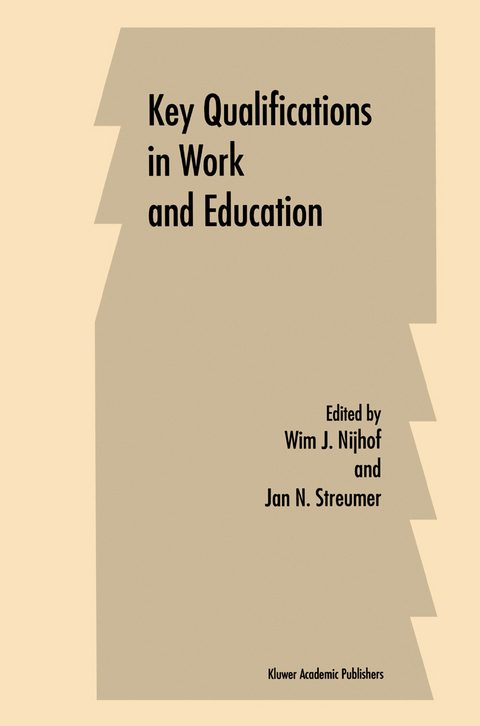
Key Qualifications in Work and Education
Springer (Verlag)
978-94-010-6190-2 (ISBN)
In today's rapidly changing world a constant renewal of knowledge and skills in every human endeavour can be observed. The characteristics of workers and the jobs that they perform have been attended by technological, social, and political change on a global scale. New forms of employment have made work more mobile to an extent never experienced before. An increasing proportion of workers no longer need come to their employer's job site in order to do their work. The instability of employment is creating a new breed of workers who know how to move efficiently from one job to another. As a consequence workers need flexible qualifications to perform jobs.
Key qualifications are the answer! Key qualifications provide the key to rapid and effective acquisition of new knowledge and skills. First, qualifications enable workers to react effectively to, and exercise initiative in, changes to their work. Second, qualifications enable workers to shape their own career in a time of diminishing job security, nowadays frequently defined as `employability'.
1. The Demarcation Issue: Introduction.- 1: The meaning of key qualifications.- 2. Qualifying for the Future.- 3. The Many Meanings of Occupational Competence and Qualification.- 4. Qualification and Labour Markets: Institutionalisation and Individualisation.- 5. The German ‘Berufsprinzip’ as a Model for Regulating Training Content and Qualification Standards.- 2: Qualification systems and programmes.- 6. The Demarcation Line in Funding for School-Based Vocational Education and Training in the United States.- 7. A Converging System? Explaining Difference in the Academic and Vocational Tracks in England.- 8. New Structures and New Contents in Dutch Vocational Education.- 9. General Versus Vocational Education — Demarcation and Integration.- 3: Key qualifications in research and practice.- 10. Occupational Standards and Business Ethics.- 11. Designing Effective Learning Programs for the Development of a Broad Occupational Competence.- 12. Generic Skills at Work: Implications for Occupationally-Oriented Education.- 13. Competence Based Assessment. Does it Shift the Demarcation Lines?.- 14. The Knowledge and Skills of Economics Graduates and their Significance on the Labour Market.- 4: Reflections.- 15. Moving Beyond Traditional Vocational Education and Training: Emerging Issues.- List of Contributors.
| Zusatzinfo | 274 p. |
|---|---|
| Verlagsort | Dordrecht |
| Sprache | englisch |
| Maße | 160 x 240 mm |
| Themenwelt | Sozialwissenschaften ► Pädagogik |
| Wirtschaft ► Betriebswirtschaft / Management ► Personalwesen | |
| Wirtschaft ► Volkswirtschaftslehre ► Makroökonomie | |
| ISBN-10 | 94-010-6190-4 / 9401061904 |
| ISBN-13 | 978-94-010-6190-2 / 9789401061902 |
| Zustand | Neuware |
| Informationen gemäß Produktsicherheitsverordnung (GPSR) | |
| Haben Sie eine Frage zum Produkt? |
aus dem Bereich