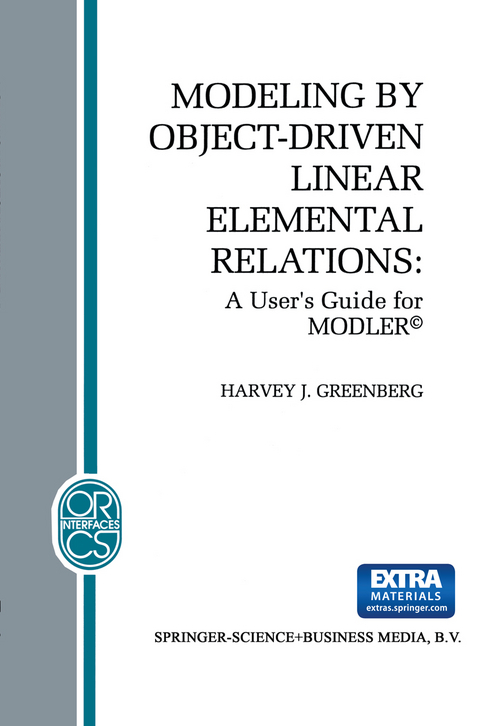
Modeling by Object-Driven Linear Elemental Relations
Springer-Verlag New York Inc.
978-1-4613-6388-0 (ISBN)
Chapter1 Overview, Installation, and Help.- 1.1 What you have and how to begin.- 1.2 Quick installation for DOS environment.- 1.3 Alternative environments.- 1.4 Some interactive language conventions.- 1.5 On-line documentation.- Chapter2 Anatomy of a Linear Program.- 2.1 Algebraic form.- 2.2 Model syntax.- 2.3 Objects and relations.- Chapter3 Preliminaries.- 3.1 The sign-on and basic interactive conventions.- 3.2 Elementary models and query.- 3.3 Randomization by command.- Chapter4 Models and Instances.- 4.1 Some precepts.- 4.2 More examples.- 4.3 Data objects.- 4.4 Randomization options.- Chapter5 Special Structures.- 5.1 Binary variables and logical constraints.- 5.2 Dynamic models.- 5.3 Approximation of nonlinear functions.- 5.4 Elastic programming.- Chapter6 The SUM Expression.- 6.1 Simple examples.- 6.2 Index conditions.- 6.3 Data conditions.- Chapter7 Dependencies.- 7.1 Set maps.- 7.2 Implicit sets.- 7.3 Implicit tables.- 7.4 The SHOW command.- Chapter8 File Interfaces.- 8.1 Environment controls.- 8.2 Dictionaries, documents, help, and keyword files.- 8.3 Execution files.- 8.4 Model files.- 8.5 Data files.- 8.6 Matrix and packed files.- 8.7 Schema and syntax files.- 8.8 Explain files.- Chapter9 More Model Description.- 9.1 Term expressions.- 9.2 A blending model.- 9.3 The REPORT execution file.- 9.4 Attribute inheritance.- 9.5 Equation conditions.- 9.6 Use of set maps.- Chapter10 Model Management.- 10.1 Overview.- 10.2 A case study.- 10.3 Using directories to aid model formulation.
| Reihe/Serie | Operations Research /Computer Science Interfaces Series ; 2 |
|---|---|
| Zusatzinfo | X, 163 p. |
| Verlagsort | New York, NY |
| Sprache | englisch |
| Maße | 155 x 235 mm |
| Themenwelt | Mathematik / Informatik ► Informatik ► Theorie / Studium |
| Mathematik / Informatik ► Mathematik ► Angewandte Mathematik | |
| Mathematik / Informatik ► Mathematik ► Finanz- / Wirtschaftsmathematik | |
| Wirtschaft ► Betriebswirtschaft / Management | |
| ISBN-10 | 1-4613-6388-8 / 1461363888 |
| ISBN-13 | 978-1-4613-6388-0 / 9781461363880 |
| Zustand | Neuware |
| Informationen gemäß Produktsicherheitsverordnung (GPSR) | |
| Haben Sie eine Frage zum Produkt? |
aus dem Bereich