


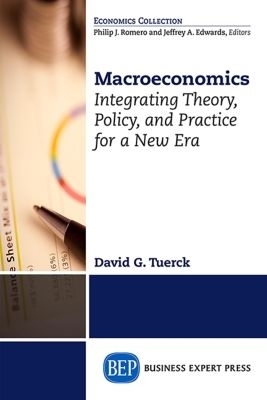
MACROECONOMICS: POLICIES FOR A
Seiten
2014
Business Expert Press (Verlag)
978-1-60649-676-3 (ISBN)
Business Expert Press (Verlag)
978-1-60649-676-3 (ISBN)
Provides a coherent approach to understanding the macro economy, one that avoids artificial distinctions between supply-side and demand-side policies and which goes to the heart of the policy issue, which concerns effects on relative and absolute prices and, through those effects, the ability of the economy to coordinate economic decisions.
Five years ago, macroeconomics texts reflected confidence in the 'great moderation,' which began in 1983 and ended in 2007. The dominant paradigm was the 'new classical model,' which predicts that economic downturns are self-correcting. The guiding principle of monetary policy was the 'Taylor Rule,' which, though not conceived in the tradition of the new classical economics, served the country well until it was abandoned in the last decade. The current economy is, by comparison, afflicted with persistent, low levels of employment that seem to invalidate the new classical model. The Taylor rule has been abandoned for one round after another of 'quantitative easing,' and the once-dominant Keynesian model has been brought back to life for the purpose of giving intellectual cover to fiscal-stimulus remedies. The approach consists of creating a model in which aggregate supply equals aggregate demand and in which policies falling under the label 'new-classical' appear on the supply side and policies falling under the label 'new-Keynesian' on the demand side of the economy. The new approach is to identify those policies (usually tax and regulatory policies) that operate on the supply side and those (monetary and fiscal policies) that operate on the demand side and then prescribe policy changes that will improve economic performance. In my opinion this approach ultimately fails - and for the simple reason that it confuses the distinction between supply and demand with the distinction between what matters, which is how government policies and shocks to the economy affect relative prices, on the one hand, and absolute (or average) prices and wages, on the other. I thus plan to provide the reader with a more coherent approach to understanding the macro economy, one that avoids artificial distinctions between supply-side and demand-side policies and which goes to the heart of the policy issue, which concerns effects on relative and absolute prices and, through those effects, the ability of the economy to coordinate economic decisions. The job of macroeconomics is to identify the two paths - the ideal and the actual - and to identify the policy changes that would bring the actual path closer to the ideal path. It will be the purpose of this book to do this job in a fashion that is accessible to the general reader.
Five years ago, macroeconomics texts reflected confidence in the 'great moderation,' which began in 1983 and ended in 2007. The dominant paradigm was the 'new classical model,' which predicts that economic downturns are self-correcting. The guiding principle of monetary policy was the 'Taylor Rule,' which, though not conceived in the tradition of the new classical economics, served the country well until it was abandoned in the last decade. The current economy is, by comparison, afflicted with persistent, low levels of employment that seem to invalidate the new classical model. The Taylor rule has been abandoned for one round after another of 'quantitative easing,' and the once-dominant Keynesian model has been brought back to life for the purpose of giving intellectual cover to fiscal-stimulus remedies. The approach consists of creating a model in which aggregate supply equals aggregate demand and in which policies falling under the label 'new-classical' appear on the supply side and policies falling under the label 'new-Keynesian' on the demand side of the economy. The new approach is to identify those policies (usually tax and regulatory policies) that operate on the supply side and those (monetary and fiscal policies) that operate on the demand side and then prescribe policy changes that will improve economic performance. In my opinion this approach ultimately fails - and for the simple reason that it confuses the distinction between supply and demand with the distinction between what matters, which is how government policies and shocks to the economy affect relative prices, on the one hand, and absolute (or average) prices and wages, on the other. I thus plan to provide the reader with a more coherent approach to understanding the macro economy, one that avoids artificial distinctions between supply-side and demand-side policies and which goes to the heart of the policy issue, which concerns effects on relative and absolute prices and, through those effects, the ability of the economy to coordinate economic decisions. The job of macroeconomics is to identify the two paths - the ideal and the actual - and to identify the policy changes that would bring the actual path closer to the ideal path. It will be the purpose of this book to do this job in a fashion that is accessible to the general reader.
David G. Tuerck, Professor of Economics and Executive Director of the Beacon Hill Institute for Public Policy Research, Suffolk University, UK.
| Verlagsort | Sterling Forest |
|---|---|
| Sprache | englisch |
| Maße | 150 x 231 mm |
| Gewicht | 380 g |
| Themenwelt | Wirtschaft ► Betriebswirtschaft / Management |
| Wirtschaft ► Volkswirtschaftslehre ► Makroökonomie | |
| ISBN-10 | 1-60649-676-X / 160649676X |
| ISBN-13 | 978-1-60649-676-3 / 9781606496763 |
| Zustand | Neuware |
| Informationen gemäß Produktsicherheitsverordnung (GPSR) | |
| Haben Sie eine Frage zum Produkt? |
Mehr entdecken
aus dem Bereich

aus dem Bereich
Buch | Softcover (2024)
Schäffer-Poeschel (Verlag)
CHF 48,95
Makroökonomie, Wirtschaftspolitik und nachhaltige Entwicklung
Buch | Hardcover (2022)
Vahlen (Verlag)
CHF 69,70
Kontroversen, Daten und Fakten zur Nachhaltigkeit
Buch | Softcover (2025)
Kohlhammer (Verlag)
CHF 54,60


