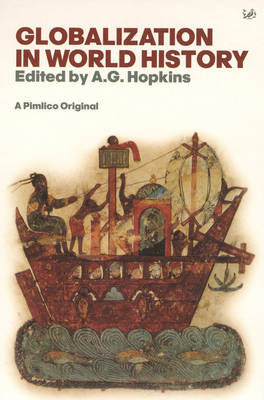
Globalisation In World History (eBook)
288 Seiten
Random House (Verlag)
978-1-4464-2682-1 (ISBN)
Globalisation was the buzzword of the 1990s, it promises to become even more important in the first decade of the new century. There is now a flood of literature on the economics, politics and sociology of globalization, and regular commentary in the serious daily and weekly press.
Virtually all of this discussion makes assumptions, and frequently explicit claims, about the novelty of globalisation. According to one view, the globalisation is a new phenomenon that can be dated from the 1980s. A second view holds that globalisation has a long history that can be traced back to the nineteenth century, if not earlier. The importance of these themes scarcely needs elaborating. Yet they have still to attract significant attention from historians. This volume is the first by a team of historians to address these issues.
Globalisation in World History has two distinctive features. First, it offers a categorisation of types and stages of globalisation that existed before the late twentieth century, No such taxonomy exists at present. Secondly, it emphasises a feature that the current debate greatly underestimates: the fact that globalisation has non-Western as well as Western origins. Globalisation is much more than the 'rise of the West' presented in new terminology. The contributors bring their expertise to bear on themes that give prominence to China, South Asia, Africa and the world of Islam as well as to Europe and the United States, and span the last three centuries while also showing an awareness of more distant antecedents. The result is a coherent and thought-provoking collection of essays. Globalisation will become a major theme of historical research during the next decade, this book will help to set the new agenda.
Globalisation was the buzzword of the 1990s; it promises to become even more important in the first decade of the new century. There is now a flood of literature on the economics, politics and sociology of globalization, and regular commentary in the serious daily and weekly press. Virtually all of this discussion makes assumptions, and frequently explicit claims, about the novelty of globalisation. According to one view, the globalisation is a new phenomenon that can be dated from the 1980s. A second view holds that globalisation has a long history that can be traced back to the nineteenth century, if not earlier. The importance of these themes scarcely needs elaborating. Yet they have still to attract significant attention from historians. This volume is the first by a team of historians to address these issues. Globalisation in World History has two distinctive features. First, it offers a categorisation of types and stages of globalisation that existed before the late twentieth century, No such taxonomy exists at present. Secondly, it emphasises a feature that the current debate greatly underestimates: the fact that globalisation has non-Western as well as Western origins. Globalisation is much more than the 'rise of the West' presented in new terminology. The contributors bring their expertise to bear on themes that give prominence to China, South Asia, Africa and the world of Islam as well as to Europe and the United States, and span the last three centuries while also showing an awareness of more distant antecedents. The result is a coherent and thought-provoking collection of essays. Globalisation will become a major theme of historical research during the next decade; this book will help to set the new agenda.
| Erscheint lt. Verlag | 22.2.2011 |
|---|---|
| Sprache | englisch |
| Themenwelt | Sachbuch/Ratgeber |
| Geschichte ► Allgemeine Geschichte ► Neuzeit (bis 1918) | |
| Geschichte ► Teilgebiete der Geschichte ► Wirtschaftsgeschichte | |
| Sozialwissenschaften ► Soziologie | |
| Technik | |
| Wirtschaft ► Volkswirtschaftslehre ► Makroökonomie | |
| ISBN-10 | 1-4464-2682-3 / 1446426823 |
| ISBN-13 | 978-1-4464-2682-1 / 9781446426821 |
| Informationen gemäß Produktsicherheitsverordnung (GPSR) | |
| Haben Sie eine Frage zum Produkt? |
 EPUB (Adobe DRM)
Kopierschutz: Adobe-DRM
Adobe-DRM ist ein Kopierschutz, der das eBook vor Mißbrauch schützen soll. Dabei wird das eBook bereits beim Download auf Ihre persönliche Adobe-ID autorisiert. Lesen können Sie das eBook dann nur auf den Geräten, welche ebenfalls auf Ihre Adobe-ID registriert sind.
Details zum Adobe-DRM
Dateiformat: EPUB (Electronic Publication)
EPUB ist ein offener Standard für eBooks und eignet sich besonders zur Darstellung von Belletristik und Sachbüchern. Der Fließtext wird dynamisch an die Display- und Schriftgröße angepasst. Auch für mobile Lesegeräte ist EPUB daher gut geeignet.
Systemvoraussetzungen:
PC/Mac: Mit einem PC oder Mac können Sie dieses eBook lesen. Sie benötigen eine
eReader: Dieses eBook kann mit (fast) allen eBook-Readern gelesen werden. Mit dem amazon-Kindle ist es aber nicht kompatibel.
Smartphone/Tablet: Egal ob Apple oder Android, dieses eBook können Sie lesen. Sie benötigen eine
Geräteliste und zusätzliche Hinweise
Buying eBooks from abroad
For tax law reasons we can sell eBooks just within Germany and Switzerland. Regrettably we cannot fulfill eBook-orders from other countries.
aus dem Bereich