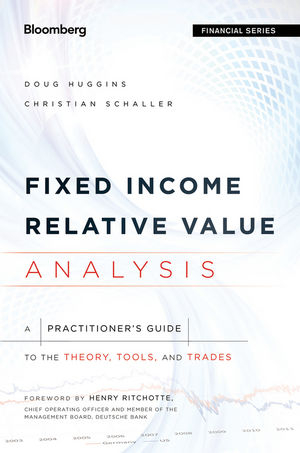
Fixed Income Relative Value Analysis (eBook)
John Wiley & Sons (Verlag)
978-1-118-47721-2 (ISBN)
Taking a practitioner's point of view, the book presents the theory behind market analysis in connection with tools for finding and expressing trade ideas. The extensive use of actual market examples illustrates the ways these analytic tools can be applied in practice.
The book covers:
- Statistical models for quantitative market analysis, in particular mean reversion models and principal component analysis.
- An in-depth approach to understanding swap spreads in theory and in practice.
- A comprehensive discussion of the various basis swaps and their combinations.
- The incorporation of credit default swaps in yield curve analysis.
- A classification of option trades, with appropriate analysis tools for each category.
- Fitted curve techniques for identifying relative value among different bonds.
- A multi-factor delivery option model for bond future contracts.
Fixed Income Relative Value Analysis provides an insightful presentation of the relevant statistical and financial theories, a detailed set of statistical and financial tools derived from these theories, and a multitude of actual trades resulting from the application of these tools to the fixed income markets. As such, it's an indispensable guide for relative value analysts, relative value traders, and portfolio managers for whom security selection and hedging are part of the investment process.
Doug Huggins has been working in the fixed income markets in the US and Europe for 25 years. He managed the European fixed income relative value research group at Deutsche Bank in the late 90's, when the group was voted best in its class for three consecutive years by the readers of Global Investor Magazine. He joined ABN AMRO in 2001 as Global Head of Fixed Income Relative Value Research, and subsequently became the firm's Global Head of Hedge Fund Sales. In 2003, he started a proprietary trading desk at ABN, focusing on fixed income relative value opportunities. He continued a career as a relative value trader in the London offices of two global hedge funds: Citadel and Old Lane.
Doug has a Ph.D. in financial economics and statistics from the University of Chicago and has focused throughout his career on developing financial and statistical models for the purpose of identifying relative value opportunities in global markets. In both Research and Trading, Doug has applied these models successfully to generate attractive risk-adjusted returns for clients and the firms for which he's traded. Doug is currently applying relative value models to the energy and agricultural markets as a managing director of Starsupply Commodity Brokers in London.
Christian Schaller earned a Ph.D. in Mathematics at the University of Bonn, Germany before learning the tools of the fixed income trade in the Relative Value team at Deutsche Bank, managed by Anshu Jain. Over time, he's made a number of original contributions, particularly in the areas of principal component analysis and basis swap modeling. While responsible for Deutsche Bank's research in Tokyo, he was voted 'best relative value researcher' by customers in the Greenwich survey.
As Global Head of Leveraged Investment Strategy at ABN AMRO, Christian used his skill to translate mathematical theory into profitable trading positions for the firm's most demanding clients, including hedge funds, proprietary trading desks, central banks, and other financial institutions. In 2004, Christian founded Shinzenbi, a consulting firm based in Japan, advising investment banks on the development, training, and management of quantitative research teams.
In early 2013, Christian and Doug created Quantitative Markets Analysis Ltd, a London-based firm helping financial organizations apply quantitative methods to identify relative value opportunities in global markets. In addition to financial software, Quantitative Markets Analysis provides consulting services, including staff training and the design and implementation of bespoke systems for pre-trade and post-trade analytics.
As western governments issue increasing amounts of debt, the fixed income markets have never been more important. Yet the methods for analyzing these markets have failed to keep pace with recent developments, including the deterioration in the credit quality of many sovereign issuers. In Fixed Income Relative Value Analysis, Doug Huggins and Christian Schaller address this gap with a set of analytic tools for assessing value in the markets for government bonds, interest rate swaps, and related basis swaps, as well as associated futures and options. Taking a practitioner s point of view, the book presents the theory behind market analysis in connection with tools for finding and expressing trade ideas. The extensive use of actual market examples illustrates the ways these analytic tools can be applied in practice. The book covers:Statistical models for quantitative market analysis, in particular mean reversion models and principal component analysis.An in-depth approach to understanding swap spreads in theory and in practice. A comprehensive discussion of the various basis swaps and their combinations. The incorporation of credit default swaps in yield curve analysis. A classification of option trades, with appropriate analysis tools for each category. Fitted curve techniques for identifying relative value among different bonds. A multi-factor delivery option model for bond future contracts. Fixed Income Relative Value Analysis provides an insightful presentation of the relevant statistical and financial theories, a detailed set of statistical and financial tools derived from these theories, and a multitude of actual trades resulting from the application of these tools to the fixed income markets. As such, it s an indispensable guide for relative value analysts, relative value traders, and portfolio managers for whom security selection and hedging are part of the investment process.
Doug Huggins has been working in the fixed income markets in the US and Europe for 25 years. He managed the European fixed income relative value research group at Deutsche Bank in the late 90's, when the group was voted best in its class for three consecutive years by the readers of Global Investor Magazine. He joined ABN AMRO in 2001 as Global Head of Fixed Income Relative Value Research, and subsequently became the firm's Global Head of Hedge Fund Sales. In 2003, he started a proprietary trading desk at ABN, focusing on fixed income relative value opportunities. He continued a career as a relative value trader in the London offices of two global hedge funds: Citadel and Old Lane. Doug has a Ph.D. in financial economics and statistics from the University of Chicago and has focused throughout his career on developing financial and statistical models for the purpose of identifying relative value opportunities in global markets. In both Research and Trading, Doug has applied these models successfully to generate attractive risk-adjusted returns for clients and the firms for which he's traded. Doug is currently applying relative value models to the energy and agricultural markets as a managing director of Starsupply Commodity Brokers in London. Christian Schaller earned a Ph.D. in Mathematics at the University of Bonn, Germany before learning the tools of the fixed income trade in the Relative Value team at Deutsche Bank, managed by Anshu Jain. Over time, he's made a number of original contributions, particularly in the areas of principal component analysis and basis swap modeling. While responsible for Deutsche Bank's research in Tokyo, he was voted "best relative value researcher" by customers in the Greenwich survey. As Global Head of Leveraged Investment Strategy at ABN AMRO, Christian used his skill to translate mathematical theory into profitable trading positions for the firm's most demanding clients, including hedge funds, proprietary trading desks, central banks, and other financial institutions. In 2004, Christian founded Shinzenbi, a consulting firm based in Japan, advising investment banks on the development, training, and management of quantitative research teams. In early 2013, Christian and Doug created Quantitative Markets Analysis Ltd, a London-based firm helping financial organizations apply quantitative methods to identify relative value opportunities in global markets. In addition to financial software, Quantitative Markets Analysis provides consulting services, including staff training and the design and implementation of bespoke systems for pre-trade and post-trade analytics.
Foreword by Henry Ritchotte Relative Value: a Practitioner's Guide vii
Introduction
Chapter 1 Relative Value 1
Part I: Statistical Models 17
Chapter 2 Mean Reversion 19
Chapter 3 Principal Component Analysis 51
Part II Financial Models 113
Chapter 4 Some Comments on Yield, Duration, and Convexity 115
Chapter 5 Bond Futures Contracts 121
Chapter 6 LIBOR, OIS Rates, and Repo Rates 137
Chapter 7 Intra-Currency Basis Swaps 153
Chapter 8 Theoretical Determinants of Swap Spreads 157
Chapter 9 Swap Spreads from an Empirical Perspective 169
Chapter 10 Swap Spreads as Relative Value Indicators for Government Bonds 185
Chapter 11 Fitted Bond Curves 193
Chapter 12 A Brief Comment on Interpolated Swap Spreads 207
Chapter 13 Cross-Currency Basis Swaps 211
Chapter 14 Relative Values of Bonds Denominated in Different Currencies 223
Chapter 15 Credit Default Swaps 245
Chapter 16 USD Asset Swap Spreads versus Credit Default Swaps 273
Chapter 17 Options 299
Epilogue
Chapter 18 Relative Value in a Broader Perspective 349
Bibliography 357
Index 359
Chapter 2
Mean Reversion
What Is Mean Reversion and How Does It Help Us?
Mean reversion is one of the most fundamental concepts underpinning relative value analysis. But while mean reversion is widely understood at an intuitive level, surprisingly few analysts are familiar with the specific tools available for characterizing mean-reverting processes.
In this chapter, we discuss some of the key characteristics of mean-reverting processes and the mean reversion tools that can be used to identify attractive trading opportunities. In particular, we address:
- model selection;
- model estimation;
- calculating conditional expectations and probabilities;
- calculating ex ante risk-adjusted returns, particularly Sharpe ratios;
- calculating first passage times, also known as stopping times.
For each concept, we start with a verbal and intuitive description of the concept, followed by a mathematical definition of the concept, and finish with an example application of the concept to market data.
A variable is said to exhibit mean reversion if it shows a tendency to return to its long-term average over time. Mathematicians will object that this definition is simply an exercise in replacing the words “exhibit”, “mean”, and “reversion” with the synonyms “shows”, “long-term average”, and “return”. To address such objections, we’ll provide a more mathematical definition shortly. But first we’ll attempt to establish some further intuition about mean-reverting processes. To some extent, Justice Stewart’s famous maxim on pornography, “I know it when I see it”, applies to mean reversion. With that in mind, let’s take a look at some processes that exhibit mean reversion and a few that don’t.
Figure 2.1 and Figure 2.2 show two simulated time series. Both have an initial value of zero, and both have identical volatilities. But one is constructed to be a simple random walk, with zero drift, while the other is constructed to have a tendency to return toward its long-run mean, constructed to be zero in this example. In fact, the two series were constructed with identical normal random variates. In the case of the random walk, the mean of each observation was the value of the previous observation, so that the process was a martingale. In the case of the mean-reverting process, the mean of each observation was set to reflect the tendency for the process to return to the mean. At this point, we’d hope most readers would identify Figure 2.2 as the one with the mean-reverting variable. If we observe both figures closely, we can see that the mean-reverting process is in some sense a transformation of the random walk in Figure 2.1.
FIGURE 2.1 Simulated random walk.
Source: Authors.
FIGURE 2.2 Simulated mean-reverting process.
Source: Authors.
The speed with which a variable tends to revert toward its mean can vary. For example, Figure 2.3 and Figure 2.4 show time series that were simulated using the same random normal variates that generated the mean-reverting variable in Figure 2.2 but with an important difference. The variable in Figure 2.3 was constructed to have a faster speed of mean reversion than the variable in Figure 2.2, while the variable in Figure 2.4 was constructed to have a still faster speed of mean reversion.
FIGURE 2.3 Simulated mean-reverting process: Faster mean reversion.
Source: Authors.
FIGURE 2.4 Simulated mean-reverting process: Even faster mean reversion.
Source: Authors.
While it’s well and good to consider variables simulated via known equations by a computer, traders and analysts have to make judgments about real-world data, which are almost always messier in some respects than simulated data. So it’s also useful to consider a few real-world examples.
Figure 2.5 shows the spot price of gold in US dollars since January 1975. In our view, the strong upward drift exhibited in this series makes it a poor candidate to be modeled by a mean-reverting process.
FIGURE 2.5 Spot price of gold in US dollars since January 1975.
Source: Bloomberg.
Figure 2.6 shows the realized volatility of the ten-year (10Y) US Treasury yield since January 1962. Given that this series has repeatedly returned to a long-run mean in the past, it appears to be a relatively good candidate for modeling with a mean-reverting process.
FIGURE 2.6 Realized volatility of 10Y US Treasury bond yield (bp/year).
Source: Bloomberg.
As another example, Figure 2.7 shows the 2Y/5Y/10Y butterfly spread along the USD swap curve since 1998. Given the number of times during the sample that this spread returns to its long-run mean, we consider it another good candidate for modeling with a mean-reverting process.
FIGURE 2.7 2/5/10 butterfly spread along USD swap curve since 1988.
Source: Bloomberg.
Mathematical Definitions
Having provided verbal and graphical intuition regarding mean reversion, it’s time to attempt to provide a few useful mathematical definitions.
Stochastic Differential Equation
First, we’ll provide a brief definition of a stochastic differential equation (SDE). In practice, this term is fairly simple to define, as most of the definition is contained within the name. In other words, it’s an equation that characterizes the random behavior of a variable over an infinitesimal period of time. As a result, it gives us the data-generating mechanism for the variable. For example, the equation would allow us to simulate the variable over time using a computer.
For example, dxt = k(μ−xt)dt + σdWt is the SDE for an Ornstein–Uhlenbeck (OU) process, the continuous-time limit of a first-order autoregressive process. The OU process is a popular SDE for modeling mean-reverting variables, as it has moments and densities that can be expressed analytically. In this equation, dxt is the change in the value of the random variable x at time t, over the infinitesimal interval dt. The speed of mean reversion is given by the parameter k and the long-run mean of the variable is given by μ. The instantaneous volatility of the variable is given by σ, and the term dWt is the change in the value of Wt over the instantaneous time interval dt. In fact, Wt is ultimately the source of randomness that drives the process in this equation. In particular, Wt is a pure random walk, often referred to as Gaussian white noise. Wt is also referred to as a Wiener process, after the American mathematician Norbert Wiener.
In general, SDEs take the form
The term f(xt) is the drift coefficient of the equation, and it defines the mean of the process. The term g(xt) is the diffusion coefficient of the equation, and it defines the volatility of the process.
Conditional Density
Next, we’ll define the conditional density of a process, also referred to as a transition density. In particular, the conditional density gives us the probability density for the future value of a random variable conditional on knowing some other information about the variable. In the case of a time series process, the conditioning information is usually some earlier value of the variable. For example, in the case of the OU process, the transition density of xt+τ for τ > 0 is a normal density with mean given by μ + (xt − μ)e−kτ and with a variance given by .
Unconditional Density
The unconditional density of a process is the probability density for the future value of a random variable without being able to condition the density on any additional information. You could think of the unconditional density as the histogram that would result from simulating the process over an infinitely long period. More precisely, it’s the limit of the conditional density p(xt+τ) as τ goes to infinity. So in the case of the OU process, the unconditional density is a normal density with mean given by μ and with variance given by .
Stationary Densities and Mean-Reverting Processes
In some cases, a variable will have a conditional density, but it won’t have an unconditional density. In other words, the limit of the conditional density p(xt) won’t converge to a limiting density.
A simple example of this would be a random walk with drift, given by the SDE dxt = ρdt + σdWt. The transition density or unconditional density for this process is normal...
| Erscheint lt. Verlag | 20.5.2013 |
|---|---|
| Reihe/Serie | Bloomberg Financial |
| Bloomberg Professional | Bloomberg Professional |
| Sprache | englisch |
| Themenwelt | Recht / Steuern ► Wirtschaftsrecht |
| Wirtschaft ► Betriebswirtschaft / Management ► Finanzierung | |
| Schlagworte | amounts • Analytic • Assessing • credit • debt • Deterioration • Finance & Investments • Finanz- u. Anlagewesen • Fixed • Governments • Huggins • important • income • income relative • increasing • Investments & Securities • Issue • issuers • Kapitalanlage • Kapitalanlagen u. Wertpapiere • many • Markets • Methods • Pace • quality • Recent Developments • Sovereign • Western |
| ISBN-10 | 1-118-47721-9 / 1118477219 |
| ISBN-13 | 978-1-118-47721-2 / 9781118477212 |
| Informationen gemäß Produktsicherheitsverordnung (GPSR) | |
| Haben Sie eine Frage zum Produkt? |
 EPUB (Adobe DRM)
Kopierschutz: Adobe-DRM
Adobe-DRM ist ein Kopierschutz, der das eBook vor Mißbrauch schützen soll. Dabei wird das eBook bereits beim Download auf Ihre persönliche Adobe-ID autorisiert. Lesen können Sie das eBook dann nur auf den Geräten, welche ebenfalls auf Ihre Adobe-ID registriert sind.
Details zum Adobe-DRM
Dateiformat: EPUB (Electronic Publication)
EPUB ist ein offener Standard für eBooks und eignet sich besonders zur Darstellung von Belletristik und Sachbüchern. Der Fließtext wird dynamisch an die Display- und Schriftgröße angepasst. Auch für mobile Lesegeräte ist EPUB daher gut geeignet.
Systemvoraussetzungen:
PC/Mac: Mit einem PC oder Mac können Sie dieses eBook lesen. Sie benötigen eine
eReader: Dieses eBook kann mit (fast) allen eBook-Readern gelesen werden. Mit dem amazon-Kindle ist es aber nicht kompatibel.
Smartphone/Tablet: Egal ob Apple oder Android, dieses eBook können Sie lesen. Sie benötigen eine
Geräteliste und zusätzliche Hinweise
Buying eBooks from abroad
For tax law reasons we can sell eBooks just within Germany and Switzerland. Regrettably we cannot fulfill eBook-orders from other countries.
aus dem Bereich