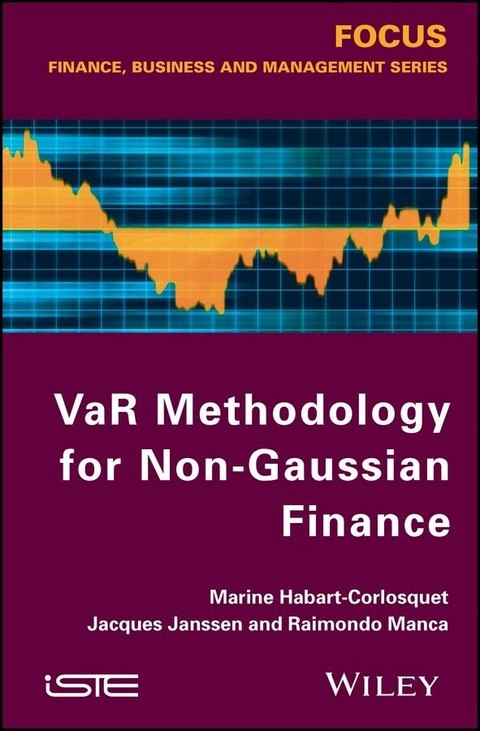
VaR Methodology for Non-Gaussian Finance (eBook)
John Wiley & Sons (Verlag)
978-1-118-73390-5 (ISBN)
With the impact of the recent financial crises, more attention must be given to new models in finance rejecting 'Black-Scholes-Samuelson' assumptions leading to what is called non-Gaussian finance. With the growing importance of Solvency II, Basel II and III regulatory rules for insurance companies and banks, value at risk (VaR) - one of the most popular risk indicator techniques plays a fundamental role in defining appropriate levels of equities. The aim of this book is to show how new VaR techniques can be built more appropriately for a crisis situation.
VaR methodology for non-Gaussian finance looks at the importance of VaR in standard international rules for banks and insurance companies; gives the first non-Gaussian extensions of VaR and applies several basic statistical theories to extend classical results of VaR techniques such as the NP approximation, the Cornish-Fisher approximation, extreme and a Pareto distribution. Several non-Gaussian models using Copula methodology, Lévy processes along with particular attention to models with jumps such as the Merton model are presented; as are the consideration of time homogeneous and non-homogeneous Markov and semi-Markov processes and for each of these models.
Contents
1. Use of Value-at-Risk (VaR) Techniques for Solvency II, Basel II and III.
2. Classical Value-at-Risk (VaR) Methods.
3. VaR Extensions from Gaussian Finance to Non-Gaussian Finance.
4. New VaR Methods of Non-Gaussian Finance.
5. Non-Gaussian Finance: Semi-Markov Models.
Marine Habart-Corlosquet is a Qualified and Certified Actuary at BNP Paribas Cardif, Paris, France. She is co-director of EURIA (Euro-Institut d'Actuariat, University of West Brittany, Brest, France), and associate researcher at Telecom Bretagne (Brest, France) as well as a board member of the French Institute of Actuaries. She teaches at EURIA, Telecom Bretagne and Ecole Centrale Paris (France). Her main research interests are pandemics, Solvency II internal models and ALM issues for insurance companies.
Jacques Janssen is now Honorary Professor at the Solvay Business School (ULB) in Brussels, Belgium, having previously taught at EURIA (Euro-Institut d'Actuariat, University of West Brittany, Brest, France) and Telecom Bretagne (Brest, France) as well as being a director of Jacan Insurance and Finance Services, a consultancy and training company.
Raimondo Manca is Professor of mathematical methods applied to economics, finance and actuarial science at University of Roma 'La Sapienza' in Italy. He is associate editor for the journal Methodology and Computing in Applied Probability. His main research interests are multidimensional linear algebra, computational probability, application of stochastic processes to economics, finance and insurance and simulation models.
With the impact of the recent financial crises, more attention must be given to new models in finance rejecting Black-Scholes-Samuelson assumptions leading to what is called non-Gaussian finance. With the growing importance of Solvency II, Basel II and III regulatory rules for insurance companies and banks, value at risk (VaR) one of the most popular risk indicator techniques plays a fundamental role in defining appropriate levels of equities. The aim of this book is to show how new VaR techniques can be built more appropriately for a crisis situation. VaR methodology for non-Gaussian finance looks at the importance of VaR in standard international rules for banks and insurance companies; gives the first non-Gaussian extensions of VaR and applies several basic statistical theories to extend classical results of VaR techniques such as the NP approximation, the Cornish-Fisher approximation, extreme and a Pareto distribution. Several non-Gaussian models using Copula methodology, L vy processes along with particular attention to models with jumps such as the Merton model are presented; as are the consideration of time homogeneous and non-homogeneous Markov and semi-Markov processes and for each of these models.
Marine Habart-Corlosquet is a Qualified and Certified Actuary at BNP Paribas Cardif, Paris, France. She is co-director of EURIA (Euro-Institut d'Actuariat, University of West Brittany, Brest, France), and associate researcher at Telecom Bretagne (Brest, France) as well as a board member of the French Institute of Actuaries. She teaches at EURIA, Telecom Bretagne and Ecole Centrale Paris (France). Her main research interests are pandemics, Solvency II internal models and ALM issues for insurance companies. Jacques Janssen is now Honorary Professor at the Solvay Business School (ULB) in Brussels, Belgium, having previously taught at EURIA (Euro-Institut d'Actuariat, University of West Brittany, Brest, France) and Telecom Bretagne (Brest, France) as well as being a director of Jacan Insurance and Finance Services, a consultancy and training company. Raimondo Manca is Professor of mathematical methods applied to economics, finance and actuarial science at University of Roma "La Sapienza" in Italy. He is associate editor for the journal Methodology and Computing in Applied Probability. His main research interests are multidimensional linear algebra, computational probability, application of stochastic processes to economics, finance and insurance and simulation models.
INTRODUCTION ix
CHAPTER 1. USE OF VALUE-AT-RISK (VAR) TECHNIQUES FOR SOLVENCY
II, BASEL II AND III 1
1.1. Basic notions of VaR 1
1.2. The use of VaR for insurance companies 6
1.3. The use of VaR for banks 13
1.4. Conclusion 16
CHAPTER 2. CLASSICAL VALUE-AT-RISK (VAR) METHODS 17
2.1. Introduction 17
2.2. Risk measures 18
2.3. General form of the VaR 19
2.4. VaR extensions: tail VaR and conditional VaR 25
2.5. VaR of an asset portfolio 28
2.6. A simulation example: the rates of investment of assets
32
CHAPTER 3. VAR EXTENSIONS FROM GAUSSIAN FINANCE TO
NON-GAUSSIAN FINANCE 35
3.1. Motivation 35
3.2. The normal power approximation 37
3.3. VaR computation with extreme values 40
3.4. VaR value for a risk with Pareto distribution 56
3.5. Conclusion 62
CHAPTER 4. NEW VAR METHODS OF NON-GAUSSIAN FINANCE 63
4.1. Lévy processes 63 model with jumps 76
4.2. Copula models and VaR techniques 90
4.3. VaR for insurance 109
CHAPTER 5. NON-GAUSSIAN FINANCE: SEMI-MARKOV MODELS
115
5.1. Introduction 115
5.2. Homogeneous semi-Markov process 116
5.3. Semi-Markov option model 139
5.4. Semi-Markov VaR models 143
5.5. The Semi-Markov Monte Carlo Model in a homogeneous
environment 147
CONCLUSION 159
BIBLIOGRAPHY 161
INDEX 165
| Erscheint lt. Verlag | 6.5.2013 |
|---|---|
| Sprache | englisch |
| Themenwelt | Recht / Steuern ► Wirtschaftsrecht |
| Wirtschaft ► Betriebswirtschaft / Management ► Finanzierung | |
| Schlagworte | asset • Assets • Banks • BASIC • classical valueatrisk • companies • Conditional • Finance & Investments • Financial Engineering • Finanztechnik • Finanz- u. Anlagewesen • insurance • Introduction • notions • Portfolio • rates • Simulation • solvency • tail • techniques • use • valueatrisk var • VaR • var extensions |
| ISBN-10 | 1-118-73390-8 / 1118733908 |
| ISBN-13 | 978-1-118-73390-5 / 9781118733905 |
| Informationen gemäß Produktsicherheitsverordnung (GPSR) | |
| Haben Sie eine Frage zum Produkt? |
 PDF (Adobe DRM)
Kopierschutz: Adobe-DRM
Adobe-DRM ist ein Kopierschutz, der das eBook vor Mißbrauch schützen soll. Dabei wird das eBook bereits beim Download auf Ihre persönliche Adobe-ID autorisiert. Lesen können Sie das eBook dann nur auf den Geräten, welche ebenfalls auf Ihre Adobe-ID registriert sind.
Details zum Adobe-DRM
Dateiformat: PDF (Portable Document Format)
Mit einem festen Seitenlayout eignet sich die PDF besonders für Fachbücher mit Spalten, Tabellen und Abbildungen. Eine PDF kann auf fast allen Geräten angezeigt werden, ist aber für kleine Displays (Smartphone, eReader) nur eingeschränkt geeignet.
Systemvoraussetzungen:
PC/Mac: Mit einem PC oder Mac können Sie dieses eBook lesen. Sie benötigen eine
eReader: Dieses eBook kann mit (fast) allen eBook-Readern gelesen werden. Mit dem amazon-Kindle ist es aber nicht kompatibel.
Smartphone/Tablet: Egal ob Apple oder Android, dieses eBook können Sie lesen. Sie benötigen eine
Geräteliste und zusätzliche Hinweise
Buying eBooks from abroad
For tax law reasons we can sell eBooks just within Germany and Switzerland. Regrettably we cannot fulfill eBook-orders from other countries.
aus dem Bereich