


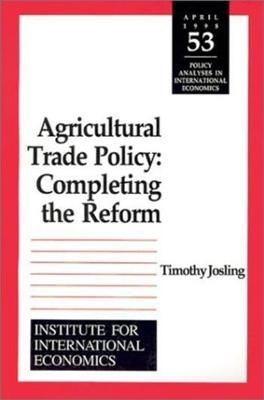
Agricultural Trade Policy – Completing the Reform
Seiten
1998
The Peterson Institute for International Economics (Verlag)
978-0-88132-256-9 (ISBN)
The Peterson Institute for International Economics (Verlag)
978-0-88132-256-9 (ISBN)
The Uruguay Round Agreement on Agriculture (URAA) replaced non-tariff barriers with bound tariffs, curbed subsidies, and codified domestic agricultural programmes. This study argues that multilateral, regional, and unilateral paths could be coordinated to liberalize agricultual trade.
The Uruguay Round trade negotiations marked a historic turning point in the reform of agricultural trade. The Uruguay Round Agreement on Agriculture (URAA) replaced nontariff barriers with bound tariffs, curbed export subsidies, and codified domestic agricultural programs. Unfortunately, the URAA bound many of the tariffs that replaced nontariff barriers too high, it legitimized export subsidies, and it left the domestic farm policies of the major industrial countries largely untouched. Fortunately, regional trade institutions have also begun to grapple with agricultural trade liberalization. Agriculture was featured in the Mercosur agreement, in recent agreements between the European Union and the countries of Central and Eastern Europe, and in the North American Free Trade Area (NAFTA). Plans for broad supraregional trade structures, such as the Asia Pacific Economic Cooperation (APEC) forum and the Free Trade Area of the Americas (FTAA), have also dealt with the inclusion of agricultural trade. Meanwhile, in developing and middle-income countries, unilateral agricultural policy reforms have been part of recent economic policy changes.
However, in the industrial countries, agricultural policy reform has languished in the face of much domestic opposition. But the reform of the European Union's Common Agricultural Policy (CAP) in 1992 and the 1996 Farm Bill in the United States seems to have ushered in a new era of relations between government and agricultural groups. The author points out ways that multilateral, regional, and unilateral paths could be coordinated to liberalized agricultural trade. He proposes a set of multilateral talks that would benefit from agricultural reform at all levels and complete the job begun at the Uruguay Round.
The Uruguay Round trade negotiations marked a historic turning point in the reform of agricultural trade. The Uruguay Round Agreement on Agriculture (URAA) replaced nontariff barriers with bound tariffs, curbed export subsidies, and codified domestic agricultural programs. Unfortunately, the URAA bound many of the tariffs that replaced nontariff barriers too high, it legitimized export subsidies, and it left the domestic farm policies of the major industrial countries largely untouched. Fortunately, regional trade institutions have also begun to grapple with agricultural trade liberalization. Agriculture was featured in the Mercosur agreement, in recent agreements between the European Union and the countries of Central and Eastern Europe, and in the North American Free Trade Area (NAFTA). Plans for broad supraregional trade structures, such as the Asia Pacific Economic Cooperation (APEC) forum and the Free Trade Area of the Americas (FTAA), have also dealt with the inclusion of agricultural trade. Meanwhile, in developing and middle-income countries, unilateral agricultural policy reforms have been part of recent economic policy changes.
However, in the industrial countries, agricultural policy reform has languished in the face of much domestic opposition. But the reform of the European Union's Common Agricultural Policy (CAP) in 1992 and the 1996 Farm Bill in the United States seems to have ushered in a new era of relations between government and agricultural groups. The author points out ways that multilateral, regional, and unilateral paths could be coordinated to liberalized agricultural trade. He proposes a set of multilateral talks that would benefit from agricultural reform at all levels and complete the job begun at the Uruguay Round.
Timothy E. Josling was a Visitng Scholar whose research focuses on agricultural policy and food policy in industrialized nations; international trade in agricultural and food products; and the development of the multilateral trade regime. His recent research topics include the reform of the agricultural trading system in the World Trade Organization; the treatment of agriculture in bilateral trade agreements; the use of geographical indications in food markets; the role of health and safety regulations in trade; the impact of climate change legislation on agricultural trade policies; and the treatment of biofuel subsidies in the WTO.
| Erscheint lt. Verlag | 1.4.1998 |
|---|---|
| Reihe/Serie | Policy Analyses in International Economics |
| Verlagsort | Washington |
| Sprache | englisch |
| Maße | 153 x 229 mm |
| Gewicht | 222 g |
| Themenwelt | Wirtschaft ► Volkswirtschaftslehre ► Makroökonomie |
| Weitere Fachgebiete ► Land- / Forstwirtschaft / Fischerei | |
| ISBN-10 | 0-88132-256-3 / 0881322563 |
| ISBN-13 | 978-0-88132-256-9 / 9780881322569 |
| Zustand | Neuware |
| Informationen gemäß Produktsicherheitsverordnung (GPSR) | |
| Haben Sie eine Frage zum Produkt? |
Mehr entdecken
aus dem Bereich


aus dem Bereich
Kompakt und prüfungsrelevant für Wirtschaftswissenschaftler
Buch | Softcover (2021)
Vahlen, Franz (Verlag)
CHF 16,65
Buch | Softcover (2024)
Schäffer-Poeschel (Verlag)
CHF 48,95
Kontroversen, Daten und Fakten zur Nachhaltigkeit
Buch | Softcover (2025)
Kohlhammer (Verlag)
CHF 54,60


