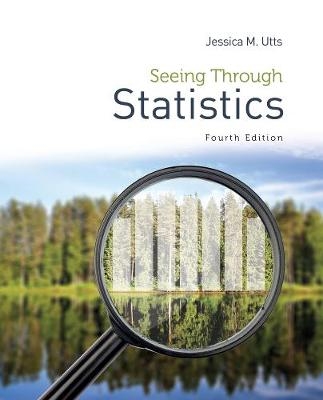
Seeing Through Statistics
Brooks/Cole (Verlag)
978-1-285-05088-1 (ISBN)
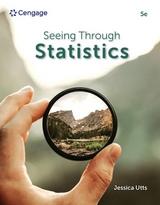
The fourth edition of this popular book by Jessica Utts develops statistical literacy and critical thinking through real-world applications, with an emphasis on ideas, not calculations. This text focuses on the key concepts that educated citizens need to know about statistics. These ideas are introduced in interesting applied and real contexts, without using an abundance of technicalities and calculations that only serve to confuse students.
Jessica Utts is professor emerita of statistics at the University of California at Irvine. She received her B.A. in math and psychology at SUNY Binghamton and her M.A. and Ph.D. in statistics at Penn State University. Aside from MIND ON STATISTICS, Dr. Utts has authored SEEING THROUGH STATISTICS and co-authored STATISTICAL IDEAS AND METHODS, both published by Cengage Learning. Dr. Utts has been active in the statistics education community at the high school and college levels. She served as chair of the Advanced Placement Statistics Development Committee and as Chief Reader for the A.P. Statistics Exam. In 2016 she was the president of the American Statistical Association, the largest professional organization in the world for statisticians. She is a recipient of the Academic Senate Distinguished Teaching Award and the Magnar Ronning Award for Teaching Excellence, both at the University of California at Davis. She is also a fellow of the American Statistical Association, the Institute of Mathematical Statistics, the American Association for the Advancement of Science and the Association for Psychological Science. Beyond statistics education, Dr. Utts’s major contributions have been in applying statistics to a variety of disciplines, most notably to parapsychology, the laboratory study of psychic phenomena. She has appeared on numerous television shows, including Larry King Live, ABC's Nightline, CNN Morning News and 20/20.
PART 1: FINDING DATA IN LIFE.
1. THE BENEFITS AND RISKS OF USING STATISTICS
1.1 Statistics. Case study. 1.1 Heart or Hypothalamus? 1.2 Detecting Patterns and Relationships. Case study. 1.2 Does Aspirin Prevent Heart Attacks? 1.3 Don’t Be Deceived by Improper Use of Statistics. CASE STUDY 1.3 [To come]. 1.4 Summary and Conclusions. Thinking About Key Concepts. Exercises. Mini-Projects. References.
2. READING THE NEWS.
2.1 The Educated Consumer of Data. 2.2 Origins of News Stories. 2.3 How to be a Statistics Sleuth: Seven Critical Components. 2.4 Four Hypothetical Examples of Bad Reports. CASE STUDY 2.1 Who Suffers from Hangovers? 2.5 Planning Your Own Study: Defining the Components in Advance. CASE STUDY 2.2. Thinking About Key Concepts. Exercises. Mini-Projects. References.
3. MEASUREMENTS, MISTAKES, AND MISUNDERSTANDINGS.
3.1 Simple Measures Don’t Exist. 3.2 It’s All in the Wording. CASE STUDY 3.1 No Opinion of Your Own? Let Politics Decide. 3.3 Open or Closed Questions: Should Choices Be Given?. 3.4 Defining What Is Being Measured. CASE STUDY 3.2. 3.5 Defining a Common Language. Thinking About Key Concepts. Exercises. Mini-Projects. References.
4. HOW TO GET A GOOD SAMPLE.
4.1 Common Research Strategies. 4.2 Defining a Common Language. 4.3 The Beauty of Sampling. 4.4 Simple Random Sampling. 4.5 Other Sampling Methods. 4.6 Difficulties and Disasters in Sampling. CASE STUDY 4.1 The Infamous Literary Digest Poll of 1936. Thinking About Key Concepts. Exercises. Mini-Projects. References.
5. EXPERIMENTS AND OBSERVATIONAL STUDIES.
5.1 Defining a Common Language. 5.2 Designing a Good Experiment. CASE STUDY 5.1 Quitting Smoking with Nicotine Patches. 5.3 Difficulties and Disasters in Experiments. CASE STUDY 5.2 Beat the Heat with a Frozen Treat. 5.4 Designing a Good Observational Experiment. CASE STUDY 5.3. 5.5 Difficulties and Disasters in Observational Studies. 5.6 Random Sample versus Random Assignment. Thinking About Key Concepts. Exercises. Mini-Projects. References
6. GETTING THE BIG PICTURE.
6.1 Final Questions. CASE STUDY 6.1 Mozart, Relaxation, and Performance on Spatial Tasks. CASE STUDY. 6.2 Can Meditation Boost Test Scores?. CASE STUDY 6.3 Drinking, Driving, and the Supreme Court. CASE STUDY 6.4 Smoking During Pregnancy and Child’s IQ. CASE STUDY 6.5 For Class Discussion: Guns and. Homicides at Home. Mini-Projects. References.
PART II: FINDING LIFE IN DATA.
7. SUMMARIZING AND DISPLAYING MEASUREMENT DATA.
7.1 Turning Data into Information. 7.2 Picturing Data: Stemplots and Histograms. 7.3 Five Useful Numbers: A Summary. 7.4 Boxplots. 7.5 Traditional Measures: Mean, Variance, and Standard Deviation. 7.6 Caution: Being Average Isn’t Normal. CASE STUDY 7.1 Detecting Exam Cheating with a Histogram. Thinking About Key Concepts. For Those Who Like Formulas. Exercises. Mini-Projects. References.
8. BELL-SHAPED CURVES AND OTHER SHAPES.
8.1 Populations, Frequency Curves, and Proportions. 8.2 The Pervasiveness of Normal Curves. 8.3 Percentiles and Standardized Scores. 8.4 z-Scores and Familiar Intervals. Thinking About Key Concepts. For Those Who Like Formulas. Exercises. References
9. PLOTS, GRAPHS, AND PICTURES.
9.1 Well-Designed Statistical Pictures. 9.2 Pictures of Categorical Data. 9.3 Pictures of Measurement Variables. 9.4 Pictures Trends across Time. 9.5 Difficulties and Disasters in Plots, Graphs, and Pictures.
9.6 A Checklist for Statistical Pictures. CASE STUDY 9.1. Thinking About Key Concepts. Exercises. Mini-Projects. References.
10. RELATIONSHIPS BETWEEN MEASUREMENT VARIABLES.
10.1 Statistical Relationships. 10.2 Strength versus Statistical Significance. 10.3 Measuring Strength Through Correlation. 10.4 Specifying Linear Relationships with Regression. CASE STUDY 10.1 Are Attitudes about Love and Romance Hereditary? CASE STUDY 10.2 A Weighty Issue: Women Want Less, Men Want More. Thinking About Key Concepts. For Those Who Like Formulas. Exercises. Mini-Projects. References.
11. RELATIONSHIPS CAN BE DECEIVING.
11.1 Ille
| Verlagsort | CA |
|---|---|
| Sprache | englisch |
| Maße | 73 x 14 mm |
| Gewicht | 1110 g |
| Themenwelt | Mathematik / Informatik ► Mathematik ► Statistik |
| Wirtschaft ► Volkswirtschaftslehre ► Ökonometrie | |
| ISBN-10 | 1-285-05088-6 / 1285050886 |
| ISBN-13 | 978-1-285-05088-1 / 9781285050881 |
| Zustand | Neuware |
| Informationen gemäß Produktsicherheitsverordnung (GPSR) | |
| Haben Sie eine Frage zum Produkt? |
aus dem Bereich