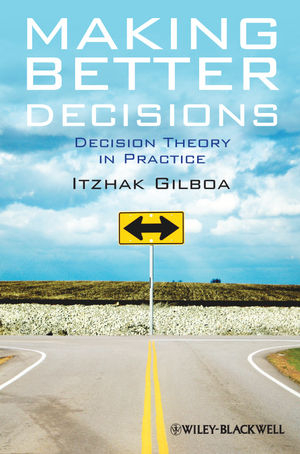
Making Better Decisions (eBook)
John Wiley & Sons (Verlag)
978-1-4443-2814-1 (ISBN)
- Introduces readers to key aspects of decision theory and examines how they might help us make better decisions
- Presentation of material encourages readers to imagine a situation and make a decision or a judgment
- Offers a broad coverage of the subject including major insights from several sub-disciplines: microeconomic theory, decision theory, game theory, social choice, statistics, psychology, and philosophy
- Explains these insights informally in a language that has minimal mathematical notation or jargon, even when describing and interpreting mathematical theorems
- Critically assesses the theory presented within the text, as well as some of its critiques
- Includes a web resource for teachers and students
Itzhak Gilboa is a chaired Professor in the Department of Economics and Decision Sciences at HEC, Paris and in the Eitan Berglas School of Economics at Tel Aviv University, and Fellow of the Cowles Foundation at Yale University. He previously held the position of chaired Professor at the Kellogg School of Management at Northwestern University. Gilboa's research focuses on decision under uncertainty. He has worked with David Schmeidler on axiomatic foundation of non-Bayesian decision theory and contributed to research in complexity in game theory, evolutionary game theory, and social choice. He is co-author of A Theory of Case-Based Decisions (with David Schmeidler, 2001), and author of Theory of Decision under Uncertainty (2009) and of Rational Choice (2010).
Making Better Decisions introduces readers to some of the principal aspects of decision theory, and examines how these might lead us to make better decisions. Introduces readers to key aspects of decision theory and examines how they might help us make better decisions Presentation of material encourages readers to imagine a situation and make a decision or a judgment Offers a broad coverage of the subject including major insights from several sub-disciplines: microeconomic theory, decision theory, game theory, social choice, statistics, psychology, and philosophy Explains these insights informally in a language that has minimal mathematical notation or jargon, even when describing and interpreting mathematical theorems Critically assesses the theory presented within the text, as well as some of its critiques Includes a web resource for teachers and students
Itzhak Gilboa is a chaired Professor in the Department of Economics and Decision Sciences at HEC, Paris and in the Eitan Berglas School of Economics at Tel Aviv University, and Fellow of the Cowles Foundation at Yale University. He previously held the position of chaired Professor at the Kellogg School of Management at Northwestern University. Gilboa's research focuses on decision under uncertainty. He has worked with David Schmeidler on axiomatic foundation of non-Bayesian decision theory and contributed to research in complexity in game theory, evolutionary game theory, and social choice. He is co-author of A Theory of Case-Based Decisions (with David Schmeidler, 2001), and author of Theory of Decision under Uncertainty (2009) and of Rational Choice (2010).
Preface viii
Acknowledgments x
1 Background 1
Suggested Reading 5
2 Judgment and Choice Biases 6
Introduction 6
Problems - Group A 9
Problems - Group B 12
Framing Effects 15
Brainstorming and Formal Models 20
Endowment Effect 22
Sunk Costs 27
Decision Trees 30
Representativeness Heuristic 34
Availability Heuristic 39
Anchoring 44
Mental Accounting 46
Dynamic Inconsistency 51
Exercises 53
3 Consuming Statistical Data 57
Introduction 57
Problems 58
Conditional Probabilities 63
Gambler's Fallacy 72
Biased Samples 77
Regression to the Mean 80
Correlation and Causation 81
Statistical Significance 84
Bayesian and Classical Statistics 85
Exercises 93
4 Decisions under Risk 98
Introduction 98
Problems 99
The Independence Axiom 102
Von Neumann and Morgenstern's Result 110
Measurement of Utility 113
Risk Aversion 116
Prospect Theory 123
Exercises 130
5 Decisions under Uncertainty 133
Introduction 133
Problems 134
Subjective Probability 141
Learning From the Fact We Know 151
Causality 163
The Sure Thing Principle 166
Alternative Models 171
Objective Probabilities 172
Exercises 174
6 Well-Being and Happiness 178
Introduction 178
Problems - Group A 179
Problems - Group B 180
Measurement Issues 184
What's Happiness? 186
Exercises 188
Appendix A: Optimal Choice 191
Appendix B: Probability and Statistics 195
Solutions 204
Index 210
"The book is a modern take on decision making. The innovative
scope will inspire instructors by encouraging them to include a
combination rather than a subset of decision-theoretic,
statistical, behavioral, and philosophical concepts in their
courses."
--Marzena J. Rostek, University of Wisconsin
"Written by a leading authority and teacher in the area of
decision theory, this is a terrific combined
textbook-handbook for students and practitioners of
management. Indeed, it is a terrific book for everyone interested
in 'making better decisions.'"
--Adam Brandenburger, New York University
"This book is extremely effective for anyone who wants to
acquire quick, basic understanding of old and new concepts of
decision theory, with a minimum level of technical
details."
--Ehud Kalai, Northwestern University
"Gilboa is one of the leaders of the revolution that has swept
through the field of decision theory in the past few decades, in
which mathematical methods of statistics and economics have been
integrated with findings from modern psychology. In this book he
provides an accessible and practical survey of the state of the
art, which encourages readers to reflect on - and try to
sharpen - their intuitions and habits of decision
making. It would make an excellent primary or supplementary
text for an undergraduate- or masters-level course in decision
theory. It should also be useful and enjoyable reading for anyone
who wants to learn about concepts that can be used and mistakes
that should be avoided when taking calculated risks."
--Robert Nau, Duke University
"Itzhak Gilboa is one of the deepest thinkers in modern decision
theory. In this fascinating and wonderfully written book he uses
the fundamental models of decision making as a basis for reflection
upon several systematic patterns revealed by our everyday choices.
He strikes a nice balance between analytical models, psychological
insights, and pragmatism with the end goals of improving our
decision making and better understanding the decisions of
others."
--Tomasz Strzalecki, Harvard University
| Erscheint lt. Verlag | 23.7.2010 |
|---|---|
| Sprache | englisch |
| Themenwelt | Wirtschaft ► Allgemeines / Lexika |
| Wirtschaft ► Volkswirtschaftslehre ► Mikroökonomie | |
| Schlagworte | Decision analysis, decision theory, game theory, statistics • Economics • Economic Theory • Microeconomics • Mikroökonomie • Mikroökonomie • Volkswirtschaftslehre • Wirtschaftstheorie |
| ISBN-10 | 1-4443-2814-X / 144432814X |
| ISBN-13 | 978-1-4443-2814-1 / 9781444328141 |
| Informationen gemäß Produktsicherheitsverordnung (GPSR) | |
| Haben Sie eine Frage zum Produkt? |
 PDF (Adobe DRM)
Kopierschutz: Adobe-DRM
Adobe-DRM ist ein Kopierschutz, der das eBook vor Mißbrauch schützen soll. Dabei wird das eBook bereits beim Download auf Ihre persönliche Adobe-ID autorisiert. Lesen können Sie das eBook dann nur auf den Geräten, welche ebenfalls auf Ihre Adobe-ID registriert sind.
Details zum Adobe-DRM
Dateiformat: PDF (Portable Document Format)
Mit einem festen Seitenlayout eignet sich die PDF besonders für Fachbücher mit Spalten, Tabellen und Abbildungen. Eine PDF kann auf fast allen Geräten angezeigt werden, ist aber für kleine Displays (Smartphone, eReader) nur eingeschränkt geeignet.
Systemvoraussetzungen:
PC/Mac: Mit einem PC oder Mac können Sie dieses eBook lesen. Sie benötigen eine
eReader: Dieses eBook kann mit (fast) allen eBook-Readern gelesen werden. Mit dem amazon-Kindle ist es aber nicht kompatibel.
Smartphone/Tablet: Egal ob Apple oder Android, dieses eBook können Sie lesen. Sie benötigen eine
Geräteliste und zusätzliche Hinweise
Buying eBooks from abroad
For tax law reasons we can sell eBooks just within Germany and Switzerland. Regrettably we cannot fulfill eBook-orders from other countries.
aus dem Bereich