James Cuno is president and CEO of the J. Paul Getty Trust and former director of the Art Institute of Chicago. His books include Who Owns Antiquity?: Museums and the Battle over Our Ancient Heritage (Princeton).
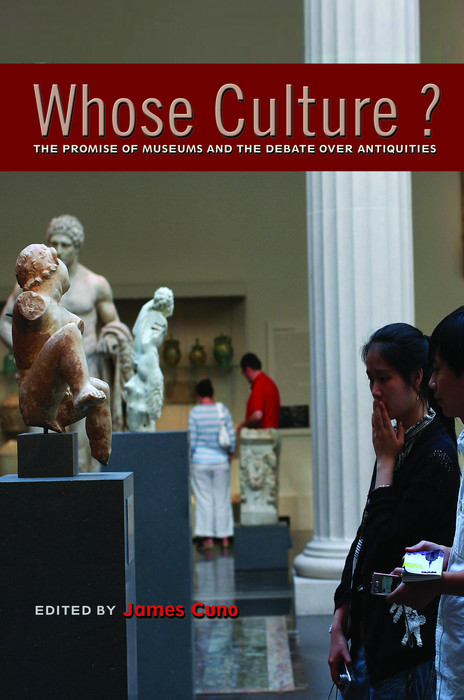
The international controversy over who "e;owns"e; antiquities has pitted museums against archaeologists and source countries where ancient artifacts are found. In his book Who Owns Antiquity?, James Cuno argued that antiquities are the cultural property of humankind, not of the countries that lay exclusive claim to them. Now in Whose Culture?, Cuno assembles preeminent museum directors, curators, and scholars to explain for themselves what's at stake in this struggle--and why the museums' critics couldn't be more wrong. Source countries and archaeologists favor tough cultural property laws restricting the export of antiquities, have fought for the return of artifacts from museums worldwide, and claim the acquisition of undocumented antiquities encourages looting of archaeological sites. In Whose Culture?, leading figures from universities and museums in the United States and Britain argue that modern nation-states have at best a dubious connection with the ancient cultures they claim to represent, and that archaeology has been misused by nationalistic identity politics. They explain why exhibition is essential to responsible acquisitions, why our shared art heritage trumps nationalist agendas, why restrictive cultural property laws put antiquities at risk from unstable governments--and more. Defending the principles of art as the legacy of all humankind and museums as instruments of inquiry and tolerance, Whose Culture? brings reasoned argument to an issue that for too long has been distorted by politics and emotionalism. In addition to the editor, the contributors are Kwame Anthony Appiah, Sir John Boardman, Michael F. Brown, Derek Gillman, Neil MacGregor, John Henry Merryman, Philippe de Montebello, David I. Owen, and James C. Y. Watt.
James Cuno is president and CEO of the J. Paul Getty Trust and former director of the Art Institute of Chicago. His books include Who Owns Antiquity?: Museums and the Battle over Our Ancient Heritage (Princeton).
| Erscheint lt. Verlag | 23.5.2012 |
|---|---|
| Zusatzinfo | 44 halftones. |
| Verlagsort | Princeton |
| Sprache | englisch |
| Themenwelt | Kunst / Musik / Theater ► Allgemeines / Lexika |
| Kunst / Musik / Theater ► Kunstgeschichte / Kunststile | |
| Geisteswissenschaften ► Archäologie | |
| Geisteswissenschaften ► Geschichte ► Hilfswissenschaften | |
| Sozialwissenschaften ► Politik / Verwaltung | |
| Wirtschaft | |
| Schlagworte | Accessibility • Afghanistan • African Art • Ahmed Chalabi • Ambiguity • American Journal of Archaeology • American Schools of Oriental Research • ancient art • Ancient Egypt • Ancient Greece • Ancient Greek art • And/or • animal rights • Annus Mirabilis (poem) • Antiquities • Archaeological context • Archaeological Site • archaeology • Art History • Art Loss Register • art museum • Arts and Crafts Movement • awareness • Beijing • Benin • Betty Radice • buddhist temple • burial • Cambridge University Press • Capital City • Capital Museum • Censorship • Chain-link fencing • Christopher Hitchens • circumstantial evidence • Civilization • Collecting • Colonialism • Conservation-restoration of cultural heritage • Consideration • consignment • Copts in Egypt • Cosmopolitanism • Country of Origin • Courtier • Crime • Criticism • cultural appropriation • cultural critic • cultural heritage • Cultural Nationalism • Cultural property • Cultural Property (Japan) • cultural property law • Culture of ancient Rome • curator • deep history • distraction • edict • Elgin Marbles • Epigraphy • Ethical Dilemma • Euphronios Krater • Fetishism • Figurine • Fu Hao • Funding • Furniture • gift shop • G. (novel) • hungarians • Iconoclasm • Ideology • Imperial Spoils • Impossibility • impunity • Indigenous peoples • Insider • Institution • Intellectual history • Intellectual Property • International Council of Museums • intestacy • Jews • J. Paul Getty Museum • Kenya • Kwame Anthony Appiah • Lansdowne portrait • Lecture • Legislation • Legislator • Literature • Looting • material culture • Matthew Bogdanos • Member State • Metropolitan Museum of Art • Morgantina • Museum • musical instrument • Nationality • National Museum of the American Indian • National Palace Museum • national treasure • National Treasure (Japan) • national wealth • Native American Graves Protection and Repatriation Act • Neolithic • newspaper • Northwest Coast art • Ownership • Ownership (psychology) • Partage • Personhood • Philippe de Montebello • Philistinism • place of origin • Politics • Polymath • private collection • Provenance • Publication • Public Policy • Punitive Expedition • Quid Pro Quo • Repatriation (humans) • rhetoric • rights • Robert Browning • Roman Art • Ruler • Santa Prassede • Smithsonian Institution • Smuggling • Sophistication • Spolia • State Ownership • Statute • Superiority (short story) • Taliban • Tax • Tempera • terrorism • Theft • The Hundreds • The New York Review of Books • The New York Times • tomb • Tomb of Fu Hao • Treaty • Tribal Art • true value • UNESCO • University of Chicago Press • Urkesh • warfare • weapon of mass destruction • Western Europe • work of art • world heritage committee • world heritage site • world's fair |
| ISBN-10 | 1-4008-3304-3 / 1400833043 |
| ISBN-13 | 978-1-4008-3304-7 / 9781400833047 |
| Informationen gemäß Produktsicherheitsverordnung (GPSR) | |
| Haben Sie eine Frage zum Produkt? |
 PDF (Wasserzeichen)
Größe: 2,5 MB
DRM: Digitales Wasserzeichen
Dieses eBook enthält ein digitales Wasserzeichen und ist damit für Sie personalisiert. Bei einer missbräuchlichen Weitergabe des eBooks an Dritte ist eine Rückverfolgung an die Quelle möglich.
Dateiformat: PDF (Portable Document Format)
Mit einem festen Seitenlayout eignet sich die PDF besonders für Fachbücher mit Spalten, Tabellen und Abbildungen. Eine PDF kann auf fast allen Geräten angezeigt werden, ist aber für kleine Displays (Smartphone, eReader) nur eingeschränkt geeignet.
Systemvoraussetzungen:
PC/Mac: Mit einem PC oder Mac können Sie dieses eBook lesen. Sie benötigen dafür einen PDF-Viewer - z.B. den Adobe Reader oder Adobe Digital Editions.
eReader: Dieses eBook kann mit (fast) allen eBook-Readern gelesen werden. Mit dem amazon-Kindle ist es aber nicht kompatibel.
Smartphone/Tablet: Egal ob Apple oder Android, dieses eBook können Sie lesen. Sie benötigen dafür einen PDF-Viewer - z.B. die kostenlose Adobe Digital Editions-App.
Buying eBooks from abroad
For tax law reasons we can sell eBooks just within Germany and Switzerland. Regrettably we cannot fulfill eBook-orders from other countries.
 EPUB (Adobe DRM)
Kopierschutz: Adobe-DRM
Adobe-DRM ist ein Kopierschutz, der das eBook vor Mißbrauch schützen soll. Dabei wird das eBook bereits beim Download auf Ihre persönliche Adobe-ID autorisiert. Lesen können Sie das eBook dann nur auf den Geräten, welche ebenfalls auf Ihre Adobe-ID registriert sind.
Details zum Adobe-DRM
Dateiformat: EPUB (Electronic Publication)
EPUB ist ein offener Standard für eBooks und eignet sich besonders zur Darstellung von Belletristik und Sachbüchern. Der Fließtext wird dynamisch an die Display- und Schriftgröße angepasst. Auch für mobile Lesegeräte ist EPUB daher gut geeignet.
Systemvoraussetzungen:
PC/Mac: Mit einem PC oder Mac können Sie dieses eBook lesen. Sie benötigen eine
eReader: Dieses eBook kann mit (fast) allen eBook-Readern gelesen werden. Mit dem amazon-Kindle ist es aber nicht kompatibel.
Smartphone/Tablet: Egal ob Apple oder Android, dieses eBook können Sie lesen. Sie benötigen eine
Geräteliste und zusätzliche Hinweise
Buying eBooks from abroad
For tax law reasons we can sell eBooks just within Germany and Switzerland. Regrettably we cannot fulfill eBook-orders from other countries.
aus dem Bereich