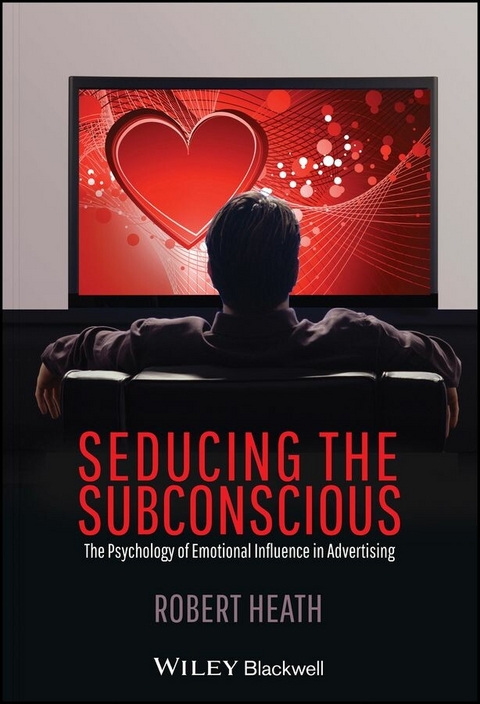
Seducing the Subconscious (eBook)
John Wiley & Sons (Verlag)
978-1-119-96762-0 (ISBN)
A must-read for anyone intrigued by the role and influence of the ad world, Seducing the Subconscious explores the complexities of our relationship to advertising. Robert Heath uses approaches from experimental psychology and cognitive neuroscience to outline his theory of the subconscious influence of advertising in its audience's lives. In addition to looking at ads' influence on consumers, Heath also addresses how advertising is evolving, noting especially the ethical implications of its development. Supported by current research, Seducing the Subconscious shows us just how strange and complicated our relationship is with the ads we see every day.
Dr. Robert Heath has a worldwide reputation as an expert in the role of emotion and attention in the field of brand communication. In 2001 he developed the Low Attention Processing Model of advertising, after which he published the best-selling monograph The Hidden Power of Advertising. His published research has garnered him major prizes, including the dual award of the MRS David Winton and ISBA Prizes. Dr. Heath is a Senior Lecturer in Advertising at University of Bath School of Management and a Board Member of the Wharton Global Future of Advertising Project.
Our relationship with ads: it's complicated A must-read for anyone intrigued by the role and influence of the ad world, Seducing the Subconscious explores the complexities of our relationship to advertising. Robert Heath uses approaches from experimental psychology and cognitive neuroscience to outline his theory of the subconscious influence of advertising in its audience s lives. In addition to looking at ads influence on consumers, Heath also addresses how advertising is evolving, noting especially the ethical implications of its development. Supported by current research, Seducing the Subconscious shows us just how strange and complicated our relationship is with the ads we see every day.
Dr. Robert Heath has a worldwide reputation as an expert in the role of emotion and attention in the field of brand communication. In 2001 he developed the Low Attention Processing Model of advertising, after which he published the best-selling monograph The Hidden Power of Advertising. His published research has garnered him major prizes, including the dual award of the MRS David Winton and ISBA Prizes. Dr. Heath is a Senior Lecturer in Advertising at University of Bath School of Management and a Board Member of the Wharton Global Future of Advertising Project.
Foreword ix
Introduction 1
Part 1 Taking Advertising Apart
1 The Persuasion Model 15
2 Alternative Ideas 24
3 WhyWe Don't Pay Attention to Advertising 39
Part 1 Summary 48
Part 2 The Psychology of Communication
4 Learning and Attention 53
5 The Role of Memory 63
6 HowWe Process Communication 74
7 Problems with Getting Attention 85
Part 2 Summary 95
Part 3 Emotion and Consciousness
8 Emotional Processing 101
9 Our Adaptive Subconscious 111
10 Emotion and Attention 123
Part 3 Summary 133
Part 4 Decisions and Relationships
11 Decision-Making 137
12 The Power of Metacommunication 149
13 The Subconscious Seduction Model 160
Part 4 Summary 174
Part 5 Taking A Fresh Look at Advertising
14 Under the Radar 179
15 The Hidden Power of New Media 189
16 Legal, Decent, Honest, and Truthful? 198
17 How to Spot Subconscious Seduction 207
Conclusion 219
References 229
Index 239
"Summing Up: Recommended. Upper-division and
graduate students of advertising and psychology, faculty, and
practitioners." (Choice, 1 October 2012)
"Heath's book is far more persuasive than any
advertisement, no matter how top-loaded the latter may be with
accurate information. His thesis depends on a lengthy journey
through cognitive science and evolutionary psychology, and a firm
grasp on how - so far as we know - the human mind
actually does work (rather than how we would like it to work).
Heath demonstrates quite clearly - at least to my
satisfaction - that it is precisely when we pay no conscious
attention to advertising that advertisers get to work on our
subconscious with complete effectiveness." WILL
SELF, Prospect, June 2012
"(Heath) avoids academic obscurantism and fills the book with
clever dissections of well-known ads... The case studies add up to
an intriguing, down-to-earth introduction to the mysteries of the
subconscious..."
Financial Times, March 2012
"Dr Robert Heath, who teaches at the University of Bath, has
popularised the theory of 'low attention processing',
which argues that ads make a stronger emotional and behavioural
impact when we are paying less conscious attention to them. In his
new book, Seducing the Subconscious, he further develops
this thinking, providing a detailed and scholarly explanation of
the psychological processes involved, and illustrating these with
advertising examples, many based on his own long experience in ad
agencies."
Paul Feldwick, Credos, March 2012
An articulate, compelling and, at times, disturbing explanation of
how advertising works. The theory and examples in Seducing the
Subconscious offer new insight into how advertising works and
are a must read for any advertiser, consumer, and policy maker.
--Jerry Wind, Lauder Professor and Professor
of Marketing at the Wharton School, Director of the Wharton Future
of Advertising Program
Dr. Heath writes with great insight into the workings of
advertising and communication. He draws on theory to frame the
question and guides the reader through how the subconscious is at
the forefront of our behaviour. His book is a 'must read' for
anyone with the slightest involvement or interest in
marketing.
--Judy Zaichkowsky, Professor of Marketing
and Communications, Copenhagen Business School, Denmark
Advertising works at both a conscious and subconscious level.
Anyone who wants to understand how should read this well-researched
and generally balanced book.
--Patrick Barwise, Emeritus Professor, London
Business School
| Erscheint lt. Verlag | 21.3.2012 |
|---|---|
| Sprache | englisch |
| Themenwelt | Geisteswissenschaften ► Psychologie ► Allgemeine Psychologie |
| Geisteswissenschaften ► Psychologie ► Verhaltenstherapie | |
| Wirtschaft ► Betriebswirtschaft / Management ► Marketing / Vertrieb | |
| Schlagworte | Advertising • adverts • Best • Brand communications • Cognitive Psychology • Entertainment • Field • Influence • ingenious • Kognitive Psychologie • lovehate relationship • New • pay attention • Power • Products • Psychologie • Psychology • purposethey • Radar • reason • Researcher • semiconscious • touch • US • Way |
| ISBN-10 | 1-119-96762-7 / 1119967627 |
| ISBN-13 | 978-1-119-96762-0 / 9781119967620 |
| Informationen gemäß Produktsicherheitsverordnung (GPSR) | |
| Haben Sie eine Frage zum Produkt? |
 PDF (Adobe DRM)
Kopierschutz: Adobe-DRM
Adobe-DRM ist ein Kopierschutz, der das eBook vor Mißbrauch schützen soll. Dabei wird das eBook bereits beim Download auf Ihre persönliche Adobe-ID autorisiert. Lesen können Sie das eBook dann nur auf den Geräten, welche ebenfalls auf Ihre Adobe-ID registriert sind.
Details zum Adobe-DRM
Dateiformat: PDF (Portable Document Format)
Mit einem festen Seitenlayout eignet sich die PDF besonders für Fachbücher mit Spalten, Tabellen und Abbildungen. Eine PDF kann auf fast allen Geräten angezeigt werden, ist aber für kleine Displays (Smartphone, eReader) nur eingeschränkt geeignet.
Systemvoraussetzungen:
PC/Mac: Mit einem PC oder Mac können Sie dieses eBook lesen. Sie benötigen eine
eReader: Dieses eBook kann mit (fast) allen eBook-Readern gelesen werden. Mit dem amazon-Kindle ist es aber nicht kompatibel.
Smartphone/Tablet: Egal ob Apple oder Android, dieses eBook können Sie lesen. Sie benötigen eine
Geräteliste und zusätzliche Hinweise
Buying eBooks from abroad
For tax law reasons we can sell eBooks just within Germany and Switzerland. Regrettably we cannot fulfill eBook-orders from other countries.
aus dem Bereich