


Share This (eBook)
John Wiley & Sons (Verlag)
978-1-118-40487-4 (ISBN)
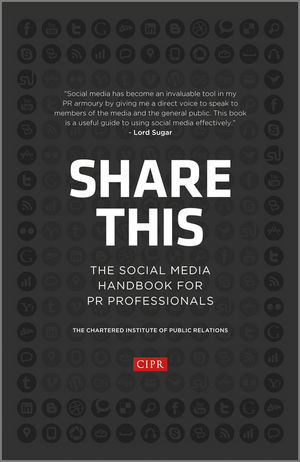
Share This is a practical handbook to the biggest changes taking place in the media and its professions by the Chartered Institute of Public Relations (CIPR) Social Media Panel. The book was conceived and written by more than 20 public relations practitioners representing a cross-section of public, private and voluntary sector expertise using many of the social tools and techniques that it addresses.
The book is split into 26 chapters over eight topic areas covering the media and public relations industry, planning, social networks, online media relations, monitoring and measurement, skills, industry change and the future of the industry. It’s a pragmatic guide for anyone that works in public relations and wants to continue working in the industry.
Share This was edited by Stephen Waddington with contributions from: Katy Howell, Simon Sanders, Andrew Smith, Helen Nowicka, Gemma Griffiths, Becky McMichael, Robin Wilson, Alex Lacey, Matt Appleby, Dan Tyte, Stephen Waddington, Stuart Bruce, Rob Brown, Russell Goldsmith, Adam Parker, Julio Romo, Philip Sheldrake, Richard Bagnall, Daljit Bhurji, Richard Bailey, Rachel Miller, Mark Pack, and Simon Collister.
Share This is a practical handbook to the biggest changes taking place in the media and its professions by the Chartered Institute of Public Relations (CIPR) Social Media Panel. The book was conceived and written by more than 20 public relations practitioners representing a cross-section of public, private and voluntary sector expertise using many of the social tools and techniques that it addresses. The book is split into 26 chapters over eight topic areas covering the media and public relations industry, planning, social networks, online media relations, monitoring and measurement, skills, industry change and the future of the industry. It s a pragmatic guide for anyone that works in public relations and wants to continue working in the industry. Share This was edited by Stephen Waddington with contributions from: Katy Howell, Simon Sanders, Andrew Smith, Helen Nowicka, Gemma Griffiths, Becky McMichael, Robin Wilson, Alex Lacey, Matt Appleby, Dan Tyte, Stephen Waddington, Stuart Bruce, Rob Brown, Russell Goldsmith, Adam Parker, Julio Romo, Philip Sheldrake, Richard Bagnall, Daljit Bhurji, Richard Bailey, Rachel Miller, Mark Pack, and Simon Collister.
The Chartered Institute of Public Relations (CIPR) - professional body for PR practitioners in the UK. Founded in February 1948 and by 2009 it had grown to over 9000 members involved in all aspects of the public relations industry, and is the largest body of its type in Europe.
List of Contributors x
Foreword by Jane Wilson xi
Introduction by Stephen Waddington xiii
Part I Changing Media, Changing PR 1
1 An Introduction to Social Networks 3
Katy Howell
Part II Planning 13
2 Kick-Start Your Social Media Strategy 15
Simon Sanders
3 What has Google Ever Done for PR? 23
Andrew Smith
4 Integrating Traditional and Social Media 31
Helen Nowicka
5 Social Media Guidelines: Creating Freedom Within a Framework 39
Gemma Griffiths
6 Open Communication: Psychology, Ethics and Etiquette 49
Becky McMichael
Part III Networks 59
7 Facebook: A Way to Engage with Your Audiences 61
Robin Wilson
8 Twitter: The Unstoppable Rise of Microblogging 71
Alex Lacey
9 LinkedIn: Social Networking for Professionals 79
Matt Appleby
10 Google+: Better than Buzz? 87
Dan Tyte
11 The Business of Blogging 93
Stephen Waddington
Part IV Online Media Relations 101
12 Modern Media Relations and Social Media Newsrooms 103
Stuart Bruce
13 Brands as Media 113
Rob Brown
14 The Future of Broadcast 121
Russell Goldsmith
15 Media Relations Modernised 129
Adam Parker
16 Pitching Using Social Media 137
Julio Romo
Part V Monitoring and Measurement 145
17 Real-Time Public Relations 147
Philip Sheldrake
18 Social Media Monitoring 157
Andrew Smith
19 Measuring Social Media 163
Richard Bagnall
Part VI Skills 175
20 Skilling Up for the Future 177
Daljit Bhurji
21 The Future of PR Education 185
Richard Bailey
Part VII Industry Change 193
22 Employee Engagement: How Social Media are Changing Internal Communication 195
Rachel Miller
23 Back to the Future for Public Sector Communications 205
Mark Pack
24 Modernising Public Affairs for the Digital Age 213
Stuart Bruce
25 Social Media and the Third Sector 221
Simon Collister
Part VIII The Future 229
26 Here Comes Web 3.0 and the Internet of Things 231
Philip Sheldrake
Index 237
"Social media has become an invaluable tool in my PRarmoury by giving me a direct voice to speak directly to members ofthe media and the general public. This book is a useful guideto using social mediaeffectively."--Lord Sugar
"Social media is PR. And this is a book by PR professionals andexperts in social media. If you're a PR professional, get theexpertise and insights of the CIPR Social Media panel and impressyour friends and clients. Gets a +1 from me. Like."--PaulMylrea, Director of Communications, BBC
"This crowd-sourced book on social media is a welcome addition toPR literature, as it brings together a range of insights andworld-views of social media and helps the sense-making process onits roles, value creation and appropriate strategies. I hope itwill be regularly updated, as this is such a fast-movingfield."--Professor Tom Watson, Professor of PublicRelations, Bournemouth University
"Blogs like mine set the news agenda for traditional media,PRs would be daft to ignore a book about how old-school spin isdead and full of advice about how to work better now that socialmedia has rewritten the rules."--Paul Staines (aka GuidoFawkes)
"This book challenges the minds and expands the horizons ofPR and marketing professionals operating in today's digitalage, providing excellent insight into how to survive and thrive init."--Steve Walker, FCIM, EMEA VP CorporateCommunications, Oracle Corporation
"Social media presents significant opportunities to the PRindustry, and understanding and embracing these is critical tobusiness success. This book covers and shines light on some of themost important topics in social media today. A must read foranyone in the PR business."--Andrew Bloch, Vice-Chairmanand Founder, Frank PR
"If you want to join a conversation on the convergence of digitaland PR, this book is the conversation to go for. A series of essaysthat shakes up the status quo, questions conventional PR practices,and takes thoughtful positions in a social tone that willchallenge, engage and entertain the reader. Get it while it'shot!"--Gerry Brown, FCIM, Lead Digital Analyst, BloorResearch
"Share This is a brilliant concept - well conceived, wellpackaged, well written and a 'must read' for any PRprofessional practicing today. To have such a broad compilation ofviews on social media -- written specifically from a PR perspective-- is definitely something our industry has been crying outfor."--Trevor Young (aka PR Warrior), EdelmanAustralia
"From corporate communications to brand marketing, social is now atthe heart of what we do as PR professionals. This book providesoutstanding practical guidance developed by some of ourindustry's most distinguished practitioners and honed throughthe very methods that they recommend."--Marshall Manson,Managing Director, Digital, EMEA, Edelman
"When trying to make sense of the rapidly evolving socialmedia world it makes sense to listen to the wisdom of crowds andShare This: The Social Media Handbook for PR Professionalsdoes exactly that, being the result of a collaborative, onlineprocess using Google Documents. What makes Share Thisreally valuable is the assumption that the PR reader isn'tstarting from scratch; so those with a working knowledge of socialmedia can use the book to provide practical and trend-led insightsand apply them to communication challenges today - andprobably tomorrow. As PR realises the power of social media toradically change how brands communicate with their audiences, neverhas there been a better time to read thisbook."--Avril Lee, Partner, CEO London,Ketchum Pleon
Chapter 2
KICK-START YOUR SOCIAL MEDIA STRATEGY
Simon Sanders
Many organisations now use social media. But not all do so strategically, and some don’t use social media at all. The six steps outlined here aim to help you overcome any obstacles or inertia and kick-start your social media strategy.
Is your organisation currently using social media? Millions of organisations around the world are publishing their latest news and engaging via Twitter, Facebook or a company blog, perhaps even uploading videos to YouTube, maintaining a company profile on LinkedIn and exploring the possibilities of Google+. For many it’s a journey of discovery as they look to find new ways to engage with customers and other stakeholders. Not everyone is at it though: Econsultancy’s State of Social Media Report 201121 surveyed more than 1000 clients, brands, marketing, digital and PR agencies and noted that around 35% are either still at a very experimental stage or not doing any social media activity at all.
1. Select Your Squad
In time it will impact every part of an organisation – yet in some businesses social media are not so much seen as a wonderful opportunity but as a worrying threat, and in others just an irrelevant distraction. To date it has tended to be the PR, marketing and customer services functions that have been at the forefront of using social media. Yet there are plenty of commonplace situations which show how different areas of a business might well have to be involved, as the following scenarios illustrate (with sample suggestions of business areas involved shown in brackets):
- Customers complaining about urgent problems with products (customer services; PR).
- Workers mocking their employers or the company’s customers (corp. comms; HR).
- Negative/slanderous content that has been published and shared (legal; PR).
- Constructive suggestions about how a company could do things better (R&D; insight).
- Competitors promoting offers directly and making direct sales (sales; marketing).
As you can see, being active in social media might require input from and collaboration with many other parts of the business. In a large organisation, this could involve multiple stakeholders, whereas in a smaller organisation, these roles might all be covered by a handful of people. The overarching point is that to overcome any inertia and rise to the opportunities and threats, you will probably need to take a few people with you on your journey – keeping them up to date with your plans and actions, and getting their input along the way. As well as getting the buy-in you need now, you may be able to build the support you may rely on later. As a side note: if you are going to be leading the introduction and integration of social media into your organisation, it will be worth reading Jeremiah Owyang’s insights into alternate frameworks for your social media structure.22
2. Choose a Goal
Remember Lewis Carroll’s Cheshire Cat from Alice’s Adventures in Wonderland? It noted ‘if you don’t know where you are going, any road will get you there.’ Such is the way with social media. So, before you rush to establish a social media presence without a clear purpose, you must first consider what the point of your social media activity is. What would you like to achieve?
To help kick-start your strategy, consider the following three business drivers and associated PR goals that social media can address.
| Business Driver | Social Media Goal | Achieving What? |
| Brand | Awareness | Earning attention/reaching more people/building profile |
| Finance | Sales | Generating enquiries, leads or sales |
| Customers | Loyalty | Keeping stakeholders engaged/maintaining reputation/encouraging repeat business |
For PR people, Awareness and Loyalty probably chime the loudest as the most natural fit but, ask yourself, for you and your organisation, does any one of these three goals leap off the page as the single most important? You may want to select them all but, to kick-start your social media manoeuvres, you might wish to choose just one to prioritise and focus on. Pick more than one if you wish, but recognise that it will probably mean a separate strategy for each goal, and more resources to achieve them.
Whatever you decide, whichever you choose, the ideal situation is to firmly align your social media goals with the core drivers of your organisation’s success. In this way, your social media achievements are most likely to be judged – and hopefully as successful – at the most senior levels.
3. Start Listening
As The Cluetrain Manifesto23 pointed out, every market is a conversation – and your own marketplace is likely to be full of conversations, content and communities to tune into. A social media listening exercise will focus on your entire online environment: not just what is being said about you, but your wider product or service ‘keywords’, your senior people, colleagues or employees, your competitors, your industry sector and your wider stakeholder environment. It should – or at least could – uncover all sorts of interesting results, allowing you to discover what others are talking about before you join the conversation.
You might discover comments and observations on Twitter or Facebook, detailed opinions on review sites or queries and answers posted in forums. You might discover relevant bloggers writing about your sector, how competitors or challengers are embracing social media and content from fellow colleagues, suppliers or partners. Against this backdrop, it’s not hard to see why pushing out one-way messages, replicating the advertising or press-release model of communications, fails to embrace the potential to engage with people in social media.
There is a range of listening tools you can use to discover what and where the conversation is. Some, like Google Alerts or Social Mention, are free and will email you when they discover new mentions of your chosen keywords. Others, like TweetDeck and HootSuite, provide an online dashboard with which you can monitor multiple keywords in channels such as Twitter, but also use it to post your own content and links or reply to other users. More advanced platforms, including the likes of Radian6, Sysomos, SM2 and Brandwatch, are available on a paid-for subscription basis: they let you monitor, analyse and drill down into the data to identify the key media, channels, influencers and sentiment and to assign tasks to others in your team to ensure the right response. Tools like these equip you not just to listen but also to participate.
4. Think Character and Content
Social media are about presenting the human side of your business, engaging with your audience to build trust, understanding and brand loyalty. As Tony Hsieh, CEO of Zappos, one of the biggest social media success stories, noted, ‘people relate to people, not companies.’ Being human is natural to (most) humans but how does an organisation do it?
Consider the difference between image and character. Image is about the ‘for show’ veneer we might use to portray ourselves or else might judge others by from afar. By contrast, character is about the ‘real’ person that we or others get to know from a more close-at-hand perspective. For your organisation, then, becoming more human might be about reducing the distance between you and your audience – perhaps showing yourself to be open, reliable, responsive, friendly or engaging. These character traits could be very different to how your organisation talks in other, more formal marketing communications which are more reliant on image – and this more human side need not mean you can’t still be inspiring or authoritative.
In practical terms, then, you might reveal your human side through customer service teams responding to queries on Twitter; through blog or video posts featuring your CEO or other people in the business that people might like to hear from; through relationship building with potential influencers or bloggers. Of course, the focus needn’t solely be on your people: you could choose to feature your audience. How could collecting and reflecting stories about how your customers are using your products help humanise you? Could telling their story, help you tell your story? Would using their actual words or voices, showing their faces, places or spaces help you create deeper, more memorable or meaningful content which could help earn you attention, create an affinity, drive loyalty or attract new customers?
Within your overall strategy you will need to plan out a content strategy. This will map out the mix of different types of content you should be creating and sharing with your audience, and a schedule for the months, weeks and individual days. It will pay to bear in mind the ‘Technographics’ studies from Forrester Research24 or the 9Cs of Social Media User Types25 research by this author for Lansons Communications, which built on this by understanding whether your audience is, for example, likely to comprise creators of content or, say, simply critics, conversationalists or just passive consumers; knowing this, you can better judge the type of content that will produce the best engagement.
5. Integrate Your Outposts
With social media strategy, the platforms you choose to...
| Erscheint lt. Verlag | 10.7.2012 |
|---|---|
| Sprache | englisch |
| Themenwelt | Wirtschaft ► Betriebswirtschaft / Management ► Marketing / Vertrieb |
| Schlagworte | Ãffentlichkeitsarbeit u. Werbung • Business & Management • Communication & Media Studies • Facebook • Kommunikation u. Medienforschung • LinkedIn • media • Neue Medien • New Media • Öffentlichkeitsarbeit u. Werbung • Public Relations • Public Relations & Advertising • Social Media • Social Networks • Strategic Marketing • Strategisches Marketing • Twitter • Wirtschaft u. Management • youtube |
| ISBN-10 | 1-118-40487-4 / 1118404874 |
| ISBN-13 | 978-1-118-40487-4 / 9781118404874 |
| Informationen gemäß Produktsicherheitsverordnung (GPSR) | |
| Haben Sie eine Frage zum Produkt? |
 EPUB (Adobe DRM)
Kopierschutz: Adobe-DRM
Adobe-DRM ist ein Kopierschutz, der das eBook vor Mißbrauch schützen soll. Dabei wird das eBook bereits beim Download auf Ihre persönliche Adobe-ID autorisiert. Lesen können Sie das eBook dann nur auf den Geräten, welche ebenfalls auf Ihre Adobe-ID registriert sind.
Details zum Adobe-DRM
Dateiformat: EPUB (Electronic Publication)
EPUB ist ein offener Standard für eBooks und eignet sich besonders zur Darstellung von Belletristik und Sachbüchern. Der Fließtext wird dynamisch an die Display- und Schriftgröße angepasst. Auch für mobile Lesegeräte ist EPUB daher gut geeignet.
Systemvoraussetzungen:
PC/Mac: Mit einem PC oder Mac können Sie dieses eBook lesen. Sie benötigen eine
eReader: Dieses eBook kann mit (fast) allen eBook-Readern gelesen werden. Mit dem amazon-Kindle ist es aber nicht kompatibel.
Smartphone/Tablet: Egal ob Apple oder Android, dieses eBook können Sie lesen. Sie benötigen eine
Geräteliste und zusätzliche Hinweise
Buying eBooks from abroad
For tax law reasons we can sell eBooks just within Germany and Switzerland. Regrettably we cannot fulfill eBook-orders from other countries.
aus dem Bereich


