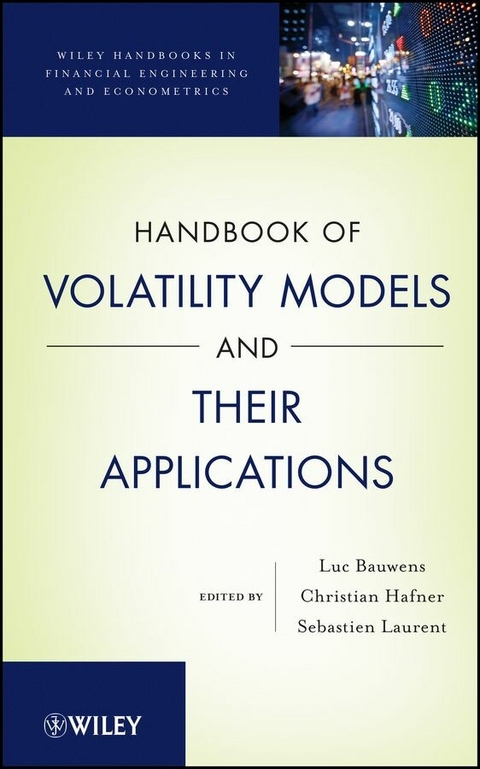
Handbook of Volatility Models and Their Applications (eBook)
John Wiley & Sons (Verlag)
978-1-118-27205-3 (ISBN)
Volatility has become a hot topic in this era of instant communications, spawning a great deal of research in empirical finance and time series econometrics. Providing an overview of the most recent advances, Handbook of Volatility Models and Their Applications explores key concepts and topics essential for modeling the volatility of financial time series, both univariate and multivariate, parametric and non-parametric, high-frequency and low-frequency.
Featuring contributions from international experts in the field, the book features numerous examples and applications from real-world projects and cutting-edge research, showing step by step how to use various methods accurately and efficiently when assessing volatility rates. Following a comprehensive introduction to the topic, readers are provided with three distinct sections that unify the statistical and practical aspects of volatility:
Autoregressive Conditional Heteroskedasticity and Stochastic Volatility presents ARCH and stochastic volatility models, with a focus on recent research topics including mean, volatility, and skewness spillovers in equity markets
Other Models and Methods presents alternative approaches, such as multiplicative error models, nonparametric and semi-parametric models, and copula-based models of (co)volatilities
Realized Volatility explores issues of the measurement of volatility by realized variances and covariances, guiding readers on how to successfully model and forecast these measures
Handbook of Volatility Models and Their Applications is an essential reference for academics and practitioners in finance, business, and econometrics who work with volatility models in their everyday work. The book also serves as a supplement for courses on risk management and volatility at the upper-undergraduate and graduate levels.
Luc Bauwens, PhD, is Professor of Economics at the Université catholique de Louvain (Belgium), where he is also President of the Center for Operations Research and Econometrics (CORE). He has written more than 100 published papers on the topics of econometrics, statistics, and microeconomics.
Christian Hafner, PhD, is Professor and President of the Louvain School of Statistics, Biostatistics, and Actuarial Science (LSBA) at the Université catholique de Louvain (Belgium). He has published extensively in the areas of time series econometrics, applied nonparametric statistics, and empirical finance.
Sebastien Laurent, PhD, is Associate Professor of Econometrics in the Department of Quantitative Economics at Maastricht University (The Netherlands). Dr. Laurent's current areas of research interest include financial econometrics and computational econometrics.
A complete guide to the theory and practice of volatility models in financial engineering Volatility has become a hot topic in this era of instant communications, spawning a great deal of research in empirical finance and time series econometrics. Providing an overview of the most recent advances, Handbook of Volatility Models and Their Applications explores key concepts and topics essential for modeling the volatility of financial time series, both univariate and multivariate, parametric and non-parametric, high-frequency and low-frequency. Featuring contributions from international experts in the field, the book features numerous examples and applications from real-world projects and cutting-edge research, showing step by step how to use various methods accurately and efficiently when assessing volatility rates. Following a comprehensive introduction to the topic, readers are provided with three distinct sections that unify the statistical and practical aspects of volatility: Autoregressive Conditional Heteroskedasticity and Stochastic Volatility presents ARCH and stochastic volatility models, with a focus on recent research topics including mean, volatility, and skewness spillovers in equity markets Other Models and Methods presents alternative approaches, such as multiplicative error models, nonparametric and semi-parametric models, and copula-based models of (co)volatilities Realized Volatility explores issues of the measurement of volatility by realized variances and covariances, guiding readers on how to successfully model and forecast these measures Handbook of Volatility Models and Their Applications is an essential reference for academics and practitioners in finance, business, and econometrics who work with volatility models in their everyday work. The book also serves as a supplement for courses on risk management and volatility at the upper-undergraduate and graduate levels.
Luc Bauwens, PhD, is Professor of Economics at the Université catholique de Louvain (Belgium), where he is also President of the Center for Operations Research and Econometrics (CORE). He has written more than 100 published papers on the topics of econometrics, statistics, and microeconomics. Christian Hafner, PhD, is Professor and President of the Louvain School of Statistics, Biostatistics, and Actuarial Science (LSBA) at the Université catholique de Louvain (Belgium). He has published extensively in the areas of time series econometrics, applied nonparametric statistics, and empirical finance. Sebastien Laurent, PhD, is Associate Professor of Econometrics in the Department of Quantitative Economics at Maastricht University (The Netherlands). Dr. Laurent's current areas of research interest include financial econometrics and computational econometrics.
"Conceived and written by over two-dozen experts in the fi eld, the book cohesively demonstrates how 'volatile' certain statistical decision-making techniques can be when solving a range of financial problems." (Zentralblatt MATH 2016)
| Erscheint lt. Verlag | 22.3.2012 |
|---|---|
| Reihe/Serie | Wiley Handbooks in Financial Engineering and Econometrics |
| Wiley Handbooks in Financial Engineering and Econometrics | Wiley Handbooks in Financial Engineering and Econometrics |
| Sprache | englisch |
| Themenwelt | Wirtschaft ► Betriebswirtschaft / Management ► Finanzierung |
| Betriebswirtschaft / Management ► Spezielle Betriebswirtschaftslehre ► Versicherungsbetriebslehre | |
| Wirtschaft ► Volkswirtschaftslehre ► Ökonometrie | |
| Schlagworte | Finance & Investments • Financial Engineering • Finanztechnik • Finanz- u. Anlagewesen • Finanz- u. Wirtschaftsstatistik • Insurance & Risk Management • Statistics • Statistics for Finance, Business & Economics • Statistik • Versicherungswesen u. Risikomanagement • volatility modeling, statistical decision making, financial engineering, financial statistics, applied statistics, volatility in the marketplace, market volatility, volatility trading |
| ISBN-10 | 1-118-27205-6 / 1118272056 |
| ISBN-13 | 978-1-118-27205-3 / 9781118272053 |
| Informationen gemäß Produktsicherheitsverordnung (GPSR) | |
| Haben Sie eine Frage zum Produkt? |
 PDF (Adobe DRM)
Größe: 70,3 MB
Kopierschutz: Adobe-DRM
Adobe-DRM ist ein Kopierschutz, der das eBook vor Mißbrauch schützen soll. Dabei wird das eBook bereits beim Download auf Ihre persönliche Adobe-ID autorisiert. Lesen können Sie das eBook dann nur auf den Geräten, welche ebenfalls auf Ihre Adobe-ID registriert sind.
Details zum Adobe-DRM
Dateiformat: PDF (Portable Document Format)
Mit einem festen Seitenlayout eignet sich die PDF besonders für Fachbücher mit Spalten, Tabellen und Abbildungen. Eine PDF kann auf fast allen Geräten angezeigt werden, ist aber für kleine Displays (Smartphone, eReader) nur eingeschränkt geeignet.
Systemvoraussetzungen:
PC/Mac: Mit einem PC oder Mac können Sie dieses eBook lesen. Sie benötigen eine
eReader: Dieses eBook kann mit (fast) allen eBook-Readern gelesen werden. Mit dem amazon-Kindle ist es aber nicht kompatibel.
Smartphone/Tablet: Egal ob Apple oder Android, dieses eBook können Sie lesen. Sie benötigen eine
Geräteliste und zusätzliche Hinweise
Buying eBooks from abroad
For tax law reasons we can sell eBooks just within Germany and Switzerland. Regrettably we cannot fulfill eBook-orders from other countries.
 EPUB (Adobe DRM)
Kopierschutz: Adobe-DRM
Adobe-DRM ist ein Kopierschutz, der das eBook vor Mißbrauch schützen soll. Dabei wird das eBook bereits beim Download auf Ihre persönliche Adobe-ID autorisiert. Lesen können Sie das eBook dann nur auf den Geräten, welche ebenfalls auf Ihre Adobe-ID registriert sind.
Details zum Adobe-DRM
Dateiformat: EPUB (Electronic Publication)
EPUB ist ein offener Standard für eBooks und eignet sich besonders zur Darstellung von Belletristik und Sachbüchern. Der Fließtext wird dynamisch an die Display- und Schriftgröße angepasst. Auch für mobile Lesegeräte ist EPUB daher gut geeignet.
Systemvoraussetzungen:
PC/Mac: Mit einem PC oder Mac können Sie dieses eBook lesen. Sie benötigen eine
eReader: Dieses eBook kann mit (fast) allen eBook-Readern gelesen werden. Mit dem amazon-Kindle ist es aber nicht kompatibel.
Smartphone/Tablet: Egal ob Apple oder Android, dieses eBook können Sie lesen. Sie benötigen eine
Geräteliste und zusätzliche Hinweise
Buying eBooks from abroad
For tax law reasons we can sell eBooks just within Germany and Switzerland. Regrettably we cannot fulfill eBook-orders from other countries.
aus dem Bereich