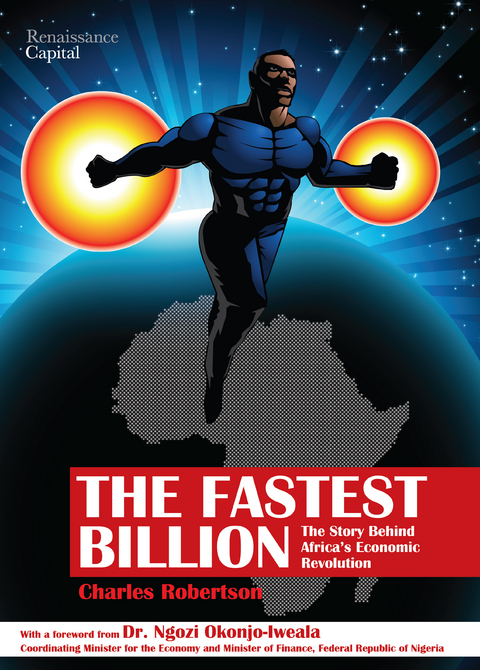
Fastest Billion (eBook)
272 Seiten
Renaissance Capital (Verlag)
978-0-9574203-1-1 (ISBN)
From the vantage point of many in the West, Africa remains a continent of woe - a place stalked by ethnic conflict, corrupt dictatorships, religious strife, war and famine. But today, at last, the flawed mythology that treats Africa as a homogenous disaster area is being challenged by investors, economists, fund managers and academics. Age is not often associated with speed; but Africa, the cradle of civilisation, now has more of the world's fastest-growing economies than any other. After a generation of relative stagnation in the late 20th Century, many in Africa have begun the long-awaited period of catch-up with the developed world. The bottom billion is becoming the fastest billion. This book, the work of a group of African economists and highly respected analysts from Renaissance Capital, the leading emerging markets investment bank, aims to accelerate the world's realisation that Africa has no intention of allowing the coming decades to add up to an "e;Asian Century"e;. Africa's day has arrived.
Introduction
The Fastest Billion and $29 Trillion
By Charles Robertson
The rise of the fastest billion will be the last phase of a global economic transformation that began a little over 200 years ago. This transformation saw countries move from agrarian to industrial states, from tyranny to pluralistic middle-class societies and increasingly into economies driven by the information age. These stages of growth have become the benchmark by which we recognise a nation’s economic progress and its population’s steady journey from subsistence towards the unprecedented prosperity and political pluralism now enjoyed by the world’s most-developed countries. The process will not be complete by 2050, but Africa is set to be the final beneficiary of this revolution. Furthermore, the most remarkable progress will occur in the next two generations. We expect the billion Africans who in the past decade have already experienced the fastest growth the continent has ever seen to become the fastest two billion, and Africa’s GDP to increase from $2 trillion today to $29 trillion in today’s money by 2050. By 2050 Africa will produce more GDP than the US and eurozone combined do today, and its basic social, demographic and political realities will also be transformed.
The necessary elements that have propelled countries from late medieval commerce with authoritarian government through to industrialised nations with comprehensive and far-reaching social and legal institutions are well known. To note but a few: educated populations, a means to generate energy and power, trade and sophisticated financial instruments and, above all, improved government. Growth has been spurred by competition in the market as well as in conflict. The demands of the modern industrial states have seen their influence spread, through trade and colonies, to encompass the world. As they have grown, so other countries in turn have followed – not necessarily the same staged progress, but taking advantage of the lessons learnt by the pioneers, and managing to climb onto the trajectory of growth more quickly by telescoping the time to adapt and learn.
Africa, a continent rich in natural resources – mineral, agricultural and in energy – is also rich in the youth of its population and the intensity of the desire of its peoples to succeed in growing their economies to match the living standards of the pioneer industrialised nations. The whole world is expanding links with Africa, so they can be part of the success of this last continent to join the world’s largest economies.
Renaissance wants to take you on a journey to show you what is happening. You will see a continent that is thriving, that is demonstrating rates of growth which will surpass that of all other continents, whose populations are becoming wealthier more rapidly than at any time in Africa’s history, and whose peoples have seen that they can achieve and succeed in this modern competitive world. Africa will be the fastest continent to reach the fourth economic age. It is and will continue to generate huge financial benefit for its peoples and for those who invest in its future. Renaissance is unequivocal in its enthusiasm. We are there now – we believe you should be, too. Follow us through this exploration of what is making Africa the most exciting continent to do business in and see why we believe that Africa will be the most exciting and rewarding continent for the next 30 years.
Africa has firmly shifted into the high-growth camp after the stagnation of 1980–2000, in line with the transition so many have made from the undemocratic post-feudal poverty that was the global norm in the 18th century to the high-income, low-corruption and generally democratic norms of most OECD countries in the 21st century. It is a combination of the demonstration effect of other emerging-market success stories and the higher aspirations from Africa’s youth to its leaders that perhaps form the most important catalyst. Others include Africa’s success in attracting foreign capital seeking higher returns. We believe that should inevitably benefit Africa today when returns in more-expensive developed markets threaten to be so low for years to come. A further catalyst is that productivity gains are made ever easier by technological transfers. The pace of technological innovation globally is now so rapid, and technology is so easy to transfer – as evidenced by the boom in mobile phone technology and the roll-out of broadband across the continent – that Africa is not just the recipient of technology, but via M-PESA banking is becoming an exporter of it.
The process of accelerating growth never happens overnight, but it is accelerating. What took the UK centuries can now be a matter of decades, or even years. The US and Germany “borrowed” and then improved on UK technology in the 19th century, Japan did the same more quickly in the 20th century and China accelerated the process still further over the past 30 years. Today Africa has the greatest room to boom on the back of two centuries of global progress.
The take-off in Africa began around the turn of the century, 40 years after independence. Why not earlier? Because human capital was extremely constrained by a lack of primary and secondary education, while global capital could find better opportunities in countries such as China. Political leaders in the 1960s and 1970s were inexperienced, often self-serving and were offered contradictory advice on how best to develop a country. There were no strong Asian role models to emulate. International involvement in Africa was too often geared towards Cold War geopolitics, feeding civil wars and strife, rather than trade and investment.
What has changed? Many governments have learnt from their mistakes and seen the positive reform examples not just in Asia, but more importantly in Africa itself, from Mauritius to Botswana and Cape Verde, and now Ghana to Rwanda. In most countries there has been no single reform miracle, such as Deng Xiaoping’s first embrace of market capitalism in 1978 or India’s shift in 1991. Yet by gradually reducing the obstacles to business, the private sector has been able to thrive and aspirations have grown. Governments have supported this by using foreign debt forgiveness programmes to put public finances on a sound footing, and have been able to deliver the essentials of strong primary education and wider access to secondary school education. This in turn has provided higher-quality public administration and better workforces for the private sector. Higher growth has resulted, reinforcing government finances and providing funds for infrastructure investment. Stronger growth and good public finances – Africa’s numbers are far better than those of Europe, the US or Japan – has helped draw in record levels of foreign private-sector capital. The success of companies such as MTN has encouraged new foreign investors to seek out the opportunities in the continent. Productivity has improved as foreign investment has seen mobile telephony sweep the continent, making business and indeed government easier for all those now able to use a phone. That IT revolution is now fostering a banking revolution, with Kenya’s Equity Bank a leading example. At a time when excessive debt threatens to sink peripheral Europe, Africa has begun a banking revolution that should help the continent thrive.
The additional kicker of higher commodity prices after the 1980–2000 bear market has undoubtedly helped. Oil revenues that averaged approximately $34 billion per year in SSA in the 1990s more than trebled to $124 billion by 2005 and have since doubled again. Higher metal prices have seen new foreign direct investment in mines and infrastructure that has dramatically accelerated growth from Sierra Leone to Zambia. The stronger balance of payments has helped most in the continent move away from the growth-destroying uncertainty of bouts of currency weakness and very high inflation, towards a confidence-inducing environment of low inflation and higher investment. Yet commodities cannot take sole credit. Even those without mineral wealth are achieving great gains. Oil does not explain the doubling of GDP in Ethiopia, Rwanda, Tanzania and Uganda in the past decade. In these countries as well as the energy producers, the benefits of better governance, stronger public finances (aided by large-scale debt relief) and growth in the private sector have made Africa’s fastest billion people.
Why is the world slow to recognise Africa’s story? Partly the problem is that too many compare Africa today with Western countries or even established emerging markets today – rather than with OECD countries when they were at similar income levels. Among existing eurozone member states, there has been no military coup within the memory of most working-age adults (the last was Portugal’s in 1974), but we’ve seen two in West Africa in 2012. The corrupt politics and autocracy in many African countries is condemned without any reference to the fact that these were once common across Europe. Too many come to the facile conclusion that Africans are not suited to democracy, or don’t care about corruption, and this makes the continent un-investable. Such thinking was wrong in Asia in the 1970s, and wrong in Europe prior to that. France, after all, is still governed by a system born out of the coup that put General Charles de Gaulle in power in 1958.
Moreover, there is too little knowledge of what is changing in Africa because few outsiders ever knew what the Economist once dubbed “the hopeless...
| Erscheint lt. Verlag | 20.11.2012 |
|---|---|
| Sprache | englisch |
| Themenwelt | Wirtschaft ► Volkswirtschaftslehre |
| ISBN-10 | 0-9574203-1-5 / 0957420315 |
| ISBN-13 | 978-0-9574203-1-1 / 9780957420311 |
| Informationen gemäß Produktsicherheitsverordnung (GPSR) | |
| Haben Sie eine Frage zum Produkt? |
 EPUB (Adobe DRM)
Größe: 7,5 MB
Kopierschutz: Adobe-DRM
Adobe-DRM ist ein Kopierschutz, der das eBook vor Mißbrauch schützen soll. Dabei wird das eBook bereits beim Download auf Ihre persönliche Adobe-ID autorisiert. Lesen können Sie das eBook dann nur auf den Geräten, welche ebenfalls auf Ihre Adobe-ID registriert sind.
Details zum Adobe-DRM
Dateiformat: EPUB (Electronic Publication)
EPUB ist ein offener Standard für eBooks und eignet sich besonders zur Darstellung von Belletristik und Sachbüchern. Der Fließtext wird dynamisch an die Display- und Schriftgröße angepasst. Auch für mobile Lesegeräte ist EPUB daher gut geeignet.
Systemvoraussetzungen:
PC/Mac: Mit einem PC oder Mac können Sie dieses eBook lesen. Sie benötigen eine
eReader: Dieses eBook kann mit (fast) allen eBook-Readern gelesen werden. Mit dem amazon-Kindle ist es aber nicht kompatibel.
Smartphone/Tablet: Egal ob Apple oder Android, dieses eBook können Sie lesen. Sie benötigen eine
Geräteliste und zusätzliche Hinweise
Buying eBooks from abroad
For tax law reasons we can sell eBooks just within Germany and Switzerland. Regrettably we cannot fulfill eBook-orders from other countries.
aus dem Bereich