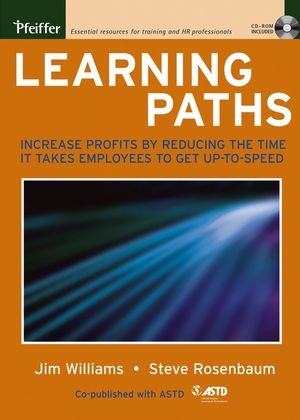
Learning Paths (eBook)
334 Seiten
John Wiley & Sons (Verlag)
978-0-7879-7534-0 (ISBN)
filled with illustrative examples, methods, techniques, strategies,
processes, and tools for making company-wide, real-time training
possible. Created to be flexible, the Learning Path approach can be
customized to fit your organization no matter what its type or
size. Learning Paths is divided into three sections:
The Learning Path Methodology: Walks the reader
through the major steps and strategies needed for building Learning
Paths.
Doing the Right Training: Offers a wide-range of
strategies, methods and techniques that can be targeted to the
training within a Learning Path and tied to an organization's
particular business needs.
Do the Training Right: Shows how to ensure the training
within a Learning Path is delivered in the most cost-effective
manner and introduces methods for structuring training so that it
transfers to the job easily and effectively.
Steve Rosenbaum is a consultant who has worked with America's leading companies including Disney, Dupont, Ceridian, GE Capital CarlsonWagonlit Travel, and Allina Health Systems to help them design, develop, and implement creative training solutions. Jim Williams is a training and development leader with more than twenty years experience creating and implementing training solutions to support organizational change and growth initiatives first at IBM and then at General Electric. They can be reached at www.LearningPathConsultants.com.
Contents of the CD-ROM.
Foreword.
Acknowledgments.
Introduction.
PART I: THE LEARNING PATH METHODOLOGY.
Chapter 1: From Graduation Day to Independence Day.
Costly Delay.
Independently Productive.
How People Really Learn.
Learning Path Methodology.
The 30/30 Plan.
Summary.
Chapter 2: Getting Started.
Readiness Assessment.
Selecting a Function.
Learning Path Teams.
Holding a Kickoff Meeting.
Case Study: Part 1.
Summary.
Chapter 3: Measuring Time to Proficiency.
Finding Independence Day.
Ongoing Measurement.
Business Results.
Case Study: Part 2.
Summary.
Chapter 4: Mapping Learning Paths.
Research.
Preparation.
Mapping Session.
Case Study: Part 3.
Summary.
Chapter 5: Finding Quick Hits.
Out with the Old Stuff.
Tests and Milestones.
Pre-Hire.
Add Coaching and Mentoring.
Job Aids.
Implementation.
Case Study: Part 4.
Thirty-Day Report.
Summary.
Chapter 6: Accelerating Learning Paths.
Applying Learning Principles.
Principle #1: Managers Need to Be Trainers.
Principle #2: Reserve Classroom Time for Practice and Discussion.
Principle #3: All Self-Study Needs to Be Directed Self-Study.
Principle #4: Teach the Whole Job, Not Parts.
Principle #5: Require Mastery, Not Participation.
Principle #6: Connect to Business Needs.
Principle #7: Embrace Technology.
Principle #8: Quantity Versus Quality.
Principle #9: Use Design Templates.
Principle #10: Make Content King--Write It Down.
Principle #11: Use Proficiencies Versus Competencies.
Principle #12: Motivation.
Learning Path Evaluation Checklist.
Case Study: Part 5.
Summary.
Chapter 7: Transition and Maintenance.
Transition Planning.
Phased-In Approach.
Motivation and Communication Issues.
Maintenance Planning.
Learning Management Systems.
Reporting Results.
Summary.
Chapter 8: Managing Learning Path Projects.
Common Pitfalls.
Building Support.
Development Process.
Organization.
Planning and Tracking.
Reviews.
Pilot Tests.
Editing and Proofing.
Training for Learning Path Teams.
Virtual Teams.
Summary.
PART II: DOING THE "RIGHT TRAINING".
Chapter 9: Building Proficiency Models.
Knowledge.
Skills.
Attitudes.
Competency Models.
Proficiency Models.
Learning Objectives and Activities.
Research Resources.
Summary.
Chapter 10: Developing Top Performers.
Top Performers.
Below Average Performers.
Experienced New Hires.
Ready for the Next Level.
Functions with Few Employees.
Manager/Leadership Paths.
Turnover.
Summary.
Chapter 11: Connecting to Business Needs.
Business Planning.
Role of the Learning Function Leader.
Planning Process.
Proficiency Planning Process.
Learning Path Planning Process.
Learning Paths and ROI.
Organizational Initiatives.
Summary.
Chapter 12: Capturing Content.
Presentations.
Electronic Capture.
Video.
Process Mapping.
Summary.
PART III: DOING THE "TRAINING RIGHT".
Chapter 13: Selecting Training Methods.
Factor 1: Effectiveness.
Factor 2: Cost.
Factor 3: Speed and Flexibility.
Summary.
Chapter 14: Establishing Managers as Coaches.
Motivator.
Teacher.
Job Aids.
Debriefing.
Training Meetings.
Evaluation and Feedback.
Coaching the Coaches 217
Coaching Guide.
Summary.
Chapter 15: Building Directed Self-Study.
Definition.
Development Process.
Instructional Design Template.
Compliance and Motivation.
Summary.
Chapter 16: Creating the New Classroom Experience.
Introductions.
Team Building.
Practice Activities.
Real Situations.
Games.
Compliance.
Follow-Up.
Summary.
A Final Note.
Frequently Asked Questions.
Tool Kit.
Resources.
Index.
About the Authors.
How to Use the CD-ROM.
Pfeiffer Publications Guide.
"Learning Paths hits the bulls eye to become more accountable in the companies we work in." (OD/Leadership Network News; 1/3/2005)
"This is the first real critical look at training that I have seen in 20 years. Every HR leader needs to read this book."
--Allan H. Kennel, senior vice president of human resources, retired, GE
"If you want to make your strategy work, this is the formula for success. The process, systems and tools are practical and effective."
--Edward Robbins, director of performance learning, Ceridian-Lifeworks Services
"As an educator for the last 30 years, I was really impressed. Very innovative! I can't wait to share it with the CEOs on our foundation board."
--Nick Maras, vice president of institutional advancement, Century College
"I've already started using many of the strategies in this book with my clients. It's a great methodology for any OD consultant."
--James Lynn, organizational psychologist, Lynn & Associates
| Erscheint lt. Verlag | 7.9.2004 |
|---|---|
| Sprache | englisch |
| Themenwelt | Sozialwissenschaften ► Pädagogik ► Berufspädagogik |
| Wirtschaft ► Betriebswirtschaft / Management ► Personalwesen | |
| Wirtschaft ► Betriebswirtschaft / Management ► Unternehmensführung / Management | |
| Schlagworte | Business & Management • Training & Development • Training u. Personalentwicklung • Wirtschaft u. Management |
| ISBN-10 | 0-7879-7534-6 / 0787975346 |
| ISBN-13 | 978-0-7879-7534-0 / 9780787975340 |
| Informationen gemäß Produktsicherheitsverordnung (GPSR) | |
| Haben Sie eine Frage zum Produkt? |
 PDF (Adobe DRM)
Kopierschutz: Adobe-DRM
Adobe-DRM ist ein Kopierschutz, der das eBook vor Mißbrauch schützen soll. Dabei wird das eBook bereits beim Download auf Ihre persönliche Adobe-ID autorisiert. Lesen können Sie das eBook dann nur auf den Geräten, welche ebenfalls auf Ihre Adobe-ID registriert sind.
Details zum Adobe-DRM
Dateiformat: PDF (Portable Document Format)
Mit einem festen Seitenlayout eignet sich die PDF besonders für Fachbücher mit Spalten, Tabellen und Abbildungen. Eine PDF kann auf fast allen Geräten angezeigt werden, ist aber für kleine Displays (Smartphone, eReader) nur eingeschränkt geeignet.
Systemvoraussetzungen:
PC/Mac: Mit einem PC oder Mac können Sie dieses eBook lesen. Sie benötigen eine
eReader: Dieses eBook kann mit (fast) allen eBook-Readern gelesen werden. Mit dem amazon-Kindle ist es aber nicht kompatibel.
Smartphone/Tablet: Egal ob Apple oder Android, dieses eBook können Sie lesen. Sie benötigen eine
Geräteliste und zusätzliche Hinweise
Buying eBooks from abroad
For tax law reasons we can sell eBooks just within Germany and Switzerland. Regrettably we cannot fulfill eBook-orders from other countries.
aus dem Bereich