Zum Hauptinhalt springen
Nicht aus der Schweiz? Besuchen Sie lehmanns.de

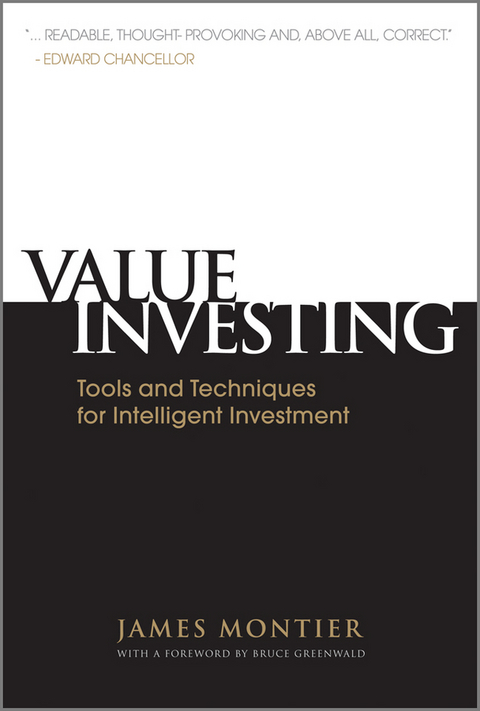
Value Investing (eBook)

Tools and Techniques for Intelligent Investment

(Autor)

eBook Download: EPUB
2022
John Wiley & Sons (Verlag)
978-0-470-68518-1 (ISBN)
Lese- und Medienproben

Value Investing - James Montier
Systemvoraussetzungen
31,99 inkl. MwSt
(CHF 31,25)
Der eBook-Verkauf erfolgt durch die Lehmanns Media GmbH (Berlin) zum Preis in Euro inkl. MwSt.
  • Download sofort lieferbar
  • Zahlungsarten anzeigen
'As with his weekly column, James Montier's Value Investing is a must read for all students of the financial markets. In short order, Montier shreds the 'efficient market hypothesis', elucidates the pertinence of behavioral finance, and explains the crucial difference between investment process and investment outcomes. Montier makes his arguments with clear insight and spirited good humor, and then backs them up with cold hard facts. Buy this book for yourself, and for anyone you know who cares about their capital!'
—Seth Klarman, President, The Baupost Group LLC

The seductive elegance of classical finance theory is powerful, yet value investing requires that we reject both the precepts of modern portfolio theory (MPT) and pretty much all of its tools and techniques.

In this important new book, the highly respected and controversial value investor and behavioural analyst, James Montier explains how value investing is the only tried and tested method of delivering sustainable long-term returns.

James shows you why everything you learnt at business school is wrong; how to think properly about valuation and risk; how to avoid the dangers of growth investing; how to be a contrarian; how to short stocks; how to avoid value traps; how to hedge ignorance using cheap insurance. Crucially he also gives real time examples of the principles outlined in the context of the 2008/09 financial crisis.

In this book James shares his tried and tested techniques and provides the latest and most cutting edge tools you will need to deploy the value approach successfully.

It provides you with the tools to start thinking in a different fashion about the way in which you invest, introducing the ways of over-riding the emotional distractions that will bedevil the pursuit of a value approach and ultimately think and act differently from the herd.

James Montier is a member of GMO's asset allocation team. Prior to that he was global strategist for Société Générale and Dresdner Kleinwort. He has been the top rated strategist in the annual extel survey for most of the last decade. He is also the author of three other books – Behavioural Finance (2000, Wiley), Behavioural Investing (2007, Wiley) and The Little Book of Behavioral Investing (Forthcoming, Wiley). James is a regular speaker at both academic and practitioner conferences, and is regarded as the leading authority on applying behavioural finance to investment. He is a visiting fellow at the University of Durham and a fellow of the Royal Society of Arts. He has been described as a maverick, an iconoclast, an enfant terrible by the press.


"e;A must read for all students of the financial markets . . . clear insight and spirited good humor [backed] up with cold hard facts."e; -Seth Klarman, President, The Baupost Group LLC The seductive elegance of classical finance theory is powerful, yet value investing requires that we reject both the precepts of modern portfolio theory (MPT) and pretty much all of its tools and techniques. In this important new book, highly respected and controversial value investor and behavioral analyst James Montier explains how value investing is the only tried and tested method of delivering sustainable long-term returns. He shows you why everything you learnt at business school is wrong; how to think properly about valuation and risk; how to avoid the dangers of growth investing; how to be a contrarian; how to short stocks; how to avoid value traps; and how to hedge ignorance using cheap insurance. Value Investing provides the tools to start thinking in a different fashion about the way in which you invest, introducing ways of overriding the emotional distractions that bedevil the pursuit of a value approach and ultimately thinking and acting differently from the herd. "e;A leading light in value investing and behavioral finance . . . shows you what's wrong with standard investment thinking and offers important insight into how to improve your process."e; Michael J. Mauboussin, Chief Investment Strategist at Legg Mason Capital Management, and author of Think Twice: Harnessing the Power of Counterintuition

James Montier is a member of GMO's asset allocation team. Prior to that he was global strategist for Société Générale and Dresdner Kleinwort. He has been the top rated strategist in the annual extel survey for most of the last decade. He is also the author of three other books - Behavioural Finance (2000, Wiley), Behavioural Investing (2007, Wiley) and The Little Book of Behavioral Investing (Forthcoming, Wiley). James is a regular speaker at both academic and practitioner conferences, and is regarded as the leading authority on applying behavioural finance to investment. He is a visiting fellow at the University of Durham and a fellow of the Royal Society of Arts. He has been described as a maverick, an iconoclast, an enfant terrible by the press.

Preface xi

Foreword xvii

Part I Why Everything You Learned in Business School Is Wrong 1

1 Six Impossible Things before Breakfast, or, How EMH has Damaged our Industry 3

2 CAPM is Crap 19

3 Pseudoscience and Finance: The Tyranny of Numbers and the Fallacy of Safety 29

4 The Dangers of Diversification and Evils of the Relative Performance Derby 39

5 The Dangers of DCF 47

6 Is Value Really Riskier than Growth? Dream On 57

7 Deflation, Depressions and Value 65

Part II The Behavioural Foundations of Value Investing 73

8 Learn to Love Your Dogs, or, Overpaying for the Hope of Growth (Again!) 75

9 Placebos, Booze and Glamour Stocks 85

10 Tears before Bedtime 93

11 Clear and Present Danger: The Trinity of Risk 105

12 Maximum Pessimism, Profit Warnings and the Heat of the Moment 113

13 The Psychology of Bear Markets 121

14 The Behavioural Stumbling Blocks to Value Investing 129

Part III The Philosophy of Value Investing 141

15 The Tao of Investing: The Ten Tenets of My Investment Creed 143

16 Process not Outcomes: Gambling, Sport and Investment! 165

17 Beware of Action Man 173

18 The Bullish Bias and the Need for Scepticism. Or, Am I Clinically Depressed? 181

19 Keep it Simple, Stupid 195

20 Confused Contrarians and Dark Days for Deep Value 205

Part IV The Empirical Evidence 215

21 Going Global: Value Investing without Boundaries 217

22 Graham's Net-Nets: Outdated or Outstanding? 229

Part V The 'dark Side' of Value Investing: Short Selling 237

23 Grimm's Fairy Tales of Investing 239

24 Joining the Dark Side: Pirates, Spies and Short Sellers 247

25 Cooking the Books, or, More Sailing Under the Black Flag 259

26 Bad Business: Thoughts on Fundamental Shorting and Value Traps 265

Part VI Real-time Value Investing 279

27 Overpaying for the Hope of Growth: The Case Against Emerging Markets 281

28 Financials: Opportunity or Value Trap? 291

29 Bonds: Speculation not Investment 299

30 Asset Fire Sales, Depression and Dividends 309

31 Cyclicals, Value Traps, Margins of Safety and Earnings Power 315

32 The Road to Revulsion and the Creation of Value 325

33 Revulsion and Valuation 343

34 Buy When it's Cheap - If Not Then, When? 355

35 Roadmap to Inflation and Sources of Cheap Insurance 361

36 Value Investors versus Hard-Core Bears: The Valuation Debate 371

References 379

Index 383

Preface

Part I: Why everything you learned in business school is wrong


In fairness I should have entitled Part I ‘Why Everything you Learned in Business School is Wrong (unless you went to Columbia)’. Equally well I could have used the title ‘Six Impossible Things Before Breakfast’.
The seductive elegance of classical finance theory is powerful, yet value investing requires that we reject both the precepts of modern portfolio theory (MPT) and almost all of its tools and techniques. The existence of MPT wouldn’t bother me nearly as much as it does, if real-world investors didn’t take its conclusions into investment practice. Sadly, all too often this is exactly what happens. Unfortunately, the prescriptions of MPT end up thwarting the investor. They lead us astray from the things on which we really should be concentrating.
Milton Freidman argued that a model shouldn’t be judged by its assumptions but rather by the accuracy of its predictions. The chapters in Part I attempt to demonstrate that the basic edicts of MPT are empirically flawed. The capital asset pricing model (CAPM), so beloved of MPT, leads investors to try to separate alpha and beta, rather than concentrate upon maximum after tax total real return (the true object of investment). The concept that risk can be measured by price fluctuations leads investors to focus upon tracking error and excessive diversification, rather than the risk of permanent loss of capital. The prevalent use of discounted cash flow models leads the unwary down the road of spurious accuracy, without any awareness of the extreme sensitivity of their models. As Third Avenue Management put it: DCF is like the Hubble telescope, if you move it an inch you end up studying a different galaxy. Thus, following MPT actually hinders rather than helps the investor.

Part II: The behavioural foundations of value investing


MPT holds that all returns must be a function of the risk entailed. Thus, the believers in this approach argue that the outperformance of value stocks over time must be a function of their inherent riskiness. I’ve always thought that this was a classic example of tautological thinking. The chapters in Part II attempt to demonstrate an alternative perspective - that the source of the value outperformance is a function of behavioural and institutional biases that prevent many investors from behaving sensibly.
We will cover the most dangerous (and one of the most common) errors that investors make - overpaying for the hope of growth (or capitalizing hope if you prefer). The chapters in Part II also try to provide you with the tools to enable you to start thinking differently about the way you invest. Value investing is the one form of investing that puts risk management at the very heart of the approach. However, you will have to rethink the notion of risk. You will learn to think of risk as a permanent loss of capital, not random fluctuations. You will also learn to understand the trinity of sources that compose this risk: valuation, earnings and balance sheets.
In Part II we will also try to introduce you to ways of overriding the emotional distractions that will bedevil the pursuit of a value approach. As Ben Graham said: ‘The investor’s chief problem - and even his worst enemy - is likely to be himself.’

Part III: The philosophy of value investing


The chapters in Part III set out the core principles involved in following a value approach. The first chapter lays out the 10 tenets of my approach to value investing, and details the elements you will need to be able to display if you intend to follow the value approach:
• Tenet I: Value, value, value
• Tenet II: Be contrarian
• Tenet III: Be patient
• Tenet IV: Be unconstrained
• Tenet V: Don’t forecast
• Tenet VI: Cycles matter
• Tenet VII: History matters
• Tenet VIII: Be sceptical
• Tenet IX: Be top-down and bottom-up
• Tenet X: Treat your clients as you would treat yourself
The remaining chapters explore some of the issues in more depth, such as the need for patience, and the need to think independently. One of the most important chapters in Part III concerns the role of process versus outcomes. As we have no control over outcomes, the only thing we can control is the process. The best way to achieve good outcomes is to have a sensible investment process as this maximizes the chances of success. As Ben Graham said: ‘I recall . . . the emphasis that the bridge experts place on playing a hand right rather than playing it successfully. Because, as you know, if you play it right you are going to make money and if you play it wrong you lose money - in the long run.’

Part IV: The empirical evidence


Nassim Taleb talks about the need for empirical scepticism. This, in effect, is a desire to check your beliefs against the evidence. The two chapters in Part IV provide a very brief look at the evidence on value investing. The first looks at the proposition that an unconstrained global approach to value investing can create returns. The second considers a deep value technique, much loved by Ben Graham, and shows that it still works today (a direct response to those who argue that Graham’s approach is outdated or outmoded). I could have included additional chapters in Part IV, but many excellent surveys on the evidence supporting value investing are easily available to the interested reader. The ultimate proof of the value approach is that almost all (if not all) of the world’s most successful investors take a value approach. As Warren Buffett opined:
I would like you to imagine a national coin-flipping contest. Let’s assume we get 225 million Americans up tomorrow morning and we ask them all to wager a dollar. They go out in the morning at sunrise, and they all call the flip of a coin. If they call correctly, they win a dollar from those who called wrong. Each day the losers drop out, and on the subsequent day the stakes build as all previous winnings are put on the line. After ten flips on ten mornings, there will be approximately 220,000 people in the United States who have correctly called ten flips in a row. They each will have won a little over $1,000.
Now this group will probably start getting a little puffed up about this, human nature being what it is. They may try to be modest, but at cocktail parties they will occasionally admit to attractive members of the opposite sex what their technique is, and what marvellous insights they bring to the field of flipping.
Assuming that the winners are getting the appropriate rewards from the losers, in another ten days we will have 215 people who have successfully called their coin flips 20 times in a row and who, by this exercise, each have turned one dollar into a little over $1 million. $225 million would have been lost, $225 million would have been won.
By then, this group will really lose their heads. They will probably write books on ‘How I Turned a Dollar into a Million in Twenty Days Working Thirty Seconds a Morning.’ Worse yet, they’ll probably start jetting around the country attending seminars on efficient coin-flipping and tackling skeptical professors with, ‘If it can’t be done, why are there 215 of us?’
By then some business school professor will probably be rude enough to bring up the fact that if 225 million orangutans had engaged in a similar exercise, the results would be much the same - 215 egotistical orangutans with 20 straight winning flips.
I would argue, however, that there are some important differences in the examples I am going to present. For one thing, if (a) you had taken 225 million orangutans distributed roughly as the US population is, if (b) 215 winners were left after 20 days, and if (c) you found that 40 came from a particular zoo in Omaha, you would be pretty sure you were on to something. So you would probably go out and ask the zookeeper about what he’s feeding them, whether they had special exercises, what books they read, and who knows what else. That is, if you found any really extraordinary concentrations of success, you might want to see if you could identify concentrations of unusual characteristics that might be causal factors.
Scientific inquiry naturally follows such a pattern. If you were trying to analyse possible causes of a rare type of cancer - with, say, 1,500 cases a year in the United States - and you found that 400 of them occurred in some little mining town in Montana, you would get very interested in the water there, or the occupation of those afflicted, or other variables. You know it’s not random chance that 400 come from a small area. You would not necessarily know the causal factors, but you would know where to search.
I submit to you that there are ways of defining an origin other than geography. In addition to geographical origins, there can be what I call an intellectual origin. I think you will find that a disproportionate number of successful coin-flippers in the investment world came from a very small intellectual village that could be called Graham-and-Doddsville. A concentration of winners that simply cannot be explained by chance can be traced to this particular intellectual village.

Part V: The ‘Dark Side’ of value investing: Short selling


The recent market woes have led to the all-too-predictable backlash against short sellers. Indeed this pattern seems to have existed since time immemorial. As stated in the New York...

Erscheint lt. Verlag 31.8.2022
Sprache englisch
Themenwelt Recht / Steuern Wirtschaftsrecht
Wirtschaft Betriebswirtschaft / Management Finanzierung
Schlagworte anyone • arguments • behavioral • between investment • Book • Capital • clear insight • cold • crucial • difference • FACTS • Finance • Finance & Investments • Financial • Finanz- u. Anlagewesen • good humor • Hard • Investments & Securities • james montiers • Kapitalanlage • Kapitalanlagen u. Wertpapiere • market hypothesis • Markets • Montier • outcomes • Pertinence • students • Weekly
ISBN-10 0-470-68518-2 / 0470685182
ISBN-13 978-0-470-68518-1 / 9780470685181
Informationen gemäß Produktsicherheitsverordnung (GPSR)
Haben Sie eine Frage zum Produkt?
EPUBEPUB (Adobe DRM)

Kopierschutz: Adobe-DRM
Adobe-DRM ist ein Kopierschutz, der das eBook vor Mißbrauch schützen soll. Dabei wird das eBook bereits beim Download auf Ihre persönliche Adobe-ID autorisiert. Lesen können Sie das eBook dann nur auf den Geräten, welche ebenfalls auf Ihre Adobe-ID registriert sind.
Details zum Adobe-DRM

Dateiformat: EPUB (Electronic Publication)
EPUB ist ein offener Standard für eBooks und eignet sich besonders zur Darstellung von Belle­tristik und Sach­büchern. Der Fließ­text wird dynamisch an die Display- und Schrift­größe ange­passt. Auch für mobile Lese­geräte ist EPUB daher gut geeignet.

Systemvoraussetzungen:
PC/Mac: Mit einem PC oder Mac können Sie dieses eBook lesen. Sie benötigen eine Adobe-ID und die Software Adobe Digital Editions (kostenlos). Von der Benutzung der OverDrive Media Console raten wir Ihnen ab. Erfahrungsgemäß treten hier gehäuft Probleme mit dem Adobe DRM auf.
eReader: Dieses eBook kann mit (fast) allen eBook-Readern gelesen werden. Mit dem amazon-Kindle ist es aber nicht kompatibel.
Smartphone/Tablet: Egal ob Apple oder Android, dieses eBook können Sie lesen. Sie benötigen eine Adobe-ID sowie eine kostenlose App.
Geräteliste und zusätzliche Hinweise

Buying eBooks from abroad
For tax law reasons we can sell eBooks just within Germany and Switzerland. Regrettably we cannot fulfill eBook-orders from other countries.

Mehr entdecken
aus dem Bereich
Mit den Besonderheiten beim Auto- und Dienstradleasing sowie beim …

von Wolfgang Grundmann

eBook Download (2025)
Springer Gabler (Verlag)
CHF 53,70
Wohlstand steigern – Ungleichheit verringern – Demokratie stärken

von Hans-Jörg Naumer

eBook Download (2024)
Springer Fachmedien Wiesbaden (Verlag)
CHF 38,95