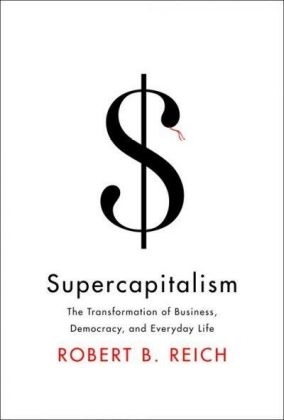
Supercapitalism (eBook)
288 Seiten
Knopf Doubleday Publishing Group (Verlag)
978-0-307-26785-6 (ISBN)
From one of America's foremost economic and political thinkers comes a vital analysis of our new hypercompetitive and turbo-charged global economy and the effect it is having on American democracy. With his customary wit and insight, Reich shows how widening inequality of income and wealth, heightened job insecurity, and corporate corruption are merely the logical results of a system in which politicians are more beholden to the influence of business lobbyists than to the voters who elected them. Powerful and thought-provoking, Supercapitalism argues that a clear separation of politics and capitalism will foster an enviroment in which both business and government thrive, by putting capitalism in the service of democracy, and not the other way around.
From the Trade Paperback edition.
From one of America's foremost economic and political thinkers comes a vital analysis of our new hypercompetitive and turbo-charged global economy and the effect it is having on American democracy. With his customary wit and insight, Reich shows how widening inequality of income and wealth, heightened job insecurity, and corporate corruption are merely the logical results of a system in which politicians are more beholden to the influence of business lobbyists than to the voters who elected them. Powerful and thought-provoking, Supercapitalism argues that a clear separation of politics and capitalism will foster an enviroment in which both business and government thrive, by putting capitalism in the service of democracy, and not the other way around.
Roughly between 1945 and 1975, America struck a remarkable accommodation between capitalism and democracy. It combined a hugely productive economic system with a broadly responsive and widely admired political system. America in those years achieved its highest degree of income equality (since measurements have been available). It generated a larger proportion of good-paying jobs than before or since, and more economic security than ever for more of its people. Perhaps not coincidentally, in those years Americans also expressed high confidence in democracy and trust in government, both of which sharply declined in subsequent years.[1] That singular success and that powerful promise extended the moral authority of the American system throughout the world. In contrast to Soviet communism, America became an exemplar of both political freedom and suburban middle-class affluence.
The economy was based on mass production. Mass production was profitable because a large middle class had enough money to purchase what could be mass-produced. The middle class had the money because the profits from mass production were divided up between the giant corporations and their suppliers, retailers, and employees. The bargaining power of these latter groups was enhanced and enforced by government action. Almost a third of the workforce belonged to a labor union. Economic benefits were also spread across the nation--to farmers, veterans, smaller towns, and small businesses--through regulation (of railroads, telephones, utilities, and energy supplies) and subsidy (price supports, highways, federal loans). Thus did democracy offset the economic power of large-scale production and widely disperse its benefits.
But it was not quite a golden age. Women and minorities still struggled for political equality and economic opportunity. Much of the nation's poverty was hidden away in rural hollows or black ghettos. Foreign policy, ostensibly shaped by the perceived threat of Soviet communism, all too frequently pandered to the needs of large American firms for cheap raw materials abroad, such as bananas, tin, and oil. Civil liberties were imperiled during Senator Joe McCarthy's anti-communist witch hunt. Much of American life was monotonous, conformist, and deadly dull. And yet for all its shortcomings, democratic capitalism seemed to be working remarkably well, and on the way to working even better.
In order to understand what happened to the Not Quite Golden Age, we first need to understand how it came about.
The evolution began as the nineteenth century ended, when large corporations posed a profound challenge to American democracy. They brought a new level of prosperity to the nation but also sweatshops, child labor, and unsafe working conditions, and they monopolized whole industries. The unprecedented economic power of these giant companies made them politically unaccountable. America groped for a way to respond.
It started with outsized personalities whose footprints are still visible--J. P. Morgan, a banker's son who sold stocks for the railroads, engineered a huge rail combination, and became a wealthy financier (J. P. Morgan and Sons, which evolved into today's Morgan Stanley), Andrew Carnegie, who began as a telephone clerk, rose to the presidency of the Pennsylvania Railroad, and then made a fortune as a steel magnate (Carnegie Steel), John D. Rockefeller, who started as a bookkeeper in Cleveland, bought his first oil refinery in 1862, cornered the oil market in the 1890s with his Standard Oil Company (whose descendant is ExxonMobil), and then moved into coal, iron, shipping, copper, and banking (Chase Manhattan), and, subsequently, Henry Ford.
With these...
| Erscheint lt. Verlag | 4.9.2007 |
|---|---|
| Sprache | englisch |
| Themenwelt | Sozialwissenschaften ► Politik / Verwaltung |
| Sozialwissenschaften ► Soziologie ► Allgemeines / Lexika | |
| Wirtschaft ► Volkswirtschaftslehre ► Makroökonomie | |
| ISBN-10 | 0-307-26785-7 / 0307267857 |
| ISBN-13 | 978-0-307-26785-6 / 9780307267856 |
| Informationen gemäß Produktsicherheitsverordnung (GPSR) | |
| Haben Sie eine Frage zum Produkt? |
 EPUB (Adobe DRM)
Kopierschutz: Adobe-DRM
Adobe-DRM ist ein Kopierschutz, der das eBook vor Mißbrauch schützen soll. Dabei wird das eBook bereits beim Download auf Ihre persönliche Adobe-ID autorisiert. Lesen können Sie das eBook dann nur auf den Geräten, welche ebenfalls auf Ihre Adobe-ID registriert sind.
Details zum Adobe-DRM
Dateiformat: EPUB (Electronic Publication)
EPUB ist ein offener Standard für eBooks und eignet sich besonders zur Darstellung von Belletristik und Sachbüchern. Der Fließtext wird dynamisch an die Display- und Schriftgröße angepasst. Auch für mobile Lesegeräte ist EPUB daher gut geeignet.
Systemvoraussetzungen:
PC/Mac: Mit einem PC oder Mac können Sie dieses eBook lesen. Sie benötigen eine
eReader: Dieses eBook kann mit (fast) allen eBook-Readern gelesen werden. Mit dem amazon-Kindle ist es aber nicht kompatibel.
Smartphone/Tablet: Egal ob Apple oder Android, dieses eBook können Sie lesen. Sie benötigen eine
Geräteliste und zusätzliche Hinweise
Buying eBooks from abroad
For tax law reasons we can sell eBooks just within Germany and Switzerland. Regrettably we cannot fulfill eBook-orders from other countries.
aus dem Bereich