Zum Hauptinhalt springen
Nicht aus der Schweiz? Besuchen Sie lehmanns.de
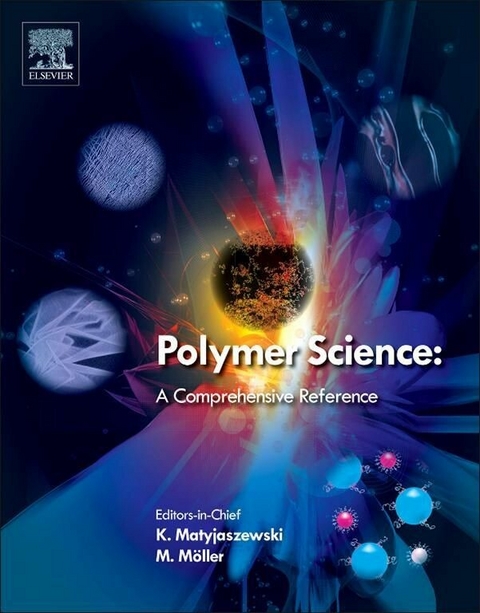
Polymer Science: A Comprehensive Reference

Polymer Science: A Comprehensive Reference (eBook)

eBook Download: PDF | EPUB
2012 | 1. Auflage
7760 Seiten
Elsevier Science (Verlag)
978-0-08-087862-1 (ISBN)
4.150,00 € (CHF 4.049,95)
Systemvoraussetzungen
4.283,17 € (CHF 4.179,95)
Systemvoraussetzungen
Der eBook-Verkauf erfolgt durch die Lehmanns Media GmbH (Berlin) zum Preis in Euro inkl. MwSt.
  • Download sofort lieferbar
  • Zahlungsarten anzeigen
Zu diesem Artikel existiert eine Nachauflage
The progress in polymer science is revealed in the chapters of Polymer Science: A Comprehensive Reference, Ten Volume Set. In Volume 1, this is reflected in the improved understanding of the properties of polymers in solution, in bulk and in confined situations such as in thin films. Volume 2 addresses new characterization techniques, such as high resolution optical microscopy, scanning probe microscopy and other procedures for surface and interface characterization. Volume 3 presents the great progress achieved in precise synthetic polymerization techniques for vinyl monomers to control macromolecular architecture: the development of metallocene and post-metallocene catalysis for olefin polymerization, new ionic polymerization procedures, and atom transfer radical polymerization, nitroxide mediated polymerization, and reversible addition-fragmentation chain transfer systems as the most often used controlled/living radical polymerization methods. Volume 4 is devoted to kinetics, mechanisms and applications of ring opening polymerization of heterocyclic monomers and cycloolefins (ROMP), as well as to various less common polymerization techniques. Polycondensation and non-chain polymerizations, including dendrimer synthesis and various "e;click"e; procedures, are covered in Volume 5. Volume 6 focuses on several aspects of controlled macromolecular architectures and soft nano-objects including hybrids and bioconjugates. Many of the achievements would have not been possible without new characterization techniques like AFM that allowed direct imaging of single molecules and nano-objects with a precision available only recently. An entirely new aspect in polymer science is based on the combination of bottom-up methods such as polymer synthesis and molecularly programmed self-assembly with top-down structuring such as lithography and surface templating, as presented in Volume 7. It encompasses polymer and nanoparticle assembly in bulk and under confined conditions or influenced by an external field, including thin films, inorganic-organic hybrids, or nanofibers. Volume 8 expands these concepts focusing on applications in advanced technologies, e.g. in electronic industry and centers on combination with top down approach and functional properties like conductivity. Another type of functionality that is of rapidly increasing importance in polymer science is introduced in volume 9. It deals with various aspects of polymers in biology and medicine, including the response of living cells and tissue to the contact with biofunctional particles and surfaces. The last volume is devoted to the scope and potential provided by environmentally benign and green polymers, as well as energy-related polymers. They discuss new technologies needed for a sustainable economy in our world of limited resources. - Provides broad and in-depth coverage of all aspects of polymer science from synthesis/polymerization, properties, and characterization methods and techniques to nanostructures, sustainability and energy, and biomedical uses of polymers- Provides a definitive source for those entering or researching in this area by integrating the multidisciplinary aspects of the science into one unique, up-to-date reference work- Electronic version has complete cross-referencing and multi-media components- Volume editors are world experts in their field (including a Nobel Prize winner)
Erscheint lt. Verlag 5.12.2012
Mitarbeit Chef-Herausgeber: Krzysztof Matyjaszewski, Martin Moeller
Sprache englisch
Themenwelt Schulbuch / Wörterbuch Lexikon / Chroniken
Mathematik / Informatik Mathematik Analysis
Naturwissenschaften Chemie Organische Chemie
Naturwissenschaften Chemie Technische Chemie
Technik Maschinenbau
Wirtschaft
ISBN-10 0-08-087862-8 / 0080878628
ISBN-13 978-0-08-087862-1 / 9780080878621
Informationen gemäß Produktsicherheitsverordnung (GPSR)
Haben Sie eine Frage zum Produkt?
PDFPDF (Adobe DRM)
Größe: 249,7 MB

Kopierschutz: Adobe-DRM
Adobe-DRM ist ein Kopierschutz, der das eBook vor Mißbrauch schützen soll. Dabei wird das eBook bereits beim Download auf Ihre persönliche Adobe-ID autorisiert. Lesen können Sie das eBook dann nur auf den Geräten, welche ebenfalls auf Ihre Adobe-ID registriert sind.
Details zum Adobe-DRM

Dateiformat: PDF (Portable Document Format)
Mit einem festen Seiten­layout eignet sich die PDF besonders für Fach­bücher mit Spalten, Tabellen und Abbild­ungen. Eine PDF kann auf fast allen Geräten ange­zeigt werden, ist aber für kleine Displays (Smart­phone, eReader) nur einge­schränkt geeignet.

Systemvoraussetzungen:
PC/Mac: Mit einem PC oder Mac können Sie dieses eBook lesen. Sie benötigen eine Adobe-ID und die Software Adobe Digital Editions (kostenlos). Von der Benutzung der OverDrive Media Console raten wir Ihnen ab. Erfahrungsgemäß treten hier gehäuft Probleme mit dem Adobe DRM auf.
eReader: Dieses eBook kann mit (fast) allen eBook-Readern gelesen werden. Mit dem amazon-Kindle ist es aber nicht kompatibel.
Smartphone/Tablet: Egal ob Apple oder Android, dieses eBook können Sie lesen. Sie benötigen eine Adobe-ID sowie eine kostenlose App.
Geräteliste und zusätzliche Hinweise

Buying eBooks from abroad
For tax law reasons we can sell eBooks just within Germany and Switzerland. Regrettably we cannot fulfill eBook-orders from other countries.

EPUBEPUB (Adobe DRM)

Kopierschutz: Adobe-DRM
Adobe-DRM ist ein Kopierschutz, der das eBook vor Mißbrauch schützen soll. Dabei wird das eBook bereits beim Download auf Ihre persönliche Adobe-ID autorisiert. Lesen können Sie das eBook dann nur auf den Geräten, welche ebenfalls auf Ihre Adobe-ID registriert sind.
Details zum Adobe-DRM

Dateiformat: EPUB (Electronic Publication)
EPUB ist ein offener Standard für eBooks und eignet sich besonders zur Darstellung von Belle­tristik und Sach­büchern. Der Fließ­text wird dynamisch an die Display- und Schrift­größe ange­passt. Auch für mobile Lese­geräte ist EPUB daher gut geeignet.

Systemvoraussetzungen:
PC/Mac: Mit einem PC oder Mac können Sie dieses eBook lesen. Sie benötigen eine Adobe-ID und die Software Adobe Digital Editions (kostenlos). Von der Benutzung der OverDrive Media Console raten wir Ihnen ab. Erfahrungsgemäß treten hier gehäuft Probleme mit dem Adobe DRM auf.
eReader: Dieses eBook kann mit (fast) allen eBook-Readern gelesen werden. Mit dem amazon-Kindle ist es aber nicht kompatibel.
Smartphone/Tablet: Egal ob Apple oder Android, dieses eBook können Sie lesen. Sie benötigen eine Adobe-ID sowie eine kostenlose App.
Geräteliste und zusätzliche Hinweise

Buying eBooks from abroad
For tax law reasons we can sell eBooks just within Germany and Switzerland. Regrettably we cannot fulfill eBook-orders from other countries.

Mehr entdecken
aus dem Bereich