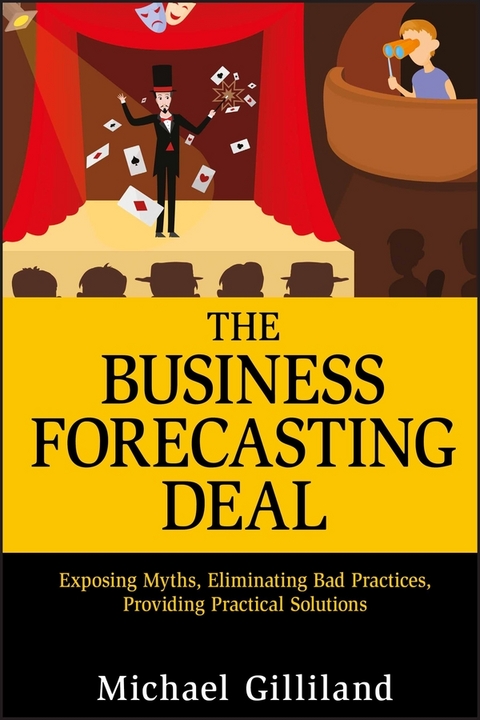
The Business Forecasting Deal (eBook)
272 Seiten
John Wiley & Sons (Verlag)
978-0-470-76965-2 (ISBN)
forecasting
Written in a nontechnical style, this book provides practical
solutions to common business forecasting problems, showing you how
to think about business forecasting in the context of uncertainty,
randomness and process performance.
* Addresses the philosophical foundations of forecasting
* Raises awareness of fundamental issues usually overlooked in
pursuit of the perfect forecast
* Introduces a new way to think about business forecasting,
focusing on process efficiency and the elimination of worst
practices
* Provides practical approaches for the non-statistical problems
forecasters face
* Illustrates Forecast Value Added (FVA) Analysis for identifying
waste in the forecasting process
Couched in the context of uncertainty, randomness, and process
performance, this book offers new, innovative ideas for resolving
your business forecasting problems.
MICHAEL GILLILAND is Product Marketing Manager at SAS Institute and has worked in consu-mer products forecasting for more than twenty years. Prior to joining SAS in 2004, Mike held forecasting management positions in the food, electronics, and apparel industries and served as a consultant. He is a frequent speaker at industry events, has published articles in Supply Chain Management Review, Journal of Business Forecasting, Foresight, and APICS magazine, and was a columnist on "Worst Practices in Business Forecasting" for Supply Chain Forecasting Digest. Mike holds a BA in philosophy from Michigan State University, and master's degrees in philosophy and mathematical sciences from Johns Hopkins University. Follow his blog, The Business Forecasting Deal, at blogs.sas.com/forecasting.
Foreword (Tom Wallace).
Foreword (Anne G. Robinson).
Acknowledgments.
Prologue.
Chapter 1 Fundamental Issues in Business Forecasting.
The Problem of Induction.
The Realities of Business Forecasting.
The Contest.
What Is Demand?
Constrained Forecast.
Demand Volatility.
Inherent Volatility and Artificial Volatility.
Evils of Volatility.
Evaluating Forecast Performance.
Embarking on Improvement.
Notes.
Chapter 2 Worst Practices in Business Forecasting: Part 1.
Worst Practices in the Mechanics of Forecasting.
Model "Overfi tting" and "Pick-Best" Selection.
Confusing Model Fit with Forecast Accuracy.
Accuracy Expectations and Performance Goals.
Failure to Use a Naïve Model or Assess Forecast Value Added.
Forecasting Hierarchies.
Outlier Handling.
Notes.
Chapter 3 Worst Practices in Business Forecasting: Part 2.
Worst Practices in the Process and Practices of Forecasting.
Politics of Forecasting.
Blaming the Forecast.
Adding Variation to Demand.
Evangelical Forecasting.
Overinvesting in the Forecasting Function.
Forecasting Performance Measurement and Reporting.
Forecasting Software Selection.
Editorial Comment on Forecasting Practices.
Notes.
Chapter 4 Forecast Value Added Analysis.
What Is Forecast Value Added?
The Naïve Forecast.
Why Is FVA Important?
FVA Analysis: Step-by-Step.
Further Application of FVA Analysis.
Case Studies.
Summary: The Lean Approach to Forecasting.
Notes.
Chapter 5 Forecasting without History.
Typical New Product Forecasting Situations.
New Product Forecasting by Structured Analogy.
Organizational Realignment.
Summary.
Notes.
Chapter 6 Alternative Approaches to the Problems of Business Forecasting.
Statistical Approach.
Collaborative Approach.
Supply Chain Engineering Approach.
Pruning Approach.
Summary.
Notes.
Chapter 7 Implementing a Forecasting Solution.
Why Do Forecasting Implementations Fail?
Preproject Assessment.
Requesting Information or Proposals.
Evaluating Software Vendors.
Warning Signs of Failure.
Notes.
Chapter 8 Practical First Steps.
Step 1: Recognize the Volatility versus Accuracy Relationship.
Step 2: Determine Inherent and Artificial Volatility.
Step 3: Understand What Accuracy Is Reasonable to Expect.
Step 4: Use Forecast Value Added Analysis to Eliminate Wasted Efforts.
Step 5: Utilize Meaningful Performance Metrics and Reporting.
Step 6: Eliminate Worst Practices.
Step 7: Consult Forecasting Resources.
Notes.
Chapter 9 What Management Must Know About Forecasting.
Aphorism 1: Forecasting Is a Huge Waste of Management Time.
Aphorism 2: Accuracy Is Determined More by the Nature of the Behavior Being Forecast than by the Specific Method Being Used to Forecast It.
Aphorism 3: Organizational Policies and Politics Can Have a Significant Impact on Forecasting Effectiveness.
Aphorism 4: You May Not Control the Accuracy Achieved, But You Can Control the Process Used and the Resources You Invest.
Aphorism 5: The Surest Way to Get a Better Forecast Is to Make the Demand Forecastable.
Aphorism 6: Minimize the Organization's Reliance on Forecasting.
Aphorism 7: Before Investing in a New System or Process, Put It to the Test.
Notes.
Epilogue.
Glossary.
Appendix Forecasting FAQs.
Accuracy Expectations.
Performance Benchmarks.
Performance Measurement and Reporting.
The Naïve Forecast.
Forecast Value Added Analysis.
Forecast Modeling.
Politics and Practices of Forecasting.
Demand Volatility.
Forecasting Process.
Judgment.
Forecasting Organization.
Low Volume/Intermittent Demand.
New Product Forecasting.
Forecasting Hierarchy.
Software Selection.
Index.
| Erscheint lt. Verlag | 14.5.2010 |
|---|---|
| Reihe/Serie | SAS Institute Inc | SAS Institute Inc |
| Sprache | englisch |
| Themenwelt | Wirtschaft ► Betriebswirtschaft / Management ► Unternehmensführung / Management |
| Schlagworte | Business & Management • Strategic Management • Strategisches Management • Wirtschaft u. Management |
| ISBN-10 | 0-470-76965-3 / 0470769653 |
| ISBN-13 | 978-0-470-76965-2 / 9780470769652 |
| Informationen gemäß Produktsicherheitsverordnung (GPSR) | |
| Haben Sie eine Frage zum Produkt? |
 EPUB (Adobe DRM)
Kopierschutz: Adobe-DRM
Adobe-DRM ist ein Kopierschutz, der das eBook vor Mißbrauch schützen soll. Dabei wird das eBook bereits beim Download auf Ihre persönliche Adobe-ID autorisiert. Lesen können Sie das eBook dann nur auf den Geräten, welche ebenfalls auf Ihre Adobe-ID registriert sind.
Details zum Adobe-DRM
Dateiformat: EPUB (Electronic Publication)
EPUB ist ein offener Standard für eBooks und eignet sich besonders zur Darstellung von Belletristik und Sachbüchern. Der Fließtext wird dynamisch an die Display- und Schriftgröße angepasst. Auch für mobile Lesegeräte ist EPUB daher gut geeignet.
Systemvoraussetzungen:
PC/Mac: Mit einem PC oder Mac können Sie dieses eBook lesen. Sie benötigen eine
eReader: Dieses eBook kann mit (fast) allen eBook-Readern gelesen werden. Mit dem amazon-Kindle ist es aber nicht kompatibel.
Smartphone/Tablet: Egal ob Apple oder Android, dieses eBook können Sie lesen. Sie benötigen eine
Geräteliste und zusätzliche Hinweise
Buying eBooks from abroad
For tax law reasons we can sell eBooks just within Germany and Switzerland. Regrettably we cannot fulfill eBook-orders from other countries.
aus dem Bereich