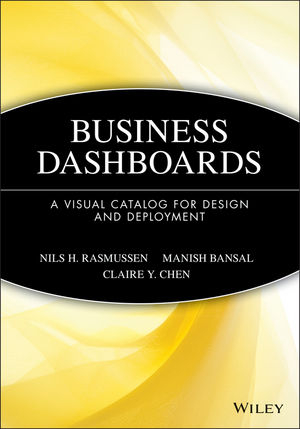
Business Dashboards (eBook)
304 Seiten
John Wiley & Sons (Verlag)
978-0-470-46069-6 (ISBN)
organization, this timely, full color book reveals how to
successfully deploy dashboards by building the optimal software
architecture and dashboard design. In addition, it describes the
value of this popular technology to a business and how it can have
a significant impact on performance improvement. A unique
collection of more than 120 dashboard images are organized by
category. One of the chapters provides a step-by-step description
of the key performance indicator (KPIs) design process. One of the
appendices contains more than 1,000 examples of KPIs to help design
the content of dashboards. The book also describes all the steps in
a dashboard implementation and offers related advice.
Nils Rasmussen (West Hollywood, CA) is cofounder and Principal
of Solver, Inc. Claire Y. Chen (Long Beach, CA) is a Senior
Business Intelligence Architect at Solver, Inc. Manish Bansal
(Irvine, CA) is Vice President of Sales at Solver, Inc.
NILS RASMUSSEN, BA, MBA, is the CEO at Solver, Inc., an international company that provides implementation of comprehensive performance management, planning, analytics, scorecard, and dashboard solutions. He is the coauthor of three titles published by John Wiley & Sons. CLAIRE Y. CHEN is the Chief Business Intelligence Architect at Solver, Inc., and the Microsoft Virtual Technology Specialist in Southern California region. She is well experienced in providing data warehouse and business intelligence solutions via multiple technologies in various industries. MANISH BANSAL, BE, MS, is the Vice President at Solver, Inc., and advises companies on various ways to improve performance by leveraging technology solutions. He is an experienced management consultant who has worked across various industries and functional areas, with a special focus to deliver value.
Preface.
Book Summary.
Part 1. Introduction to Dashboards.
Chapter 1. Dashboards Definition.
Chapter 2. Dashboards' Role in a Business Intelligence
Solution.
Chapter 3. Why Dashboards Have Become so Popular.
Chapter 4. Types of Dashboards.
Chapter 5. Designing Metrics and Key Performance Indicators.
Chapter 6. Dashboard Scenario: Use Case.
Chapter 7. Getting Ready for the Implementation.
Part 2. Summary and Readiness Checklist.
Part Two. Creating the Right Business Intelligence
Architecture for Dashboards.
Chapter 8. Why a Good Architecture Is Important.
Chapter 9. Data Warehouse Techniques.
Chapter 10. Data Replication and Delivery.
Chapter 11. Query Language and Interactivity.
Chapter 12. Data Warehouse and Business Intelligence Dashboard
Paradigm.
Chapter 13. Mobile Business Intelligence.
Part Two. Summary and Readiness Checklist.
Part 3. Dashboard Design.
Chapter 14. Design Tips.
Chapter 15. Dashboard Examples.
Part Three. Summary and Readiness Checklist.
Part 4. Managing a Dashboard Project.
Chapter 16. Planning the Project.
Chapter 17. Engaging the Users.
Chapter 18. Project Tips.
Chapter 19. Training and Deployment.
Part Four. Summary and Readiness Checklist.
Appendix A. Software Selection Tips.
Appendix B. Installation.
Appendix C. Hardware Recommendations.
Appendix D. Security Authentication Techniques.
Appendix E. Metrics and Key Performance Indicator Examples.
About the Authors.
Index.
"The book tackles the question from the ground up, explaining what dashboards are and what they're for, before diving deeply into data architecture and visual design, with tons of examples and illustrations. It even explains why dashboards are so popular." (Accounting Today, June 1-14, 2009)
| Erscheint lt. Verlag | 31.3.2009 |
|---|---|
| Sprache | englisch |
| Themenwelt | Wirtschaft ► Betriebswirtschaft / Management ► Unternehmensführung / Management |
| Schlagworte | Business & Management • Business Technology • Unternehmenstechnologie • Wirtschaft u. Management |
| ISBN-10 | 0-470-46069-5 / 0470460695 |
| ISBN-13 | 978-0-470-46069-6 / 9780470460696 |
| Informationen gemäß Produktsicherheitsverordnung (GPSR) | |
| Haben Sie eine Frage zum Produkt? |
 EPUB (Adobe DRM)
Kopierschutz: Adobe-DRM
Adobe-DRM ist ein Kopierschutz, der das eBook vor Mißbrauch schützen soll. Dabei wird das eBook bereits beim Download auf Ihre persönliche Adobe-ID autorisiert. Lesen können Sie das eBook dann nur auf den Geräten, welche ebenfalls auf Ihre Adobe-ID registriert sind.
Details zum Adobe-DRM
Dateiformat: EPUB (Electronic Publication)
EPUB ist ein offener Standard für eBooks und eignet sich besonders zur Darstellung von Belletristik und Sachbüchern. Der Fließtext wird dynamisch an die Display- und Schriftgröße angepasst. Auch für mobile Lesegeräte ist EPUB daher gut geeignet.
Systemvoraussetzungen:
PC/Mac: Mit einem PC oder Mac können Sie dieses eBook lesen. Sie benötigen eine
eReader: Dieses eBook kann mit (fast) allen eBook-Readern gelesen werden. Mit dem amazon-Kindle ist es aber nicht kompatibel.
Smartphone/Tablet: Egal ob Apple oder Android, dieses eBook können Sie lesen. Sie benötigen eine
Geräteliste und zusätzliche Hinweise
Buying eBooks from abroad
For tax law reasons we can sell eBooks just within Germany and Switzerland. Regrettably we cannot fulfill eBook-orders from other countries.
aus dem Bereich