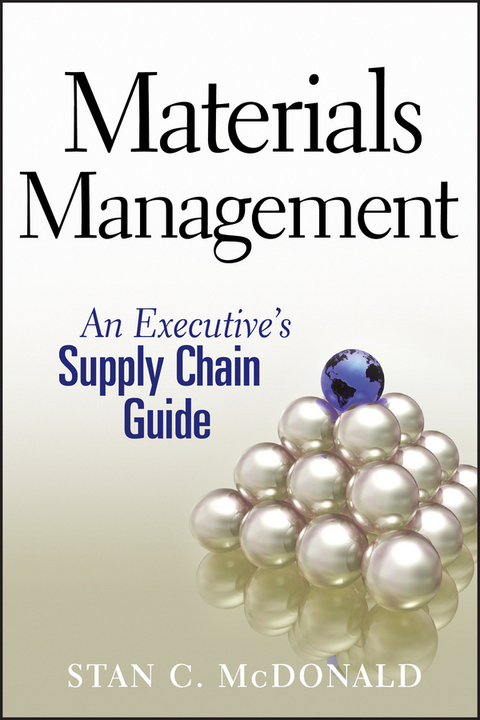
Materials Management (eBook)
208 Seiten
John Wiley & Sons (Verlag)
978-0-470-44909-7 (ISBN)
to create a world-class materials management program
This nuts-and-bolts guide presents an overview of the inner
workings of the materials process, as well as the best practices to
achieve a world-class operating system that will help to eliminate
ineffective materials management. Coverage includes discussion of
material requirements planning, planning parameters, electronic
data interchange, and material control graphs and reports, among
many other topics. Thorough and practical, Materials Management
explains the impact that inadequate inventory control has on a
company and how these poor controls can reduce production, cause
inefficiencies in labor, create excessive inventory, and increase
freight expenses.
Stan McDonald (Northville, MI) is an independent consultant on
materials management. Throughout his 30-year career, he has held
various positions in the supply chain/materials management
arena.
STAN C. MCDONALD is an independent consultant on materials management. Throughout his thirty-year career, he has held various positions in the supply chain/materials management arena. Companies that he has worked for include TRW and Bundy Corporation (automotive supply companies). In addition, he was the director of logistics for Fasco Motors, a global supplier of small motor applications.
Preface.
Acknowledgments.
Chapter 1. Before Computer Systems.
Inventory Card Control System.
Advantages of the Manual Card System of Inventory Control.
Bill of Materials Accuracy.
Pick Ticket System.
Advantage of Computer-Generated Inventory Control Systems.
Chapter 2. Material Requirements Planning.
Foundation for Material Requirements Planning.
Importance of Planning Parameters.
Understanding the Impact of MRP.
Chapter 3. The Raging Fire and Firefighting.
Burning Up Company Profits.
Get It Correct at the Beginning.
Develop Good Scrap Reporting Methods.
Ownership of Inventory.
Vanishing Inventory Issue.
Responsibility for Inventory: The Few or the Many?
Chapter 4. A Strong, Well-Balanced Materials Organization.
Materials Management Status in Organizations.
Obstacles Preventing Materials Management Success.
Measuring Materials Management Success.
Chapter 5. General Review of Materials Practices.
Calculating Inventory Turns.
Obsolete Dollars Calculated in Inventory Turns.
Customer-Generated Obsolescence.
Obsolescence Controls.
What Are the Customer Ratings?
How Does the Shipping Department Function?
How Does the Receiving Department Function?
Chapter 6. Lead Time.
Long Lead-Time Items.
Managing Customer Changes.
International Releases.
Supplier Lead Time.
International Lead Times.
Transit Time versus Freight Costs.
Lower Lead-Time Inhibiters.
Chapter 7. Inventory Accuracy.
Managing the Computer-Controlled Inventory System.
Limiting Access to Make Changes.
Inventory Accuracy Influencers.
Chapter 8. Cycle Counting.
Convincing Argument for Cycle Counting.
Computer-Generated Cycle Counts.
Cycle-Counting Proficiency.
Cycle-Counting Criteria.
Chapter 9. Releases to Suppliers.
Managing Demand in the Plant.
Supplier Release Generation.
Shortage Control.
Supplier Charge-Back System.
Customer-Mandated Suppliers.
Chapter 10. Planning Parameters.
Make-to-Order Plants.
Controlling Planning Parameters.
Chapter 11. Electronic Data Interchange.
Chapter 12. Materials Control Graphs and Reports.
On-Time Delivery.
Premium Freight.
Inventory Accuracy.
Cycle Counting.
Presentations.
Interplant Grading Systems.
Chapter 13. Obsolescence.
Balance-Out of Product or Components.
Preventing Obsolescence.
Avoiding Supplier and Customer Obsolescence.
Chapter 14. Physical Inventories.
Inventory Reconciliation.
Chapter 15. Receiving.
Review of Receiving Practices.
Verification Process.
Best Practice.
Damaged Materials.
Label Deficiencies.
Count Discrepancies.
An Alternative System.
Chapter 16. Shipping.
Cumulative Balances.
Electronic Releases.
Annual Customer Volumes.
Ownership of Shipments to the Customers.
Short Shipments.
Shipping Errors.
Chapter 17. Carrier Selection.
Analyzing Freight Expenses.
Freight Management.
Chapter 18. Supplier Selection and Ratings.
Supplier Selection.
Supplier Delivery Rating Systems.
Chapter 19. Production.
Production Scheduling.
Alternative Approaches for Production Scheduling.
Chapter 20. Best Materials Control Effort.
Bill of Materials: A Goal of 100 Percent Accuracy.
Planning Parameters: 100 Percent Accurate.
Bar Code Scanning.
Calculating the Minimum for Component Inventory.
Developing Transportation Routings.
Calculating the Maximum Inventory Levels.
Daily Raw Materials Scanning in a Closed-Loop Process.
Shipping and Receiving Raw Materials.
Skip-Lot Inspection.
Movement of Raw Materials to Line-Side Areas.
Chapter 21. Advanced Logistics Planning.
Appendix A. Mexican Plants.
Appendix B. Management Philosophies.
Appendix C. Color Code Management Styles.
Index.
"This is a comprehensive look into the total materials management
of a manufacturing operation. This book puts professionalism into
materials management. Most manufacturing disciplines are backed by
engineering, finance, or business degrees, but very little is
geared toward the materials management field. This book helps to
rectify that shortcoming."--Michael D. Sanna, Thirty Plus
Years in manufacturing management
"Stan knows how to get the best out of your materials management
system. He works with all facets of the organization, including
lean, to implement the materials business processes that make
sense."--Jim McManus, Director, Process Engineering, Henniges
Automotive
"This publication is an excellent depiction of how material flow
should be managed in a perfect operating environment. The
book's format is written in an easy-to-read and -follow
format that allows the reader to visualize the process flow
smoothly. The examples are clear in 'what if' format
and show what happens to the supply chain if a process is not
performed properly, resulting in disruptions in production. It is
clear that all disciplines must be followed throughout the supply
chain process to properly execute accurate planning and inventory
while still allowing the productive side enough material to run
lean and efficiently. This periodical explains how to do just
that."--Chuck Hineman, Transportation and Packaging Manager,
Behr America Inc.
| Erscheint lt. Verlag | 10.3.2009 |
|---|---|
| Sprache | englisch |
| Themenwelt | Wirtschaft ► Betriebswirtschaft / Management ► Logistik / Produktion |
| Schlagworte | Business & Management • Production Operations Management • Produktionssteuerung • Wirtschaft u. Management |
| ISBN-10 | 0-470-44909-8 / 0470449098 |
| ISBN-13 | 978-0-470-44909-7 / 9780470449097 |
| Informationen gemäß Produktsicherheitsverordnung (GPSR) | |
| Haben Sie eine Frage zum Produkt? |
 EPUB (Adobe DRM)
Kopierschutz: Adobe-DRM
Adobe-DRM ist ein Kopierschutz, der das eBook vor Mißbrauch schützen soll. Dabei wird das eBook bereits beim Download auf Ihre persönliche Adobe-ID autorisiert. Lesen können Sie das eBook dann nur auf den Geräten, welche ebenfalls auf Ihre Adobe-ID registriert sind.
Details zum Adobe-DRM
Dateiformat: EPUB (Electronic Publication)
EPUB ist ein offener Standard für eBooks und eignet sich besonders zur Darstellung von Belletristik und Sachbüchern. Der Fließtext wird dynamisch an die Display- und Schriftgröße angepasst. Auch für mobile Lesegeräte ist EPUB daher gut geeignet.
Systemvoraussetzungen:
PC/Mac: Mit einem PC oder Mac können Sie dieses eBook lesen. Sie benötigen eine
eReader: Dieses eBook kann mit (fast) allen eBook-Readern gelesen werden. Mit dem amazon-Kindle ist es aber nicht kompatibel.
Smartphone/Tablet: Egal ob Apple oder Android, dieses eBook können Sie lesen. Sie benötigen eine
Geräteliste und zusätzliche Hinweise
Buying eBooks from abroad
For tax law reasons we can sell eBooks just within Germany and Switzerland. Regrettably we cannot fulfill eBook-orders from other countries.
aus dem Bereich