
Riding the Indian Tiger (eBook)
272 Seiten
John Wiley & Sons (Verlag)
978-0-470-25715-9 (ISBN)
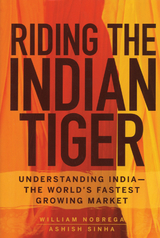
William Nobrega is President and founder of The Conrad Group, LLC. (www.conradgroupinc.com), a consulting firm specializing in emerging market strategic planning, advisory services for institutional investor groups, and mergers and acquisitions. He has authored numerous articles and has been the subject of many profiles on television and in newspapers. Ashish Sinha is the COO of RocSearch, a UK-based research and analytics offshoring firm. He has more than twelve years of experience in investment banking, consulting, and knowledge process outsourcing. Over the last six years, Ashish has built business research capabilities at McKinsey & Company and GE Capital.
Preface.
Introduction. The History of India in [5?] Pages.
I. The Largest Market the World has Ever Seen.
II. Bulls & Bears in Mumbai: India's Financial Markets.
III. Why India will Outperform China.
IV. The Road Less Traveled; India's Infrastructure
Opportunity.
V. The Next Wave; Beyond IT & Outsourcing.
VI. Look before You Leap.
VII. Understanding the Indian Business Culture.
Conclusion. The Tiger Begins to Roar.
"If you're an investor, you need to know about India.
Unfortunately, before Riding the Indian Tiger came out,
snappy, all-in-one primers on India's past, present and future had
been hard to come by. The list of companies that do business with
India includes the likes of Sony (SNE - Cramer's Take -
Stockpickr), Gap (GPS - Cramer's Take - Stockpickr), Microsoft
(MSFT - Cramer's Take - Stockpickr), General Electric (GE -
Cramer's Take - Stockpickr) and Wal-Mart(WMT - Cramer's Take -
Stockpickr). But the list of investors with experience in India,
who know its regions, tendencies and opportunities, is short. And
much of what is written about the country falls into one of two
unhelpful categories: political bombast declaring that India is
ever-powerful and will sink America, and the business hype jobs
that call India a source of evergreen profit for the average
investor. What has seemed lacking, until now, is a balanced and
digestible overview that tells a bit about India's history, a bit
about its regions, a bit about how it compares with China and
thoughts on its future.
Riding the Indian Tiger: Understanding India -- The World's
Fastest Growing Market, (Wiley) by William Nobrega and Ashish
Sinha is a must-read and earns a coveted Business Press Maven
"Help" label, granted with great ceremony to books that help
advance investor understanding. It is not a thrilling read, but the
prose isn't wooden, and it's less than 250 pages. That means no
excuses.
And here's the beautiful part: Place your finger down at random
at almost any point in this book, and you'll learn something
important, thought-provoking or, at the very least, interesting
about a country that stands as a contradiction in a myriad of ways.
Where to start? Well, anywhere. How about page 12, part of the
opening section that gives an economic tour of India's different
regions? Haryana, close to New Delhi, is an agrarian state with a
dairy bent, a fast-growing economy and an essential long-term
challenge: With an underdeveloped supply chain and little of the
milk pasteurized, potential lost revenue abounds.
Or, read any of the pages between 67 and 92, where the authors
compare India and China, point to any number of examples of the
free press in India leading to better oversight and less corruption
or the overwhelming demographic advantages enjoyed by India.
The authors also argue that fashion apparel will thrive in the
near future in India because of the nation's cotton production,
technological advances of its textile industry, and increasing
disposable income. National fashion producers are not sufficiently
up to the task; the authors smell big opportunity. For some similar
reasons and others quite separate, the hotel industry also is ripe
for growth, according to the authors.
Skip to page 203, in a section on understanding Indian business
culture, and you'll learn about the Indian businessman's
disinclination to say "no," which often causes disappointment when
deadlines pass. This, the authors say, is changing. The
introduction, an overview of India's history, which has lurched
between colonialism, socialism and now capitalism, is a bit less
subjective but probably just as important for anyone who needs a
quick sense of this emerging economic behemoth. Don't skip it. ...
The book, while not a scintillating read in terms of structure or
prose, is filled with insight and factoids that will help you
emerge, after less than 250 pages, far more knowledgeable about
India than you'd be from reading what else is available on the
topic. " --Review from TheStreet.com
| Erscheint lt. Verlag | 11.4.2008 |
|---|---|
| Sprache | englisch |
| Themenwelt | Wirtschaft ► Betriebswirtschaft / Management ► Unternehmensführung / Management |
| Wirtschaft ► Volkswirtschaftslehre | |
| Schlagworte | Business & Management • Strategic Management • Strategisches Management • Unternehmensstrategie • Wirtschaft u. Management |
| ISBN-10 | 0-470-25715-6 / 0470257156 |
| ISBN-13 | 978-0-470-25715-9 / 9780470257159 |
| Informationen gemäß Produktsicherheitsverordnung (GPSR) | |
| Haben Sie eine Frage zum Produkt? |
 PDF (Adobe DRM)
Kopierschutz: Adobe-DRM
Adobe-DRM ist ein Kopierschutz, der das eBook vor Mißbrauch schützen soll. Dabei wird das eBook bereits beim Download auf Ihre persönliche Adobe-ID autorisiert. Lesen können Sie das eBook dann nur auf den Geräten, welche ebenfalls auf Ihre Adobe-ID registriert sind.
Details zum Adobe-DRM
Dateiformat: PDF (Portable Document Format)
Mit einem festen Seitenlayout eignet sich die PDF besonders für Fachbücher mit Spalten, Tabellen und Abbildungen. Eine PDF kann auf fast allen Geräten angezeigt werden, ist aber für kleine Displays (Smartphone, eReader) nur eingeschränkt geeignet.
Systemvoraussetzungen:
PC/Mac: Mit einem PC oder Mac können Sie dieses eBook lesen. Sie benötigen eine
eReader: Dieses eBook kann mit (fast) allen eBook-Readern gelesen werden. Mit dem amazon-Kindle ist es aber nicht kompatibel.
Smartphone/Tablet: Egal ob Apple oder Android, dieses eBook können Sie lesen. Sie benötigen eine
Geräteliste und zusätzliche Hinweise
Buying eBooks from abroad
For tax law reasons we can sell eBooks just within Germany and Switzerland. Regrettably we cannot fulfill eBook-orders from other countries.
aus dem Bereich