


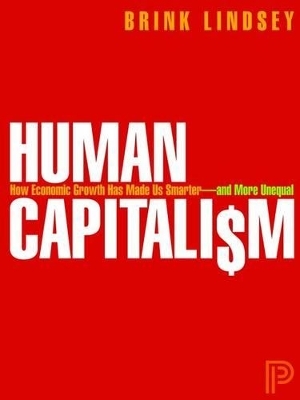
Human Capitalism
How Economic Growth Has Made Us Smarter--and More Unequal
Seiten
2013
|
Revised edition
Princeton University Press (Verlag)
978-0-691-15732-0 (ISBN)
Princeton University Press (Verlag)
978-0-691-15732-0 (ISBN)
- Titel z.Zt. nicht lieferbar
- Portofrei ab CHF 40
- Auch auf Rechnung
- Artikel merken
What explains the growing class divide between the well educated and everybody else? Noted author Brink Lindsey, a senior scholar at the Kauffman Foundation, argues that it's because economic expansion is creating an increasingly complex world in which only a minority with the right knowledge and skills--the right "human capital"--reap the majority of the economic rewards. The complexity of today's economy is not only making these lucky elites richer--it is also making them smarter. As the economy makes ever-greater demands on their minds, the successful are making ever-greater investments in education and other ways of increasing their human capital, expanding their cognitive skills and leading them to still higher levels of success. But unfortunately, even as the rich are securely riding this virtuous cycle, the poor are trapped in a vicious one, as a lack of human capital leads to family breakdown, unemployment, dysfunction, and further erosion of knowledge and skills.
In this brief, clear, and forthright eBook original, Lindsey shows how economic growth is creating unprecedented levels of human capital--and suggests how the huge benefits of this development can be spread beyond those who are already enjoying its rewards.
In this brief, clear, and forthright eBook original, Lindsey shows how economic growth is creating unprecedented levels of human capital--and suggests how the huge benefits of this development can be spread beyond those who are already enjoying its rewards.
Brink Lindsey is a senior fellow at the Cato Institute and a consultant for the Ewing Marion Kauffman Foundation. He is the author of The Age of Abundance: How Prosperity Transformed America's Politics and Culture (Collins) and Against the Dead Hand: The Uncertain Struggle for Global Capitalism (Wiley).
Acknowledgments vii Introduction 1 One: The Rise of Complexity 6 Two: The Abstract Art of Modern Living 12 Three: Capitalism with a Human Face 23 Four: Class and Consciousness 31 Five: Inequality as a Culture Gap 41 Six: From Convergence to Polarization 55 Seven: Reforming Human Capitalism 71 Eight: What Lies Ahead 98 Notes 117 Index 131
| Verlagsort | New Jersey |
|---|---|
| Sprache | englisch |
| Maße | 140 x 216 mm |
| Gewicht | 312 g |
| Themenwelt | Sozialwissenschaften ► Soziologie |
| Wirtschaft ► Volkswirtschaftslehre ► Makroökonomie | |
| ISBN-10 | 0-691-15732-4 / 0691157324 |
| ISBN-13 | 978-0-691-15732-0 / 9780691157320 |
| Zustand | Neuware |
| Informationen gemäß Produktsicherheitsverordnung (GPSR) | |
| Haben Sie eine Frage zum Produkt? |
Mehr entdecken
aus dem Bereich
aus dem Bereich
Buch | Softcover (2024)
Schäffer-Poeschel (Verlag)
CHF 48,95
Makroökonomie, Wirtschaftspolitik und nachhaltige Entwicklung
Buch | Hardcover (2022)
Vahlen (Verlag)
CHF 69,70
Kontroversen, Daten und Fakten zur Nachhaltigkeit
Buch | Softcover (2025)
Kohlhammer (Verlag)
CHF 54,60


