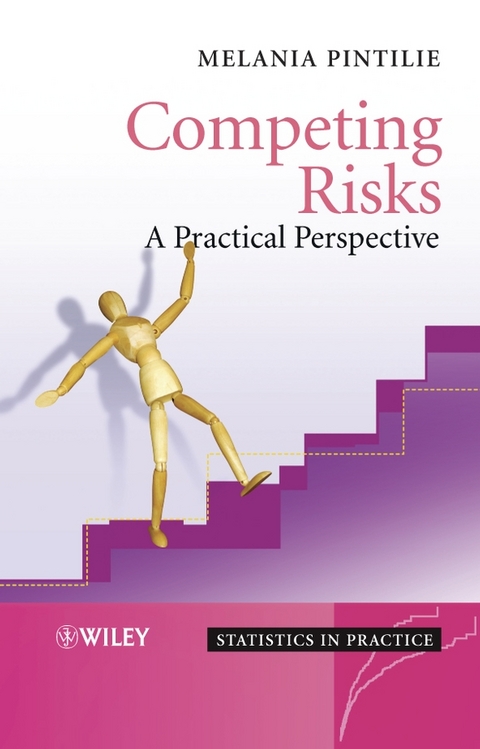
Melania Pintilie is the author of Competing Risks: A Practical Perspective, published by Wiley.
The need to understand, interpret and analyse competing risk data is key to many areas of science, particularly medical research. There is a real need for a book that presents an overview of methodology used in the interpretation and analysis of competing risks, with a focus on practical applications to medical problems, and incorporating modern techniques. This book fills that need by presenting the most up-to-date methodology, in a way that can be readily understood, and applied, by the practitioner.
Melania Pintilie is the author of Competing Risks: A Practical Perspective, published by Wiley.
Competing Risks 1
Contents 9
Preface 13
Acknowledgements 15
1 Introduction 17
1.1 Historical notes 17
1.2 Defining competing risks 18
1.3 Use of the Kaplan–Meier method in the presence of competing risks 19
1.4 Testing in the competing risk framework 21
1.5 Sample size calculation 24
1.6 Examples 25
1.6.1 Tamoxifen trial 26
1.6.2 Hypoxia study 27
1.6.3 Follicular cell lymphoma study 32
1.6.4 Bone marrow transplant study 32
1.6.5 Hodgkin’s disease study 34
2 Survival – basic concepts 39
2.1 Introduction 39
2.2 Definitions and background formulae 39
2.2.1 Introduction 39
2.2.2 Basic mathematical formulae 40
2.2.3 Common parametric distributions 44
2.2.4 Censoring and assumptions 46
2.3 Estimation and hypothesis testing 47
2.3.1 Estimating the hazard and survivor functions 47
2.3.2 Nonparametric testing: log-rank and Wilcoxon tests 49
2.3.3 Proportional hazards model 52
2.4 Software for survival analysis 53
2.5 Closing remarks 54
3 Competing risks – definitions 55
3.1 Recognizing competing risks 55
3.1.1 Practical approaches 55
3.1.2 Common endpoints in medical research 56
3.2 Two mathematical definitions 57
3.2.1 Competing risks as bivariate random variable 57
3.2.2 Competing risks as latent failure times 59
3.3 Fundamental concepts 60
3.3.1 Competing risks as bivariate random variable 60
3.3.2 Competing risks as latent failure times 64
3.3.3 Discussion of the two approaches 65
3.4 Closing remarks 67
4 Descriptive methods for competing risks data 69
4.1 Product-limit estimator and competing risks 69
4.2 Cumulative incidence function 71
4.2.1 Heuristic estimation of the CIF 72
4.2.2 Nonparametric maximum likelihood estimation of the CIF 74
4.2.3 Calculating the CIF estimator 75
4.2.4 Variance and confidence interval for the CIF estimator 78
4.3 Software and examples 80
4.3.1 Using R 80
4.3.2 Using SAS 85
4.4 Closing remarks 86
5 Testing a covariate 87
5.1 Introduction 87
5.2 Testing a covariate 90
5.2.1 Gray’s method 90
5.2.2 Pepe and Mori’s method 93
5.3 Software and examples 96
5.3.1 Using R 96
5.3.2 Using SAS 100
5.4 Closing remarks 100
6 Modelling in the presence of competing risks 103
6.1 Introduction 103
6.2 Modelling the hazard of the cumulative incidence function 103
6.2.1 Theoretical details 103
6.2.2 Model-based estimation of the CIF 108
6.2.3 Using R 109
6.3 Cox model and competing risks 118
6.4 Checking the model assumptions 120
6.4.1 Proportionality of the cause-specific hazards 120
6.4.2 Proportionality of the hazards of the CIF 125
6.4.3 Linearity assumption 126
6.5 Closing remarks 129
7 Calculating the power in the presence of competing risks 131
7.1 Introduction 131
7.2 Sample size calculation when competing risks are not present 132
7.3 Calculating power in the presence of competing risks 134
7.3.1 General formulae 134
7.3.2 Comparing cause-specific hazards 135
7.3.3 Comparing hazards of the subdistributions 136
7.3.4 Probability of event when the exponential distribution is not a valid assumption 137
7.4 Examples 138
7.4.1 Introduction 138
7.4.2 Comparing the cause-specific hazard 138
7.4.3 Comparing the hazard of the subdistribution 140
7.5 Closing remarks 141
8 Other issues in competing risks 143
8.1 Conditional probability function 143
8.1.1 Introduction 143
8.1.2 Nonparametric estimation of the CP function 144
8.1.3 Variance of the CP function estimator 144
8.1.4 Testing a covariate 146
8.1.5 Using R 148
8.1.6 Using SAS 153
8.2 Comparing two types of risk in the same population 154
8.2.1 Theoretical background 154
8.2.2 Using R 155
8.2.3 Discussion 155
8.3 Identifiability and testing independence 159
8.4 Parametric modelling 160
8.4.1 Introduction 160
8.4.2 Modelling the marginal distribution 161
8.4.3 Modelling the Weibull distribution 162
9 Food for thought 165
Problem 1: Estimation of the probability of the event of interest 165
Problem 2: Testing a covariate 168
Problem 3: Comparing the event of interest between two groups when the competing risks are different for each group 170
Problem 4: Information needed for sample size calculations 174
Problem 5: The effect of the size of the incidence of competing risks on the coefficient obtained in the model 175
Problem 6: The KLY test and the non-proportionality of hazards 177
Problem 7: The KLY and Wilcoxon tests 178
Appendix A Theoretical background 181
A.1 Nonparametric maximum likelihood estimation for the survivor function in the discrete case 181
A.2 Confidence interval for survivor function 183
A.3 The Variance for Gray’s test 184
A.4 Derivation of the parameters for the exponential latent failure time model 185
A.5 Likelihood of a mixture of exponentials in the bivariate approach 187
Appendix B Analysing competing risks data using R and SAS 189
B.1 The R software and cmprsk package 189
B.1.1 Downloading and installation 189
B.1.2 Getting help 190
B.1.3 Operators in R 191
B.1.4 Objects in R 191
B.1.5 The cmprsk package and datasets 194
B.2 Importing datasets in SAS 197
B.3 Other programs written for R 198
B.3.1 CIF variance based on the delta method 198
B.3.2 Pepe–Mori test for the difference between two CIFs 199
B.3.3 Conditional probability and its variance 201
B.3.4 Plotting the conditional probability 203
B.3.5 Testing the conditional probability 203
B.3.6 Calculating the conditional probability of observing the event of interest in a time period knowing that the patient was free of any event at the beginning of the period 205
B.3.7 Comparing two types of risk in the same population 207
B.3.8 Calculating the power 208
B.4 SAS macros for competing risk analysis 211
B.4.1 Cumulative incidence and conditional probability 211
B.4.2 Pepe–Mori test for the comparison of two CIFs 215
B.4.3 Pepe–Mori test for the comparison of two CPs 219
References 225
Index 231
Statistics in Practice 241
"Competing Risks: A Practical Perspective is a second text
in the field that will help statisticians and researchers
understand the complexity of the competing-risks problem and to
complete the required analysis. I am glad to have it on my shelf.
It meets the state goal of the Statistics in Practice series."
(Technometrics, August 2008)
"Will help statisticians and researchers understand the
complexity of the competing-risks problem and to complete the
analysis. I am glad to have it on my shelf." (Technometrics,
August 2008)
"...a concise introduction to the field of competing risks in
survival analysis, especially useful for practitioners and
researchers in the biostatistics field." (Zentralblatt MATH,
2007)
| Erscheint lt. Verlag | 2.11.2006 |
|---|---|
| Reihe/Serie | Statistics in Practice |
| Statistics in Practice | Statistics in Practice |
| Sprache | englisch |
| Themenwelt | Mathematik / Informatik ► Mathematik ► Angewandte Mathematik |
| Mathematik / Informatik ► Mathematik ► Statistik | |
| Mathematik / Informatik ► Mathematik ► Wahrscheinlichkeit / Kombinatorik | |
| Medizin / Pharmazie ► Allgemeines / Lexika | |
| Wirtschaft ► Betriebswirtschaft / Management ► Allgemeines / Lexika | |
| Schlagworte | Another • Areas • Biostatistics • Biostatistik • Development • Examples • Failure • Interest • Interpret • Key • numerous • Observation • occur • one type • Perspective • Practical • refers • Research • risk data • Risks • Science • Situation • specific • Statistics • Statistik • Term • Type |
| ISBN-13 | 9780470870693 / 9780470870693 |
| Informationen gemäß Produktsicherheitsverordnung (GPSR) | |
| Haben Sie eine Frage zum Produkt? |
 PDF (Adobe DRM)
Kopierschutz: Adobe-DRM
Adobe-DRM ist ein Kopierschutz, der das eBook vor Mißbrauch schützen soll. Dabei wird das eBook bereits beim Download auf Ihre persönliche Adobe-ID autorisiert. Lesen können Sie das eBook dann nur auf den Geräten, welche ebenfalls auf Ihre Adobe-ID registriert sind.
Details zum Adobe-DRM
Dateiformat: PDF (Portable Document Format)
Mit einem festen Seitenlayout eignet sich die PDF besonders für Fachbücher mit Spalten, Tabellen und Abbildungen. Eine PDF kann auf fast allen Geräten angezeigt werden, ist aber für kleine Displays (Smartphone, eReader) nur eingeschränkt geeignet.
Systemvoraussetzungen:
PC/Mac: Mit einem PC oder Mac können Sie dieses eBook lesen. Sie benötigen eine
eReader: Dieses eBook kann mit (fast) allen eBook-Readern gelesen werden. Mit dem amazon-Kindle ist es aber nicht kompatibel.
Smartphone/Tablet: Egal ob Apple oder Android, dieses eBook können Sie lesen. Sie benötigen eine
Geräteliste und zusätzliche Hinweise
Buying eBooks from abroad
For tax law reasons we can sell eBooks just within Germany and Switzerland. Regrettably we cannot fulfill eBook-orders from other countries.
aus dem Bereich