


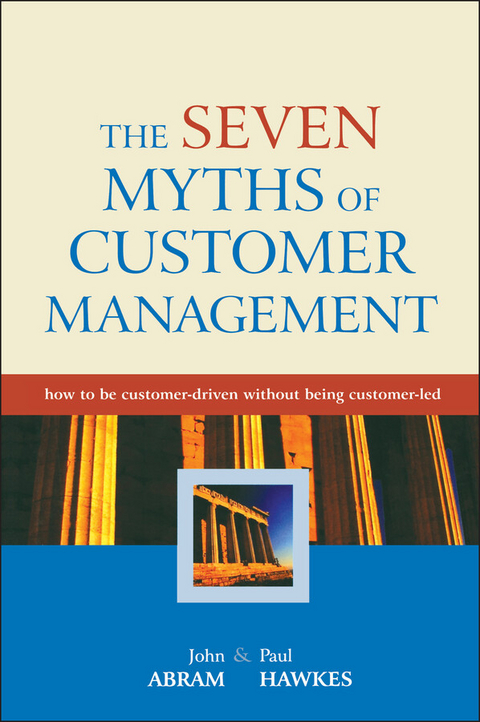
The Seven Myths of Customer Management (eBook)
John Abram began his career selling industrial textiles to major customers in industries as diverse as mining; water treatment and pollution control. He was promoted to head the firm's business development functions in the UK, where he was responsible for introducing one of the earliest examples of automated customer management systems used in the UK.
He was recruited by American Express in 1978 and appointed Marketing Manager, with responsibility for Cardmember recruitment and retention, as well as cross-sales of complementary products and services.
In 1981, backed by a leading publishing firm, he started his own business promoting a range of products and services to entrepreneurs and business managers. In 1984, he bought out his original backers and took the business on to become a significant innovator in the promotion of investment products by phone and post, being the first in the country to sell personal pension plans direct to consumers.
Paul Hawkes joined American Express Card Division in 1975 and subsequently became Marketing Manager for the merchant network in the UK and Ireland. In 1979, he moved to Time-Life Books and was promoted to become European Mark eting Vice President. In this role, he was responsible for mail order and retail marketing and sales, new product development and co-publishing relationships across 14 countries within Europe and Africa.
He was a director of the British Direct Marketing Association and a Council Member of both the Association of Mail Order Publishers and the Mail Order Publishers' Authority; and is a Fellow of the Chartered Institute of Marketing. He is now a director of the Virtual Partnership Ltd.
John and Paul co-founded Abram, Hawkes plc in January 1987. Over the next 13 years they built and managed the company to become the UK's foremost consultancy specialising in marketing and customer management; or, more simply, advising and assisting organisations on how to grow revenues and build customer profitability. They sold the company at the beginning of 2000 to Valoris, a major European consulting firm. Their clients included many of the country's largest and most successful organisations, such as Norwich Union, Centrica, Switch Card Services, Thomas Cook, Lloyds Bank, MBNA, Visa, Barclaycard, Axa Sun Life, GUS Catalogue Order, and many others.
In this lively and readable book, the authors argue that in recent years far too much has been made of customer satisfaction, and that this has come at the expense of hard-edged consumerism. Whether or not "e;the customer is king,"e; the first rule of business is to make money. Pragmatic and practical, the book destroys seven key myths about customer management that have gained almost folkloric status, and provides a step-by-step action plan for linking customer service with commercial goals.
John Abram began his career selling industrial textiles to major customers in industries as diverse as mining, water treatment and pollution control. He was promoted to head the firm's business development functions in the UK, where he was responsible for introducing one of the earliest examples of automated customer management systems used in the UK. He was recruited by American Express in 1978 and appointed Marketing Manager, with responsibility for Cardmember recruitment and retention, as well as cross-sales of complementary products and services. In 1981, backed by a leading publishing firm, he started his own business promoting a range of products and services to entrepreneurs and business managers. In 1984, he bought out his original backers and took the business on to become a significant innovator in the promotion of investment products by phone and post, being the first in the country to sell personal pension plans direct to consumers. Paul Hawkes joined American Express Card Division in 1975 and subsequently became Marketing Manager for the merchant network in the UK and Ireland. In 1979, he moved to Time-Life Books and was promoted to become European Marketing Vice President, responsible for mail order and retail marketing and sales, new product development and co-publishing relationships across 14 countries within Europe and Africa. He was a director of the British Direct Marketing Association and a Council Member of both the Association of Mail Order Publishers and the Mail Order Publishers' Authority; and is a Fellow of the Chartered Institute of Marketing. He is now a director of the Virtual Partnership Ltd. John and Paul co-founded Abram, Hawkes plc in January 1987, the UK's foremost consultancy specialising in marketing and customer management; or, more simply, advising and assisting organisations on how to grow revenues and build customer profitability. They sold the company at the beginning of 2000 to Valoris, a major European consulting firm.
Figures ix
Acknowledgements xi
Introduction xii
1 The seven myths of customer management: Debunking some established wisdom 1
The dangers of customer leadership 1
What is really happening? 5
Myth 1: Customer retention is the key to increased profitability 6
Myth 2: Divesting unprofitable customers will increase profitability overall 9
Myth 3: Customer satisfaction leads to customer loyalty 12
Myth 4: Repeat purchase is the same as customer loyalty 15
Myth 5: Organizations should develop relationships with their customers 18
Myth 6: One-to-one marketing is the ultimate goal 21
Myth 7: Technology is the primary enabler of customer focus 25
A different approach 28
2 Testing the water: Understanding where you are today 29
Picking up customer signals 32
Business-to-business customers 36
What research does not tell you 39
New technology, new danger 42
Substituting benchmarking for thought 44
Ten ways to gain real customer insight 46
3 Look before you leap: Developing a customer-focused strategy 50
What is customer-focused strategy? 52
Strategy in context 55
Developing customer-focused strategy 58
Appraising the world outside 62
Seeking to be different 66
Leading on cost 69
Focusing on markets or customers 70
The customer lifecycle 73
Deciding and evaluating alternatives 77
Action planning 80
4 Measuring your way to success: Allocating resources for maximum effect 83
The failure of measurement 85
Customer attitude measures 86
Customer retention measures 87
Customer value measures 89
The failure of management information systems 93
Towards customer value 97
Customer value analysis in action 102
The pitfalls and problems 107
The benefits of value-based management 109
5 Don't keep it too simple, stupid: The need for a segmented approach 111
Segment or die 113
Understanding customers' needs and motivations 114
Collecting the data 120
From data to intelligence 120
From intelligence to hypothesis 126
From hypothesis to appraisal 130
From appraisal to strategy 131
From strategy to results 133
Pitfalls and problems 136
Segmentation: a postscript 138
6 Lining up the ducks: Aligning the company for customer focus 140
Aligning finance 142
Aligning product strategy 143
Aligning the proposition: from product to profit 146
Brand alignment 148
Aligning distribution 150
Aligning customer communication 152
Loyalty programmes 158
Alignment: a postscript 163
7 Are you the problem? The role of leadership in creating customer focus 164
Data-less decision making 166
Rearranging the deckchairs 168
The pitfalls of project teams 169
Best practice is sometimes best left alone 170
Incentivizing inappropriate behaviour 172
Technology turmoil 175
Everyone embraces change enthusiastically 179
Reorganizing for focus 183
Changing a light bulb 187
8 Bringing the focus alive: A practical action plan 188
An action plan for customer focus 190
Managing the customer focus process 190
The internal review 193
Customer dynamics and needs 195
Segment objectives and propositions 198
Customer-management objectives, strategy and tactics 200
Channel strategies and implementation 207
Testing and performance measurement 208
Customer and market knowledge management 211
Change planning 213
Technology strategy 214
Index 218
"...is a stimulating canter through some marketing mantras,
dismantling them fairly and frankly before suggesting
alternatives..." (Marketing, 16 October 2003)
"... iconoclastic..." (Admap, February
04)
"...The myths put CRM into perspective, explaining what to use
and what to discard." (Brand Strategy, September 2006)
| Erscheint lt. Verlag | 5.8.2005 |
|---|---|
| Sprache | englisch |
| Themenwelt | Wirtschaft ► Betriebswirtschaft / Management ► Marketing / Vertrieb |
| Wirtschaft ► Betriebswirtschaft / Management ► Unternehmensführung / Management | |
| Schlagworte | Antidote • Book • Business & Management • challenges • Conventional • Customer • dangerous • everyone • experienced • impacts • INK • interacts • Job • LESS • Lot • Management • many • misconceptions • Myths • potentially • Powerful • Practical • Reading • Strategic Management • Strategisches Management • two • whos • Wirtschaft u. Management • youll |
| ISBN-13 | 9780470858813 / 9780470858813 |
| Informationen gemäß Produktsicherheitsverordnung (GPSR) | |
| Haben Sie eine Frage zum Produkt? |
 PDF (Adobe DRM)
Kopierschutz: Adobe-DRM
Adobe-DRM ist ein Kopierschutz, der das eBook vor Mißbrauch schützen soll. Dabei wird das eBook bereits beim Download auf Ihre persönliche Adobe-ID autorisiert. Lesen können Sie das eBook dann nur auf den Geräten, welche ebenfalls auf Ihre Adobe-ID registriert sind.
Details zum Adobe-DRM
Dateiformat: PDF (Portable Document Format)
Mit einem festen Seitenlayout eignet sich die PDF besonders für Fachbücher mit Spalten, Tabellen und Abbildungen. Eine PDF kann auf fast allen Geräten angezeigt werden, ist aber für kleine Displays (Smartphone, eReader) nur eingeschränkt geeignet.
Systemvoraussetzungen:
PC/Mac: Mit einem PC oder Mac können Sie dieses eBook lesen. Sie benötigen eine
eReader: Dieses eBook kann mit (fast) allen eBook-Readern gelesen werden. Mit dem amazon-Kindle ist es aber nicht kompatibel.
Smartphone/Tablet: Egal ob Apple oder Android, dieses eBook können Sie lesen. Sie benötigen eine
Geräteliste und zusätzliche Hinweise
Buying eBooks from abroad
For tax law reasons we can sell eBooks just within Germany and Switzerland. Regrettably we cannot fulfill eBook-orders from other countries.
aus dem Bereich


