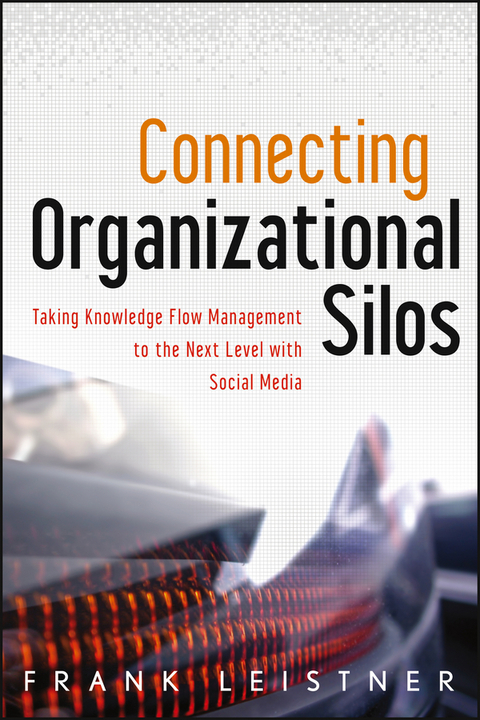
Connecting Organizational Silos (eBook)
224 Seiten
John Wiley & Sons (Verlag)
978-1-118-42193-2 (ISBN)
social networks to connect employees
While there are a fast growing number of books around social
media and enterprise 2.0, the focus is often on the technical
tools. Connecting Organizational Silos approaches social
media and enterprise 2.0 from a knowledge flow management
perspective. It offers practical and specific guidance on what to
do and what not to do when introducing social media in an
organization. This concise, easy-to-read guide offers a
nuts-and-bolts look at how to get started in social media and drive
it to success.
* Examines knowledge flows and the deployment of social media
networks within organizations
* Helps organizations become more successful in introducing
social media tools and platforms into their organizations
By incorporating social media into their business, organizations
will be able to make better use of their member's knowledge and
thereby become more competitive. Connecting Organizational
Silos discusses all aspects of enterprise social media and how
it can help to drive corporate growth.
FRANK LEISTNER is Chief Knowledge Officer for SAS Global Professional Services. He has been in the IT industry for more than twenty years, beginning as a systems programmer for Nixdorf Computer in his native Germany. From 1989 to 1993, he worked for Siemens-Nixdorf in a liaison role out of Mountain View, California, focusing on the development of UNIX multiprocessor operating systems. In 1993, Leistner joined the European headquarters of SAS, shifting his focus to application development and field consulting. Based on his experiences in the field, he founded the SAS knowledge management program in 1997 and, since then, has been leading a range of knowledge exchange initiatives on a global level.
Foreword xi
Preface xiii
Acknowledgments xxi
Chapter 1 Your Organization Is Not "The Web"
1
Terminology and Definitions 1
From Documents to Flows 6
Social Side of Knowledge Flows 7
KFM versus Social Media 10
Case Study 1: The Hub (SAS) 11
Case Study 2: RedNet (Red Ventures) 15
Notes 17
Chapter 2 Why Should You Care about Social Media? 19
Motivations 19
Network Dynamics 24
Breaking Isolation 26
The Super Watercooler 29
Handling the Dynamic Organization 32
Innovation Enablement 33
Notes 36
Chapter 3 Getting Started 37
Inside versus Outside Social Media 37
Differences in the World 39
Laying the Foundation 45
How to Really Get It Off the Ground 50
Launch: Project or Initiative? 55
Technology: Build or Buy 56
Notes 58
Chapter 4 Roles 61
More Than Just Socializing 61
Individuals and Departments 68
Mobilize Your Evangelizers 74
Notes 77
Chapter 5 Driving for Success 79
Get All Stakeholders Involved Early 79
Go Viral 82
Freedom within Borders: The Power of Guidelines 85
Training Portfolio 87
Pulse 91
Executive Participation: Not Just Buy-In 93
Notes 96
Chapter 6 Fighting Barriers 97
Fear of Losing Control 97
Unlearning 100
Dealing with "Stupid" 102
Integration 103
No Time to Post: Portfolio Management 110
Legal Concerns 111
Note 114
Chapter 7 Technology: The Enabler 115
Social or Supporting Social 115
I Want an Internal Facebook 118
The Power of Simplicity 120
Multidimensional Navigation 125
Groups or Communities 130
Notification Management 134
Notes 138
Chapter 8 Social Media Analytics 139
Analyze What Is Going On 139
Social Network Analysis versus Reporting 146
Choosing the Right KPIs 151
Notes 155
Chapter 9 What's Next 157
Advances in Technology 157
Dealing with Channel Overload 162
More Social or More Technology 164
Interaction Trends 167
Notes 168
Chapter 10 Final Thoughts 171
Appendix A Key Success Factors 175
Appendix B Additional Resources 181
About the Author 183
Index 185
| Erscheint lt. Verlag | 5.9.2012 |
|---|---|
| Reihe/Serie | SAS Institute Inc | SAS Institute Inc |
| Sprache | englisch |
| Themenwelt | Wirtschaft ► Betriebswirtschaft / Management |
| Schlagworte | Business & Management • Business Technology • Unternehmenstechnologie • Wirtschaft u. Management |
| ISBN-10 | 1-118-42193-0 / 1118421930 |
| ISBN-13 | 978-1-118-42193-2 / 9781118421932 |
| Informationen gemäß Produktsicherheitsverordnung (GPSR) | |
| Haben Sie eine Frage zum Produkt? |
 PDF (Adobe DRM)
Kopierschutz: Adobe-DRM
Adobe-DRM ist ein Kopierschutz, der das eBook vor Mißbrauch schützen soll. Dabei wird das eBook bereits beim Download auf Ihre persönliche Adobe-ID autorisiert. Lesen können Sie das eBook dann nur auf den Geräten, welche ebenfalls auf Ihre Adobe-ID registriert sind.
Details zum Adobe-DRM
Dateiformat: PDF (Portable Document Format)
Mit einem festen Seitenlayout eignet sich die PDF besonders für Fachbücher mit Spalten, Tabellen und Abbildungen. Eine PDF kann auf fast allen Geräten angezeigt werden, ist aber für kleine Displays (Smartphone, eReader) nur eingeschränkt geeignet.
Systemvoraussetzungen:
PC/Mac: Mit einem PC oder Mac können Sie dieses eBook lesen. Sie benötigen eine
eReader: Dieses eBook kann mit (fast) allen eBook-Readern gelesen werden. Mit dem amazon-Kindle ist es aber nicht kompatibel.
Smartphone/Tablet: Egal ob Apple oder Android, dieses eBook können Sie lesen. Sie benötigen eine
Geräteliste und zusätzliche Hinweise
Buying eBooks from abroad
For tax law reasons we can sell eBooks just within Germany and Switzerland. Regrettably we cannot fulfill eBook-orders from other countries.
aus dem Bereich