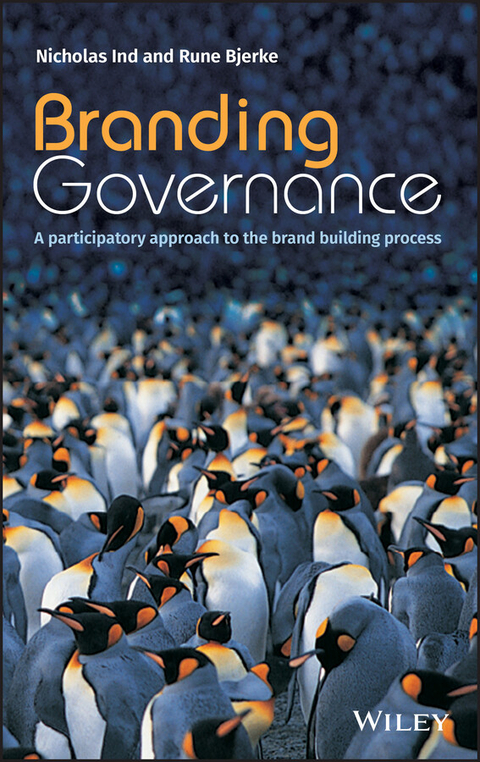
Branding Governance (eBook)
John Wiley & Sons (Verlag)
978-0-470-51169-5 (ISBN)
Drawing on a wide range of sources, they show that the key to a participatory approach is that customers and other external audiences must join managers and employees as active participants in defining and developing the brand. This requires the relationship between organization and customer to be one of trust, respect and authenticity.
NICHOLAS IND is a writer and a partner in Equilibrium Consulting. Previously he ran IconMedialab's brand consultancy arm in Sweden, had his own branding consultancy in the UK, was a Director of a design group and was an Account Director in an advertising agency. He is the author of a string of successful books including The Corporate Image, Living the Brand and the authorised biography of Terence Conran.
www.nicholasind.com
RUNE BJERKE is an Associate Professor at the Oslo School of Management. Previously he was a researcher and lecturer at BI Norwegian School of Management. Rune's PhD, from the University of Otago in New Zealand, focused on cross-cultural communications. He has published extensively in communication and marketing journals.
Branding Governance challenges traditional thinking on brands. Bestselling author Nicholas Ind and cross-cultural communications expert Rune Bjerke expose the flaws in a marketing-led approach to brand-building, and offer in its place a highly-participative, organization-wide process that delivers fulfillment to employees and value to customers. Drawing on a wide range of sources, they show that the key to a participatory approach is that customers and other external audiences must join managers and employees as active participants in defining and developing the brand. This requires the relationship between organization and customer to be one of trust, respect and authenticity.
NICHOLAS IND is a writer and a partner in Equilibrium Consulting. Previously he ran IconMedialab's brand consultancy arm in Sweden, had his own branding consultancy in the UK, was a Director of a design group and was an Account Director in an advertising agency. He is the author of a string of successful books including The Corporate Image, Living the Brand and the authorised biography of Terence Conran. www.nicholasind.com RUNE BJERKE is an Associate Professor at the Oslo School of Management. Previously he was a researcher and lecturer at BI Norwegian School of Management. Rune's PhD, from the University of Otago in New Zealand, focused on cross-cultural communications. He has published extensively in communication and marketing journals.
List of Tables and Figures xi
Introduction 1
The philosophy of the book and the concept of participation 1
The participatory branding philosophy 5
Introducing the assemblage model 10
Conclusion 15
Part I: Two Concepts of Brand Building
Introduction 17
1 The Outside-In Perspective 21
Outline: 1960 onwards 21
The nature of brands and branding 23
Understanding customers 27
The challenge of research 28
Using customer knowledge to build brands 35
Giving brand values meaning 38
Communicating the brand 41
Conclusion 46
2 The Inside-Out Perspective 49
The beginnings of inside-out thinking 49
Citizen employees 51
The value of values 57
Behavioural branding 65
Connecting employees and customers 71
Conclusion 77
Part II: Participatory Branding and The Assemblage
Introduction 81
3 A Participative Approach To Marketing 85
From marketing to market orientation 86
The principles of market orientation 88
Applying market-oriented thinking 90
Participatory market orientation (PMO) 92
Recipe for moving to PMO 96
Conclusion 101
4 Participatory Marketing 105
Connecting and co-creating with customers 107
Building internal engagement 110
Integrated marketing 115
Enhancing brand equity 119
Brand equity and financial brand value 123
Conclusion 128
5 Human Resources 131
The role of people in the organisation 132
The right people 138
Building identification, internalisation and commitment 145
Retention and development 150
Conclusion 158
6 Culture 161
Understanding culture 166
The use of narrative 173
Organisational sense-making 180
Participative cultures: participating and networking 183
Conclusion 188
7 Participatory Leadership 193
From arboresence to assemblages 196
Storytelling and transformational leadership 202
Symbolic acts 205
Reinforcing the vision 210
Conclusion 214
8 Evaluation 217
The idea of branding governance 218
Organising for management decision-making 220
Branding governance: the assemblage branding elements 224
How can brand equity and marketing efforts be measured? 228
How can HR drivers be measured in branding governance? 229
How can organisational culture be measured in branding governance? 234
How can leadership be measured? 238
Presenting the data 241
Conclusion 243
References and Bibliography 245
Index 265
"...challenges traditional thinking on brands." (Retail
& Leisure International, June 2007)
"In this superb book, the authors...provide marketers with a
practical framework for rethinking and reworking their brand
building." (The Marketer: Chartered Institute Of Marketing,
October 2007)
| Erscheint lt. Verlag | 4.4.2007 |
|---|---|
| Sprache | englisch |
| Themenwelt | Wirtschaft ► Betriebswirtschaft / Management ► Marketing / Vertrieb |
| Schlagworte | argued framework • Beyond • Book • Brand • business • Business & Management • Delight • fascinating • Framework • Integrative • Markenzeichen • Marketing & Sales • Marketing u. Vertrieb • numerous • Performance • practical examples • Professor • Readings • regret • school • steeper • Strength • Traditional • Trajectory • use • Wirtschaft u. Management |
| ISBN-10 | 0-470-51169-9 / 0470511699 |
| ISBN-13 | 978-0-470-51169-5 / 9780470511695 |
| Informationen gemäß Produktsicherheitsverordnung (GPSR) | |
| Haben Sie eine Frage zum Produkt? |
 PDF (Adobe DRM)
Kopierschutz: Adobe-DRM
Adobe-DRM ist ein Kopierschutz, der das eBook vor Mißbrauch schützen soll. Dabei wird das eBook bereits beim Download auf Ihre persönliche Adobe-ID autorisiert. Lesen können Sie das eBook dann nur auf den Geräten, welche ebenfalls auf Ihre Adobe-ID registriert sind.
Details zum Adobe-DRM
Dateiformat: PDF (Portable Document Format)
Mit einem festen Seitenlayout eignet sich die PDF besonders für Fachbücher mit Spalten, Tabellen und Abbildungen. Eine PDF kann auf fast allen Geräten angezeigt werden, ist aber für kleine Displays (Smartphone, eReader) nur eingeschränkt geeignet.
Systemvoraussetzungen:
PC/Mac: Mit einem PC oder Mac können Sie dieses eBook lesen. Sie benötigen eine
eReader: Dieses eBook kann mit (fast) allen eBook-Readern gelesen werden. Mit dem amazon-Kindle ist es aber nicht kompatibel.
Smartphone/Tablet: Egal ob Apple oder Android, dieses eBook können Sie lesen. Sie benötigen eine
Geräteliste und zusätzliche Hinweise
Buying eBooks from abroad
For tax law reasons we can sell eBooks just within Germany and Switzerland. Regrettably we cannot fulfill eBook-orders from other countries.
aus dem Bereich