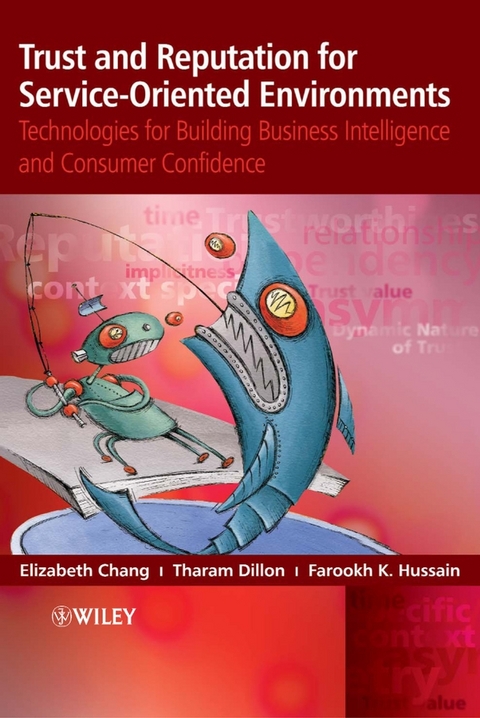
Trust and Reputation for Service-Oriented Environments (eBook)
John Wiley & Sons (Verlag)
978-0-470-02825-4 (ISBN)
Trust and Reputation for Service-Oriented Environments is a complete tutorial on how to provide business intelligence for sellers, service providers, and manufacturers. In an accessible style, the authors show how the capture of consumer requirements and end-user opinions gives modern businesses the competitive advantage.
Trust and Reputation for Service-Oriented Environments:
- Clarifies trust and security concepts, and defines trust, trust relationships, trustworthiness, reputation, reputation relationships, and trust and reputation models.
- Details trust and reputation ontologies and databases.
- Explores the dynamic nature of trust and reputation and how to manage them efficiently.
- Provides methodologies for trustworthiness measurement, reputation assessment and trustworthiness prediction.
- Evaluates current trust and reputation systems as employed by companies such as Yahoo, eBay, BizRate, Epinion and Amazon, etc.
- Gives ample illustrations and real world examples to help validate trust and reputation concepts and methodologies.
- Offers an accompanying website with lecture notes and PowerPoint slides.
This text will give senior undergraduate and masters level students of IT, IS, computer science, computer engineering and business disciplines a full understanding of the concepts and issues involved in trust and reputation. Business providers, consumer watch-dogs and government organizations will find it an invaluable reference to establishing and maintaining trust in open, distributed, anonymous service-oriented network environments.
Elizabeth Chang, Curtin Business School, has created, developed and taught courses in software engineering, project management, HCI, e-commerce, Databases, and Logistics and Supply Chain Management. She has also successfully managed several commercial-grade IT projects for industry, taking them through the entire software lifecycle to project completion. These projects range across Internet, peer-to-peer communications and e-commerce applications. Professor Chang has over 100 scientific conference and journal papers of which 20 are on Trust.
Professor Tharam Dillon is Dean of Information Technology at the University of Technology, Sydney. He is an expert in the fields of software engineering and data mining, and in trust, security and component-oriented access control. He has published five authored and four co-edited books, in addition to over 400 scientific papers in refereed journals and conferences.
Farookh K. Hussain is a PhD student at Curtin Business School, and has become an expert in the field of Trust, co-authoring over 20 papers on Trust over the last two years.
Trustworthiness technologies and systems for service-oriented environments are re-shaping the world of e-business. By building trust relationships and establishing trustworthiness and reputation ratings, service providers and organizations will improve customer service, business value and consumer confidence, and provide quality assessment and assurance for the customer in the networked economy. Trust and Reputation for Service-Oriented Environments is a complete tutorial on how to provide business intelligence for sellers, service providers, and manufacturers. In an accessible style, the authors show how the capture of consumer requirements and end-user opinions gives modern businesses the competitive advantage. Trust and Reputation for Service-Oriented Environments: Clarifies trust and security concepts, and defines trust, trust relationships, trustworthiness, reputation, reputation relationships, and trust and reputation models. Details trust and reputation ontologies and databases. Explores the dynamic nature of trust and reputation and how to manage them efficiently. Provides methodologies for trustworthiness measurement, reputation assessment and trustworthiness prediction. Evaluates current trust and reputation systems as employed by companies such as Yahoo, eBay, BizRate, Epinion and Amazon, etc. Gives ample illustrations and real world examples to help validate trust and reputation concepts and methodologies. Offers an accompanying website with lecture notes and PowerPoint slides. This text will give senior undergraduate and masters level students of IT, IS, computer science, computer engineering and business disciplines a full understanding of the concepts and issues involved in trust and reputation. Business providers, consumer watch-dogs and government organizations will find it an invaluable reference to establishing and maintaining trust in open, distributed, anonymous service-oriented network environments.
Elizabeth Chang, Curtin Business School, has created, developed and taught courses in software engineering, project management, HCI, e-commerce, Databases, and Logistics and Supply Chain Management. She has also successfully managed several commercial-grade IT projects for industry, taking them through the entire software lifecycle to project completion. These projects range across Internet, peer-to-peer communications and e-commerce applications. Professor Chang has over 100 scientific conference and journal papers of which 20 are on Trust. Professor Tharam Dillon is Dean of Information Technology at the University of Technology, Sydney. He is an expert in the fields of software engineering and data mining, and in trust, security and component-oriented access control. He has published five authored and four co-edited books, in addition to over 400 scientific papers in refereed journals and conferences. Farookh K. Hussain is a PhD student at Curtin Business School, and has become an expert in the field of Trust, co-authoring over 20 papers on Trust over the last two years.
Preface.
Author Introduction.
Acknowledgement.
Chapter 1 Trust and Security in Service-Oriented
Envirnoments.
Chapter 2 Trust Concepts and Trust Model.
Chapter 3 Trustworthiness.
Chapter 4 Trust Ontology for Service-Oriented
Environment.
Chapter 5 The Fuzzy and Dynamic Nature of Trust.
Chapter 6 Trustworthiness Measure with CCCI.
Chapter 7 Trustworthiness systems.
Chapter 8 Reputation Concepts and the Reputation
Model.
Chapter 9 Reputation Ontology.
Chapter 10 Reputation Calculation Methodologies.
Chapter 11 Reputation Systems.
Chapter 12 Trust and Reputation Prediction.
Chapter 13 Trust and Reputation Modelling.
Chapter 14 The Vision of Trust and Reputation
Technology.
References.
Index.
"...a useful addition to the library of all those that work in
electronic commerce, whether they are technologists or business
professionals. Its comprehensiveness and easy-to-follow narrative
will be helpful in many projects." (Computing Reviews.com,
October 10, 2006)
"...this book addresses important issues relative to the
creation of confidence in both human/users (agents) and
hardware/software systems (objects)." (Ubiquity, August 1,
2006)
| Erscheint lt. Verlag | 11.7.2006 |
|---|---|
| Sprache | englisch |
| Themenwelt | Mathematik / Informatik ► Informatik ► Netzwerke |
| Technik ► Elektrotechnik / Energietechnik | |
| Technik ► Nachrichtentechnik | |
| Wirtschaft ► Betriebswirtschaft / Management | |
| Schlagworte | accessible • Assurance • business • Business & Management • Business Technology • Communication Technology - Networks • complete • Computer Science • confidence • Customer • eBusiness • E-Business • economy • Electrical & Electronics Engineering • Elektrotechnik u. Elektronik • Environments • Informatik • Intelligence • Kommunikationsnetze • networked • Networking • Networking / Security • Netzwerke • Netzwerke / Sicherheit • Netzwerksicherheit • provide • quality • Reputation • Risikomanagement • sellers • serviceoriented • serviceoriented environments • Style • Tutorial • Unternehmenstechnologie • Wirtschaft u. Management • World |
| ISBN-10 | 0-470-02825-4 / 0470028254 |
| ISBN-13 | 978-0-470-02825-4 / 9780470028254 |
| Informationen gemäß Produktsicherheitsverordnung (GPSR) | |
| Haben Sie eine Frage zum Produkt? |
 PDF (Adobe DRM)
Kopierschutz: Adobe-DRM
Adobe-DRM ist ein Kopierschutz, der das eBook vor Mißbrauch schützen soll. Dabei wird das eBook bereits beim Download auf Ihre persönliche Adobe-ID autorisiert. Lesen können Sie das eBook dann nur auf den Geräten, welche ebenfalls auf Ihre Adobe-ID registriert sind.
Details zum Adobe-DRM
Dateiformat: PDF (Portable Document Format)
Mit einem festen Seitenlayout eignet sich die PDF besonders für Fachbücher mit Spalten, Tabellen und Abbildungen. Eine PDF kann auf fast allen Geräten angezeigt werden, ist aber für kleine Displays (Smartphone, eReader) nur eingeschränkt geeignet.
Systemvoraussetzungen:
PC/Mac: Mit einem PC oder Mac können Sie dieses eBook lesen. Sie benötigen eine
eReader: Dieses eBook kann mit (fast) allen eBook-Readern gelesen werden. Mit dem amazon-Kindle ist es aber nicht kompatibel.
Smartphone/Tablet: Egal ob Apple oder Android, dieses eBook können Sie lesen. Sie benötigen eine
Geräteliste und zusätzliche Hinweise
Buying eBooks from abroad
For tax law reasons we can sell eBooks just within Germany and Switzerland. Regrettably we cannot fulfill eBook-orders from other countries.
aus dem Bereich