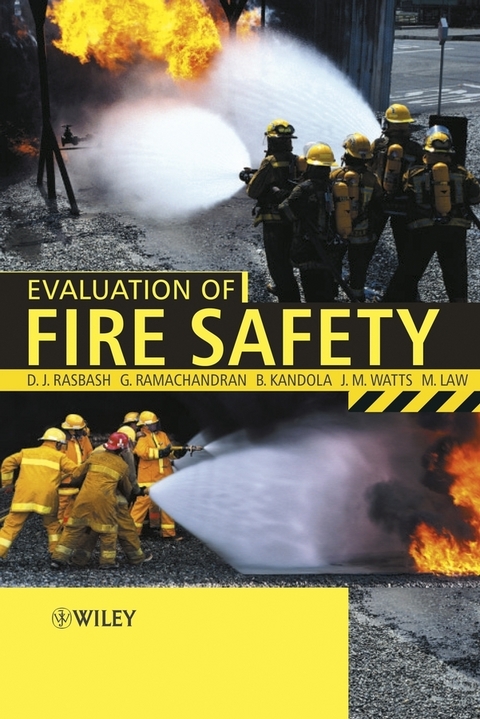
Evaluation of Fire Safety (eBook)
John Wiley & Sons (Verlag)
978-0-470-02007-4 (ISBN)
- Examines key aspects of quantifying fire safety: property damage, performance of fire services/measures, fire safety modeling and verification, and stochastic modeling.
- Includes a quantitative approach to major fire and explosion disasters, demonstrating crucial faults.
- Covers real-life problems and applications.
- There is no other reference available on this subject.
David Rasbash was a pioneer in the field of Fire Safety Engineering. Rasbash was a chemical engineer who graduated from Imperial College, London, during World War II. He began publishing and teaching about the evaluation of fire safety in the 1970s.
G. Ramachandran is the author of Evaluation of Fire Safety, published by Wiley.
B. Kandola is the author of Evaluation of Fire Safety, published by Wiley.
J. Watts is the author of Evaluation of Fire Safety, published by Wiley.
M. Law is the author of Evaluation of Fire Safety, published by Wiley.
Examines key aspects of quantifying fire safety: property damage, performance of fire services/measures, fire safety modeling and verification, and stochastic modeling. Includes a quantitative approach to major fire and explosion disasters, demonstrating crucial faults. Covers real-life problems and applications. There is no other reference available on this subject.
David Rasbash was a pioneer in the field of Fire Safety Engineering. Rasbash was a chemical engineer who graduated from Imperial College, London, during World War II. He began publishing and teaching about the evaluation of fire safety in the 1970s. G. Ramachandran is the author of Evaluation of Fire Safety, published by Wiley. B. Kandola is the author of Evaluation of Fire Safety, published by Wiley. J. Watts is the author of Evaluation of Fire Safety, published by Wiley. M. Law is the author of Evaluation of Fire Safety, published by Wiley.
Preface.
PART I: STRUCTURE OF THE FIRE PROBLEM.
1 The place of fire safety in the community.
2 The fire safety system.
3 Review of some major fire & explosion disasters.
4 Requirements from public and private authorities for fire safety.
PART II: QUANTIFYING FIRE SAFETY.
5 Physical data.
6 Sources of statistical data.
7 Occurrence and growth of fire.
8 Life loss.
9 Property damage.
10 Performance of fire safety measures.
PART III: METHODS OF MEASURING FIRE SAFETY.
11 Deterministic fire safety modeling.
12 Model Validation.
13 Point systems - a single index.
14 Logic trees.
15 Stochastic fire risk modeling.
16 Fire safety concepts tree and derivative approaches.
17 Fire safety assessment in the process industries.
Index.
| Erscheint lt. Verlag | 21.4.2004 |
|---|---|
| Sprache | englisch |
| Themenwelt | Naturwissenschaften |
| Technik ► Bauwesen | |
| Technik ► Maschinenbau | |
| Wirtschaft ► Betriebswirtschaft / Management ► Allgemeines / Lexika | |
| Schlagworte | alpha • Bauingenieur- u. Bauwesen • Brandschutz • Civil Engineering & Construction • Close • concern • continually • Explosions • Factory • Fire Protection • fires • Firework • Hazardous • highlighted • incidents • increases • Industrial Engineering • Industrial Engineering Special Topics • Industrielle Verfahrenstechnik • Industries • Larger • Major • many • Materials • particularly • Piper • plants • Process • quantities • Safety • significant • Spezialthemen Industrielle Verfahrenstechnik • years |
| ISBN-10 | 0-470-02007-5 / 0470020075 |
| ISBN-13 | 978-0-470-02007-4 / 9780470020074 |
| Informationen gemäß Produktsicherheitsverordnung (GPSR) | |
| Haben Sie eine Frage zum Produkt? |
 PDF (Adobe DRM)
Kopierschutz: Adobe-DRM
Adobe-DRM ist ein Kopierschutz, der das eBook vor Mißbrauch schützen soll. Dabei wird das eBook bereits beim Download auf Ihre persönliche Adobe-ID autorisiert. Lesen können Sie das eBook dann nur auf den Geräten, welche ebenfalls auf Ihre Adobe-ID registriert sind.
Details zum Adobe-DRM
Dateiformat: PDF (Portable Document Format)
Mit einem festen Seitenlayout eignet sich die PDF besonders für Fachbücher mit Spalten, Tabellen und Abbildungen. Eine PDF kann auf fast allen Geräten angezeigt werden, ist aber für kleine Displays (Smartphone, eReader) nur eingeschränkt geeignet.
Systemvoraussetzungen:
PC/Mac: Mit einem PC oder Mac können Sie dieses eBook lesen. Sie benötigen eine
eReader: Dieses eBook kann mit (fast) allen eBook-Readern gelesen werden. Mit dem amazon-Kindle ist es aber nicht kompatibel.
Smartphone/Tablet: Egal ob Apple oder Android, dieses eBook können Sie lesen. Sie benötigen eine
Geräteliste und zusätzliche Hinweise
Buying eBooks from abroad
For tax law reasons we can sell eBooks just within Germany and Switzerland. Regrettably we cannot fulfill eBook-orders from other countries.
aus dem Bereich