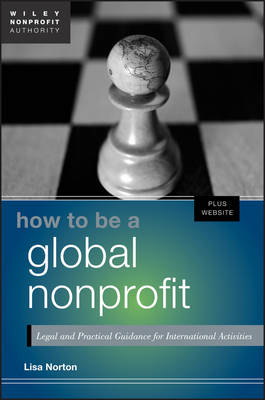
How to Be a Global Nonprofit: Legal Guidance for International Activities
John Wiley & Sons Inc (Hersteller)
978-1-118-57103-3 (ISBN)
- Keine Verlagsinformationen verfügbar
- Artikel merken
This has radically changed. How to Be a Global Nonprofit thoroughly explores the legal and practical issues nonprofits encounter as they work internationally and the resources required to deal with them.
LISA NORTON is an attorney whose law practice concentrates on serving a wide variety of nonprofit and tax-exempt organizations, helping organizations and donors to pursue their missions through proper structuring and legal compliance. Previously, she served as international tax counsel to several multinational corporations. She is a graduate of Harvard Law School and a member of the bar of the states of Washington, California, and New York. Lisa participates in various bar association committees and professional organizations that concentrate on nonprofit-related issues, and she has served on governing boards and committees of numerous charitable organizations and professional associations. Visit her website at www.lnortonlaw.com, and follow her on Twitter @GlobalNonprofit.
Preface How to Use This Book Disclaimer Internal Revenue Service Circular 230 Disclosure Acknowledgments Chapter 1 So You Want to Be a Global Nonprofit? 1.1 What Do You Really Want to Accomplish? 1.2 Spectrum of International Activities 1.3 Overview of International Grantmaking 1.4 Directly Operating Foreign Programs 1.5 Global Fundraising 1.6 Legal Considerations: A Basic Framework 1.7 The Importance of Vigilance 1.8 So, You Still Want to Be a Global Nonprofit? Chapter 2 International Grantmaking by Public Charities 2.1 Public Charity or Private Foundation: Why Does It Matter? 2.2 What Is a Public Charity? 2.3 Basic Rules for Foreign Grantmaking 2.4 American Friends of Organizations 2.5 Special Rules for Donor-advised Funds 2.6 Other U.S. Intermediaries 2.7 Review and Further Considerations Chapter 3 International Grantmaking by Private Foundations 3.1 What is a Private Foundation? 3.2 Should a Private Foundation Make Cross-border Grants? 3.3 Permitted Grants and Disbursements 3.4 International Grantmaking: Special Requirements for Private Foundations 3.5 U.S. Withholding Tax on Disbursements of Grant Funds 3.6 Review and Further Considerations Chapter 4 Going Deeper: Operating a Foreign Program 4.1 Are You Determined to Move Beyond Grantmaking? 4.2 Is Anybody Else Doing It? 4.3 Are You Sure You Will Be Allowed to Do What You Want to Do? 4.4 Alternative Models for Operating a Foreign Program 4.5 Establishing a Foreign Office 4.6 Case Study: World Association for Children and Parents (WACAP) 4.7 Do You Need to Do It Alone? 4.8 Case Study: Agros International 4.9 Staffing a Foreign Office: Consequences to the Organization 4.10 Will Your U.S. Organization Be Taxed by a Foreign Country? 4.11 What Happens If Your Organization Conducts Business Activities in a Foreign Country? 4.12 Foreign Reporting Requirements 4.13 U.S. Reporting Requirements 4.14 Review and Further Considerations Chapter 5 Forming and Operating through a Foreign Legal Entity 5.1 Establishing a Foreign Legal Entity 5.2 Case Study: Ashesi University (Ashesi) 5.3 How Hard Will It Be to Form a Foreign Legal Entity? 5.4 What Kind of Legal Entity Should You Create, and why Should You Care? 5.5 Do You Want a Model of Control or Collaboration, or Both? 5.6 Control 5.7 Collaboration 5.8 Two Case Studies: One Very Large and One Very Small Organization 5.9 Headquarters Offices: Centralized Versus Decentralized Services 5.10 Shared Employees 5.11 Case Study: Social Venture Partners International (SVPI) 5.12 Will a Foreign Legal Entity Be Tax-exempt in Its Local Country? 5.13 Will a Foreign Legal Entity Be Taxed in the U.S.? 5.14 The Importance of Keeping U.S. and Foreign Activities Separate 5.15 Consider the Burdens of Maintaining Two or More Separate Legal Entities 5.16 For-profit Subsidiaries 5.17 Soliciting Funds from U.S. Donors 5.18 Review and Further Considerations Chapter 6 Staffing Foreign Operations: Employees and Volunteers 6.1 Staffing Foreign Operations: Will You Send U.S. Staff or Hire Locally? 6.2 Sending People Overseas: Initial Considerations 6.3 If You Send U.S. Employees to Work in a Foreign Country, Will They Be Taxed There? 6.4 If Your Employees Are Taxed in a Foreign Country, Will They Still Be Taxed in the U.S.? 6.5 Making Payments to People Working in Foreign Countries 6.6 Hiring locally 6.7 Hiring or Sending Non-U.S. Citizens/Residents to Work in the U.S. 6.8 Special Considerations for Volunteers 6.9 Review and Further Considerations Chapter 7 Raising Funds Globally 7.1 Why Do You Want to Raise Funds in a Foreign Country? 7.2 Will You Be Permitted to Solicit Contributions in a Foreign Country? 7.3 Does the Foreign Country Provide Tax Benefits, and are they Important to your Donors? 7.4 Is a Separate Legal Entity Required? 7.5 Tax Benefits for Cross-border Philanthropy 7.6 Exceptions to the Separate Legal Entity Requirement for Fundraising in Foreign Countries 7.7 Structuring Relationships Among Fundraising and Operating Entities 7.8 Keep It As Simple As Possible 7.9 Review and Further Considerations Chapter 8 Additional U.S. Laws and Reporting Requirements 8.1 Anti-terrorism Compliance 8.2 Export Controls 8.3 Anti-boycott Rules 8.4 Anti-bribery Rules 8.5 Lobbying and Political Activity 8.6 Foreign Funding of Lobbying and Propaganda 8.7 U.S. Individuals Working in Foreign Countries 8.8 Non-U.S. Individuals Working in the U.S: Verifying Legal Status 8.9 Financial Reporting 8.10 U.S. Tax Reporting of Foreign Activities 8.11 U.S. Tax Withholding on Payments to Non-U.S. Citizens or Residents 8.12 Reporting of Foreign Financial Assets 8.13 Review and Further Considerations Chapter 9 Additional Foreign Legal and Practical Considerations 9.1 Finding the Right Local Counsel 9.2 Anti-terrorism Restrictions 9.3 Restrictions on Cross-border Funding 9.4 Restrictions on Sending Goods across Borders 9.5 Anti-bribery Laws and Avoiding Corruption 9.6 Restrictions on Political Activity and Lobbying 9.7 Protecting Trademarks, Copyrights, and Other Intellectual Property 9.8 Data Privacy Laws 9.9 Privacy 9.10 Managing multiple currencies and currency controls 9.11 International Travel and Security 9.12 Insurance Matters 9.13 Acquiring Real Estate 9.14 Value Added Tax ( VAT ) 9.15 Other (Non-income) Taxes 9.16 Governmental Reporting Requirements: Financial, Tax, and Others 9.17 Market and Political Impact of Foreign Direct Services 9.18 Review and Further Considerations Chapter 10 Evolution of a Global Organization: Half the Sky Foundation 10.1 Seeing a Need and Addressing It with Passion 10.2 Half the Sky's Experience in China 10.2 How Can Foreign NGOs Operate in China? 10.3 Legal Status of HTS in China 10.4 What Has HTS Learned about Working in China? 10.5 Developing a Global Fundraising Network 10.5 Closing Thoughts Appendix A Glossary of Terms Appendix B Additional Resources Resources for 501(c)(3) organizations Resources for Private Foundations International Activities of Nonprofit Organizations U.S. Intermediary Organizations for International Grantmaking Resources for Cross-border Grantmakers Resources for Finding International Collaborators Resources on foreign country NGO laws Avoiding Participation in Corruption (Anti-bribery) Updates on Anti-terrorism Policies and Their Impact on Nonprofit Organizations Intellectual Property Appendix C U.S. Bilateral Income Tax Treaties About the Author Index
| Erscheint lt. Verlag | 14.2.2013 |
|---|---|
| Verlagsort | New York |
| Sprache | englisch |
| Maße | 150 x 250 mm |
| Gewicht | 1306 g |
| Themenwelt | Wirtschaft ► Betriebswirtschaft / Management ► Planung / Organisation |
| ISBN-10 | 1-118-57103-7 / 1118571037 |
| ISBN-13 | 978-1-118-57103-3 / 9781118571033 |
| Zustand | Neuware |
| Informationen gemäß Produktsicherheitsverordnung (GPSR) | |
| Haben Sie eine Frage zum Produkt? |
aus dem Bereich