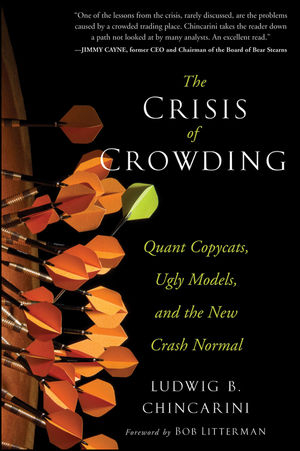
The Crisis of Crowding (eBook)
512 Seiten
John Wiley & Sons (Verlag)
9781118282717 (ISBN)
analysis
The economic crisis that began in 2008 revealed the numerous
problems in our financial system, from the way mortgage loans were
produced to the way Wall Street banks leveraged themselves.
Curiously enough, however, most of the reasons for the banking
collapse are very similar to the reasons that Long-Term Capital
Management (LTCM), the largest hedge fund to date, collapsed in
1998. The Crisis of Crowding looks at LTCM in greater
detail, with new information, for a more accurate perspective,
examining how the subsequent hedge funds started by Meriwether and
former partners were destroyed again by the lapse of judgement in
allowing Lehman Brothers to fail.
Covering the lessons that were ignored during LTCM's collapse
but eventually connected to the financial crisis of 2008, the book
presents a series of lessons for hedge funds and financial markets,
including touching upon the circle of greed from homeowners to real
estate agents to politicians to Wall Street.
* Guides the reader through the real story of Long-Term Capital
Management with accurate descriptions, previously unpublished data,
and interviews
* Describes the lessons that hedge funds, as well as the market,
should have learned from LTCM's collapse
* Explores how the financial crisis and LTCM are a global
phenomena rooted in failures to account for risk in crowded spaces
with leverage
* Explains why quantitative finance is essential for every
financial institution from risk management to valuation modeling to
algorithmic trading
* Is filled with simple quantitative analysis about the financial
crisis, from the Quant Crisis of 2007 to the failure of Lehman
Brothers to the Flash Crash of 2010
A unique blend of storytelling and sound quantitative analysis,
The Crisis of Crowding is one of the first books to offer an
analytical look at the financial crisis rather than just an account
of what happened. Also included are a layman's guide to the
Dodd-Frank rules and what it means for the future, as well as an
evaluation of the Fed's reaction to the crisis, QE1, QE2, and
QE3.
LUDWIG B. CHINCARINI, CFA, PHD, is a Professor of Finance in the School of Management at the University of San Francisco and Director of Quantitative Strategies for United States Commodity Funds, with over fifteen years of experience in the financial industry specializing in portfolio management, quantitative equity management, and derivatives. Prior to this, he was creative advisor to Index IQ. He was also Director of Research at Rydex Global Advisors, where he co-developed the S&P 500 equal-weight index and helped launch the Rydex ETF program. He helped build an internet brokerage firm, FOLIOfn, designing its innovative basket trading and portfolio management platform. He also worked at the Bank for International Settlements (BIS) and Schroders. He is the coauthor of Quantitative Equity Portfolio Management. He received a PhD from the Massachusetts Institute of Technology and a BA from the University of California at Berkeley.
| Erscheint lt. Verlag | 30.7.2012 |
|---|---|
| Reihe/Serie | Bloomberg | Bloomberg |
| Sprache | englisch |
| Themenwelt | Wirtschaft ► Betriebswirtschaft / Management ► Finanzierung |
| Wirtschaft ► Volkswirtschaftslehre ► Finanzwissenschaft | |
| Schlagworte | Börsenhandel • Börsenhandel • Finance & Investments • Finanz- u. Anlagewesen • Trading |
| ISBN-13 | 9781118282717 / 9781118282717 |
| Informationen gemäß Produktsicherheitsverordnung (GPSR) | |
| Haben Sie eine Frage zum Produkt? |
 EPUB (Adobe DRM)
Kopierschutz: Adobe-DRM
Adobe-DRM ist ein Kopierschutz, der das eBook vor Mißbrauch schützen soll. Dabei wird das eBook bereits beim Download auf Ihre persönliche Adobe-ID autorisiert. Lesen können Sie das eBook dann nur auf den Geräten, welche ebenfalls auf Ihre Adobe-ID registriert sind.
Details zum Adobe-DRM
Dateiformat: EPUB (Electronic Publication)
EPUB ist ein offener Standard für eBooks und eignet sich besonders zur Darstellung von Belletristik und Sachbüchern. Der Fließtext wird dynamisch an die Display- und Schriftgröße angepasst. Auch für mobile Lesegeräte ist EPUB daher gut geeignet.
Systemvoraussetzungen:
PC/Mac: Mit einem PC oder Mac können Sie dieses eBook lesen. Sie benötigen eine
eReader: Dieses eBook kann mit (fast) allen eBook-Readern gelesen werden. Mit dem amazon-Kindle ist es aber nicht kompatibel.
Smartphone/Tablet: Egal ob Apple oder Android, dieses eBook können Sie lesen. Sie benötigen eine
Geräteliste und zusätzliche Hinweise
Buying eBooks from abroad
For tax law reasons we can sell eBooks just within Germany and Switzerland. Regrettably we cannot fulfill eBook-orders from other countries.
aus dem Bereich