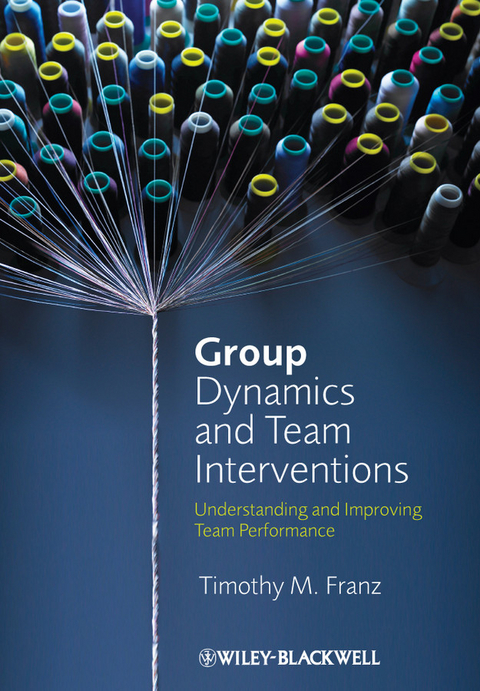
Group Dynamics and Team Interventions (eBook)
John Wiley & Sons (Verlag)
978-1-118-23268-2 (ISBN)
Organizations thrive or struggle as a result of interactions among team members. To optimize the performance of teams, Group Dynamics and Team Interventions bridges the gap between the most up-to-date academic research findings about group behavior and real-life practice. Chapters summarize the theories behind group and team behavior while offering proven application and intervention techniques that can be utilized in workplace settings. Topics addressed include team formation and development; understanding culture and team diversity; improving team cohesion, decision making, and problem solving; managing and reducing team conflict; team leadership, power, and influence; and others. Brief case studies and interventions that illustrate each theory help to enhance the clarity of the topics.
Group Dynamics and Team Interventions will benefit academics and practitioners alike, who gain from a better understanding of the dynamics that inform team behavior, along with assessment tools and practical intervention techniques to create and maintain a high-performing team.
Timothy M. Franz is a Professor of Psychology at St. John Fisher College. His area of expertise is small group and team processes. In addition, he is an experienced applied researcher, specializing in conducting focus groups, interviews, and surveys. He has published in journals such as the Journal of the American Medical Association and the Journal of Applied Psychology.
Organizations thrive or struggle as a result of interactions among team members. To optimize the performance of teams, Group Dynamics and Team Interventions bridges the gap between the most up-to-date academic research findings about group behavior and real-life practice. Chapters summarize the theories behind group and team behavior while offering proven application and intervention techniques that can be utilized in workplace settings. Topics addressed include team formation and development; understanding culture and team diversity; improving team cohesion, decision making, and problem solving; managing and reducing team conflict; team leadership, power, and influence; and others. Brief case studies and interventions that illustrate each theory help to enhance the clarity of the topics. Group Dynamics and Team Interventions will benefit academics and practitioners alike, who gain from a better understanding of the dynamics that inform team behavior, along with assessment tools and practical intervention techniques to create and maintain a high-performing team.
Timothy M. Franz is a Professor of Psychology at St. John Fisher College. His area of expertise is small group and team processes. In addition, he is an experienced applied researcher, specializing in conducting focus groups, interviews, and surveys. He has published in journals such as the Journal of the American Medical Association and the Journal of Applied Psychology.
Cover 1
Title Page 5
Copyright 6
Dedication 7
Brief Contents 9
Contents 11
Preface 18
Acknowledgements 22
Part I Introduction 23
Chapter 1 Introduction to Teams 25
Chapter 2 Methods of Assessing and Evaluating Team Functioning 40
Part II Inputs 65
Chapter 3 Team Theories and Concepts 67
Chapter 4 Understanding Culture and Diversity 92
Chapter 5 Preparing the Environment for Teamwork 115
Part III Processes 131
Chapter 6 Improving Small Group Communication and Trust 133
Chapter 7 Improving Creativity and Innovation 159
Chapter 8 Improving Problem Solving and Decision Making 179
Chapter 9 Understanding Cohesion and Collaboration 198
Chapter 10 Reducing Dysfunctional Conflict and Improving Cooperation 221
Chapter 11 Influence, Power, and Leadership 251
Chapter 12 Working in Virtual Teams 281
Part IV Outputs 303
Chapter 13 Searching for Synergy: Creating a High-Performing Team 305
Appendix: Improving Team Meetings 322
References 329
Index 362
EULA 376
"He covers this territory remarkably well in this book, which
stands as a combined textbook and operational manual. Summing
Up: Highly recommended. Lower-division undergraduates through
faculty and professionals." (Choice, 1
March 2013)
Preface
I have been considering writing this book for some time. The primary reason for this is because, as an applied psychologist, I am often dismayed by the lack of communication between academics and practitioners. I work primarily in academia but also do some consulting. I also work with many practitioners. I find that academics often develop and use theory to understand groups and then design excellent interventions that are well communicated to other academics within the research journals. Unfortunately, practitioners seldom read research journals and care little for theory; what they instead want is a tool that works, regardless of why. In addition, practitioners seldom read academic literature. On the other hand, these same practitioners often have excellent ideas that are atheoretical; the reason(s) why they work often remain unexplained. This book is intended to bridge the gap between academic research about groups and real-life practice with teams. Academics who are preparing practitioners and practitioners who are interested in grounding their work in theory should find it useful.
A secondary and related reason for writing this book results from my many years of teaching undergraduate- and Masters-level Group Dynamic courses. Many of the undergraduate and graduate students with whom I’ve had the pleasure of working are interested in theory. They want to understand systems and have explanations, so they prefer to see the theory that explains how and why groups and teams work in the ways that they do. However, they do not want to stop at only understanding theory. Instead, they want effective theory- and research-based interventions that they can immediately apply to their work. Few texts have this dual emphasis. Instead, some books focus primarily on theory with only a little application (e.g., Forsyth’s Group Dynamics, 2006 and Stangor’s Social Groups in Action and Interaction, 2004) while other books focus primarily on application and practices with little mention of or linking to theory (e.g., Kayser’s Mining Group Gold, 2011 and Wheelan’s Creating Effective Teams: A Guide for Members and Leaders, 2005). These are all excellent books, and I’ve used each one in different classes as well as to generate and improve my ideas for team development exercises. However, they are almost at opposite ends of the continuum from science to practice. Again, this book is intended to bridge the gap.
As a result, I have grounded this book in two different perspectives that best illustrate how I think about applying the small groups and teams academic literature to improving team performance. First, I modeled it after the scientist-practitioner paradigm that is regularly discussed in applied psychology (e.g., Mellott & Mehr, 2007). Although this paradigm is often used to refer to graduate training programs (including graduate programs for industrial and organizational psychologists), it also applies to how individuals subsequently view the world in which they work. This paradigm emphasizes both science (i.e., research) and practice (i.e., application). Specifically, people who believe in this paradigm find that there is benefit to understanding and developing theory resulting from time spent working in the field, and similarly there is benefit to improving work in the field from time spent understanding and/or developing theory. It is this scientist-practitioner paradigm which I hope this book reflects.
The second key theoretical paradigm in which this book is grounded is the emphasis on both action and research, an idea he termed action research. Kurt Lewin (1946/1948), who was first and foremost an academic, was one of the first to discuss the concept of action research (Dickens & Watkins, 1999). His main premise when discussing action research was that for any applied field, such as group dynamics, there must be both basic scientific research that is working to understand general laws and principles as well as applied scientific research that is designed to solve a specific problem. He stated that “for any field of action both types of scientific research are needed” (p. 204). Furthermore, he believed that the research should guide action and action should follow research. Lewin was quite successful at combining his research with action. As a person who works in the tradition of Lewin, I have written this book with understanding research and taking action in mind; this book integrates theory and research with practice and action. Thus, conducting and understanding research about teams is a key feature to the book, and there are interventions in each chapter that can guide action.
As a result, I have organized the book around the concepts that are typically found in undergraduate and graduate group or team dynamics books. Unlike the theoretical books in group dynamics, however, I have also focused each chapter on specific ways to improve groups, which I term interventions, rather than only providing a summary of theories. And, unlike other applied books in improving team functioning, I have relied heavily on theory and empirical research to help select and explain successful interventions. This combination should help readers to better understand teams so as to guide successful application and intervention.
Thus, each chapter first summarizes some of the relevant theory and then provides steps to follow in several different interventions. As a result, practitioners can better understand the “why” of how groups work when intervening in their teams and also have readily available a list of several interventions that they can use to try to help them improve the effectiveness of the teams in their workplace.
Organization of This Book
Though groups are common today, we often see surface symptoms that show us that a group or team is not performing as well as it might be. These symptoms may include behaviors such as infighting or a rush to agreement, and show that teams need assistance and intervention to improve their performance. However, we often need to learn more about what specifically we need to do before we can intervene. Thus, the first step in intervening is assessment, which is discussed in Chapter 2 along with how to conduct a follow-up evaluation to determine the success of the intervention. Next, Chapter 3 focuses on some basic concepts necessary to understand group processes, such as the importance of the team task in understanding how to help a team. Finally, the remaining chapters of this book are organized around the input-process-output model of group functioning (Hackman & Morris, 1975). This theoretical model suggests that there are certain inputs, such as team member knowledge, personality, expertise, and confidence, that each individual brings to the team (Chapter 4). Then, once the team forms there are things that happen together – this is when group process occurs – and it is necessary to understand concepts such as cohesion, decision making, and problem solving. Finally, there are group outputs, which include concepts such as performance, productivity, and member satisfaction. These are discussed in the final chapter, Chapter 14.
For each chapter in this section, I summarize the main theoretical ideas necessary to understand group functioning. Then, in each chapter I suggest possible interventions that a practitioner might try if the assessment shows that a specific group or team has problems and needs intervention in that area. Although these interventions are included in one specific chapter, some could easily have been included in other chapters as well. Many interventions, to some extent, are integrative and thus have an impact that goes well beyond the specific material in any chapter. Finally, I end each chapter with a case study from a professional in the field discussing how one of the interventions was successful. Thus, by using this book practitioners should:
How to Use This Book
The book is focused on understanding how groups work and intervening to improve team functioning. It is intended for academics and practitioners who want to understand and then improve the teams with which they work. It differs from most academic texts in that it emphasizes assessment and intervention rather than just aiding understanding. It differs from most practitioner books because it is based on theory. As a result, this book can be used by a wide range of experts. Practitioners can use it as a guide to assessing teams in their organization. In addition, they may also use the book to plan a team training exercise that helps provide members with the skills necessary to improve team performance. Academics can use the text to teach team concepts in an upper-level or Masters-level group dynamics or team performance course. Regardless of who uses it, the reader is left with a set of assessment tools and interventions to improve team functioning.
To help academics and practitioners improve team functioning, many chapters summarize specific tools and interventions (i.e., Chapters 3 through 14), and each chapter ends with a case study, titled Focus on Application. The interventions provide simplified steps for how to improve groups and teams as well as the reference citation for the original source so that people can find more information as necessary. The case studies provide specific examples of how practitioners have used one of the interventions to solve...
| Erscheint lt. Verlag | 8.3.2012 |
|---|---|
| Sprache | englisch |
| Themenwelt | Geisteswissenschaften ► Psychologie ► Sozialpsychologie |
| Medizin / Pharmazie ► Medizinische Fachgebiete ► Psychiatrie / Psychotherapie | |
| Sozialwissenschaften ► Soziologie | |
| Wirtschaft ► Betriebswirtschaft / Management ► Unternehmensführung / Management | |
| Schlagworte | Angewandte Psychologie • Applied Psychology • Organizational & Industrial Psychology • Organizational, applied, formation, cohesions, input-process-output model, communication • Psychologie • Psychologie i. d. Arbeitswelt • Psychology • Social Psychology • Sozialpsychologie |
| ISBN-10 | 1-118-23268-2 / 1118232682 |
| ISBN-13 | 978-1-118-23268-2 / 9781118232682 |
| Informationen gemäß Produktsicherheitsverordnung (GPSR) | |
| Haben Sie eine Frage zum Produkt? |
 PDF (Adobe DRM)
Kopierschutz: Adobe-DRM
Adobe-DRM ist ein Kopierschutz, der das eBook vor Mißbrauch schützen soll. Dabei wird das eBook bereits beim Download auf Ihre persönliche Adobe-ID autorisiert. Lesen können Sie das eBook dann nur auf den Geräten, welche ebenfalls auf Ihre Adobe-ID registriert sind.
Details zum Adobe-DRM
Dateiformat: PDF (Portable Document Format)
Mit einem festen Seitenlayout eignet sich die PDF besonders für Fachbücher mit Spalten, Tabellen und Abbildungen. Eine PDF kann auf fast allen Geräten angezeigt werden, ist aber für kleine Displays (Smartphone, eReader) nur eingeschränkt geeignet.
Systemvoraussetzungen:
PC/Mac: Mit einem PC oder Mac können Sie dieses eBook lesen. Sie benötigen eine
eReader: Dieses eBook kann mit (fast) allen eBook-Readern gelesen werden. Mit dem amazon-Kindle ist es aber nicht kompatibel.
Smartphone/Tablet: Egal ob Apple oder Android, dieses eBook können Sie lesen. Sie benötigen eine
Geräteliste und zusätzliche Hinweise
Buying eBooks from abroad
For tax law reasons we can sell eBooks just within Germany and Switzerland. Regrettably we cannot fulfill eBook-orders from other countries.
aus dem Bereich