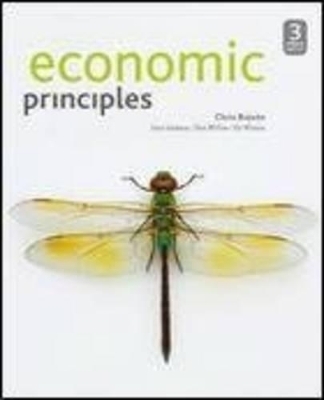
Economic Principles
McGraw-Hill Education / Australia
978-0-07-099852-0 (ISBN)
- Titel ist leider vergriffen;
keine Neuauflage - Artikel merken
Economic Principles 3e combines the essential micro and macro elements into one book created to cover a singlesemester course. It is a low to mid-level text designed for the average student to be able to understand, but without compromising the rigour of the text. It is pedagogically very strong, offering a step-by-step approach to learning but with all the flexibility of a set of six extension chapters allowing lecturers to teach at different levels, according to their students' needs.
Responding to market feedback this edition introduces new features as well as reworked existing features. For example, each chapter now has a new end-of-chapter worked case study, 'Bringing it all together', which contains a short case and a series of solved questions to guide students through the process of performing an economic analysis. The content has been updated too, incorporating coverage of the GFC, sustainability and the changing role of regulation, along with updates to all data, and new cases on hot topics such as global warming.
Economic Principles offers a blended learning approach that keeps students interested and engaged in everyday
economics. There's plenty of hands-on experience for students as they perform economic analyses on data that reflects what is happening in the world economy right now.
Dr Chris Bajada is a Senior Lecturer in the School of Finance and Economics at UTS. Chris has a B.Economics from Macquarie University, and a Phd from UNSW. Professor John Jackson, B.Sc.(Hons), M.Sc.(Economics)(London), Ph.D.(Pennsylvania) John Jackson was most recently Professor of Economics and Deputy Vice-Chancellor at RMIT; he died in 2006. He was previously Professor and Dean of Business at RMIT from 1991-1998 and before that Associate Professor and Dean of Economics and Commerce at the University of Western Australia. John had a Masters degree in economics from London University and obtained his PhD in economics from the University of Pennsylvania where he worked in the Wharton Econometrics Forecasting Unit. John had twenty years of experience teaching introductory economics and overseeing the delivery of large first year courses. He had been associated with this McGraw-Hill textbook on introductory economics since its first edition which appeared in 1980. Other teaching areas included public and welfare economics and John also contributed to senior leadership programs for public and private sector managers. John’s areas of research included optimal economic growth and growth policy and the role of education in growth of the Australian economy and he acted as a consultant to over twenty government agencies and private sector organisations. In addition to his academic and administrative work John was extensively involved as a board member of a number of arts and public broadcasting organisations. Mr Ron McIver, B.Ec. (Hons), M.Ec. (Flinders), M.App.Fin. (Macquarie), AIBF Ron McIver is a Lecturer in financial economics in the School of International Business, and Director of the Financial Markets Research Group (FMRG) within the Centre of Business Analysis and Research (CoBAR), at the University of South Australia. Prior to joining the University Ron was a Senior Research Officer (Economics) with the Industries Assistance Commission of the Australian Department of Treasury in Canberra. Ron has also held the position of Senior Lecturer in Quantitative Finance and Investment Management within the Accounting and Finance Group of the Business School at the University of Greenwich, London. Ron has provided training and advisory services in economics and finance within the banking and finance industry and the public sector, and has acted as a consultant on the design of graduate programs in business. Ron is an experienced provider of learning resources in the area of economics, having been extensively involved in the design, development and writing of a large number of courses for both the University of South Australia and the Open Learning Agency of Australia (OLAA). Ron has also co-authored a number of reports, texts on economics and articles on business and economic education. In recognition of his efforts in innovation in the teaching of economics Ron has been a recipient of a University of South Australia Award for Excellence in Teaching.
Part 1: Introduction
Chapter: 1. The general principles of economics
Appendix: Graphs and their meaning
Part 2: Core chapters – microeconomics
Chapter: 2. Demand and supply
Chapter: 3. Market behaviour – elasticity, tax and price controls
Chapter: 4. The costs of production
Chapter: 5. Pure competition and monopoly
Chapter: 6. Monopolistic competition and oligopoly
Chapter: 7. Market failure and resource allocation
Part 3: Core chapters – macroeconomics
Chapter: 8. The macro environment and its measurement
Chapter: 9. Aggregate demand and aggregate supply
Chapter: 10. Fiscal policy and public debt
Chapter: 11. Monetary policy and the financial system
Chapter: 12. Economic resources and the labour market
Chapter: 13. The international monetary system
Part 4: Extension chapters
E1. The theory of consumer behaviour
E2. International trade and protection
E3. The pricing of economic resources
E4. The aggregate expenditure model and the multiplier
E5. The economics of growth
E6. The development of macroeconomic debates
Glossary
Index
| Erscheint lt. Verlag | 28.10.2011 |
|---|---|
| Zusatzinfo | 187 Illustrations, unspecified |
| Sprache | englisch |
| Maße | 213 x 262 mm |
| Gewicht | 1500 g |
| Themenwelt | Wirtschaft ► Volkswirtschaftslehre |
| ISBN-10 | 0-07-099852-3 / 0070998523 |
| ISBN-13 | 978-0-07-099852-0 / 9780070998520 |
| Zustand | Neuware |
| Informationen gemäß Produktsicherheitsverordnung (GPSR) | |
| Haben Sie eine Frage zum Produkt? |
aus dem Bereich