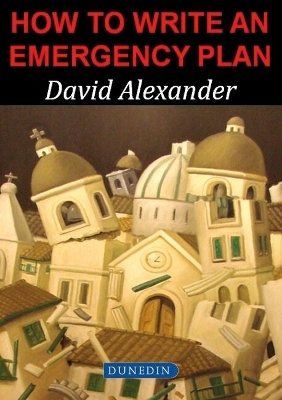
How to Write an Emergency Plan
Liverpool University Press (Verlag)
978-1-78046-012-3 (ISBN)
- Titel ist leider vergriffen;
keine Neuauflage - Artikel merken
The world is becoming more hazardous as natural and social processes combine to create complex situations of increased vulnerability and risk. There is increasing recognition that this trend is creating exigencies that must be dealt with. The common approach is to delegate the task of preparing an emergency plan to someone. Often that person is expected to get on with job but rarely is the means and instruction of how to write such a plan provided to them. There are a host of instances in which the letter of the law, not the spirit, is honoured by providing a token plan of little validity.
David Alexander provides, in this book, the assistance needed to write an emergency plan. It is a practical ‘how to’ manual and guide aimed at managers in business, civil protection officers, civil security officials, civil defence commanders, neighbourhood leaders and disaster managers who have been tasked with writing, reviewing or preparing emergency plans for all kinds of emergency, disaster or catastrophe. He takes the reader through the process of writing an emergency plan, step by step, starting with the rationale and context, before moving on through the stages of writing and activating a basic, generic emergency plan and concludes with information on specific kinds of plan, for example, for hospitals and cultural heritage sites.
This practical guide also provides a core for postgraduate training in emergency management and has been written in such a way that it is not tied to the legal constraints of any particular jurisdiction.
David Alexander is Professor of Risk and Disaster Reduction at University College London. He is also Visiting Professor at the Universities of Bournemouth and Northumbria (UK), Affiliated Professor at the University of Lund (Sweden) and Research Fellow at the Global Risk Forum GRF Davos (Switzerland). Professor Alexander is Vice-President of the Institute of Civil Protection and Emergency Management and Editor-in-Chief of the International Journal of Disaster Risk Reduction.
Contents: Foreword. 1. Introduction. Scope and objectives of this book; 2. What are emergencies? 3. What is an emergency plan? 4. The emergency planning process; 5. First step: background research; 6. Second step: scenario building; 7. Third Step: from scenarios to actions; 8. A note on the structure of the plan; 9. Fourth step: using the plan; 10. Planning to maintain the continuity of normal activities; 11. Specialized emergency planning; 12. Conclusion: the future of emergency planning. Afterword. Appendix 1: Glossary of working definitions by key terms. Appendix 2: Bibliography of selected references. Index.
| Verlagsort | Liverpool |
|---|---|
| Sprache | englisch |
| Maße | 156 x 234 mm |
| Themenwelt | Sozialwissenschaften ► Soziologie |
| Wirtschaft ► Betriebswirtschaft / Management ► Allgemeines / Lexika | |
| ISBN-10 | 1-78046-012-0 / 1780460120 |
| ISBN-13 | 978-1-78046-012-3 / 9781780460123 |
| Zustand | Neuware |
| Informationen gemäß Produktsicherheitsverordnung (GPSR) | |
| Haben Sie eine Frage zum Produkt? |
aus dem Bereich