


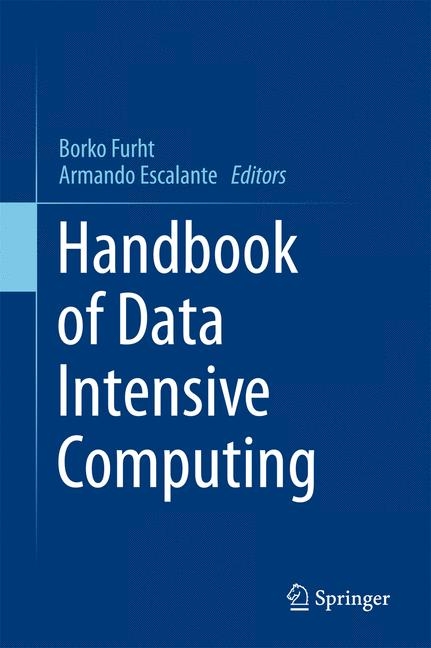
Handbook of Data Intensive Computing (eBook)
XVIII, 794 Seiten
Springer New York (Verlag)
978-1-4614-1415-5 (ISBN)
Data Intensive Computing refers to capturing, managing, analyzing, and understanding data at volumes and rates that push the frontiers of current technologies. The challenge of data intensive computing is to provide the hardware architectures and related software systems and techniques which are capable of transforming ultra-large data into valuable knowledge. Handbook of Data Intensive Computing is written by leading international experts in the field. Experts from academia, research laboratories and private industry address both theory and application. Data intensive computing demands a fundamentally different set of principles than mainstream computing. Data-intensive applications typically are well suited for large-scale parallelism over the data and also require an extremely high degree of fault-tolerance, reliability, and availability. Real-world examples are provided throughout the book.
Handbook of Data Intensive Computing is designed as a reference for practitioners and researchers, including programmers, computer and system infrastructure designers, and developers. This book can also be beneficial for business managers, entrepreneurs, and investors.
Data Intensive Computing refers to capturing, managing, analyzing, and understanding data at volumes and rates that push the frontiers of current technologies. The challenge of data intensive computing is to provide the hardware architectures and related software systems and techniques which are capable of transforming ultra-large data into valuable knowledge. Handbook of Data Intensive Computing is written by leading international experts in the field. Experts from academia, research laboratories and private industry address both theory and application. Data intensive computing demands a fundamentally different set of principles than mainstream computing. Data-intensive applications typically are well suited for large-scale parallelism over the data and also require an extremely high degree of fault-tolerance, reliability, and availability. Real-world examples are provided throughout the book. Handbook of Data Intensive Computing is designed as a referencefor practitioners and researchers, including programmers, computer and system infrastructure designers, and developers. This book can also be beneficial for business managers, entrepreneurs, and investors.
PART I ARCHITECTURES AND SYSTEMS.- High Performance Network Architectures for Data Intensive Computing.- Architecting Data-Intensive Software Systems.- ECL: A High-Level Programming Language for Data-Intensive Supercomputing.- Scalable Storage for Data-Intensive Computing.- Computation and Storage Trade-off for Cost-Effective Storage of Scientific Datasets in the Cloud.- PART II TECHNOLOGIES AND TECHNIQUES.- Load Balancing Techniques for Data Intensive Computing.- Resource Management for Data Intensive Clouds Through Dynamic Federation: A Game Theoretic Approach.- SALT: Scalable Automated Linking Technology for Data Intensive Computing.- Parallel Processing, Multiprocessors and Virtualization in Data-Intensive Computing.- Challenges in Data Intensive Analysis and Visualization at Scientific Experimental User Facilities.- Large-Scale Data Analytics Using Ensemble Clustering.- Specification of Data Intensive Applications with Data Dependency and Abstract Clocks.- Ensemble Feature Ranking Methods for Data Intensive Computing Applications.- Record Linkage Methodology and Applications.- Semantic Wrapper: Concise Semantic Querying of Legacy Relational Databases.- PART III SECURITY.- Security in Data Intensive Computing Systems.- Data Security and Privacy in Data-Intensive Supercomputing Clusters.- Information Security in Large Scale Distributed Systems.- Privacy and Security Requirements of Data Intensive Applications in Clouds.- PART IV APPLICATIONS.- On the Processing of Extreme Scale Datasets in the Geosciences.- Parallel Earthquake Simulations on Large-scale Multicore Supercomputers.- Data Intensive Computing in Bioinformatics: A Biomedical Case Study in Gene Selection and Filtering.- Design Space Exploration for Efficient Data Intensive Computing on SoCs.- Discovering Relevant Entities in Large-scale Social Information Systems.-Geospatial Data Management with Terrafly.- An Application for Processing Large and Non-uniform Media Objects on MapReduce-based Clusters.- Feature Selection Algorithms for Mining High-Dimensional DNA Microarray Data.- Application of Random Matrix Theory to Analyze Biological Data.- Keyword Search on Large Relational Databases: an OLAP-Oriented Approach.- A Distributed Publish/Subscribe System for Large Scale Sensor Networks.
| Erscheint lt. Verlag | 10.12.2011 |
|---|---|
| Zusatzinfo | XVIII, 794 p. |
| Verlagsort | New York |
| Sprache | englisch |
| Themenwelt | Mathematik / Informatik ► Informatik ► Datenbanken |
| Wirtschaft ► Betriebswirtschaft / Management ► Wirtschaftsinformatik | |
| Schlagworte | Applications • Architectures • Data • data intensive computing • data storage • hardware systems • Software systems |
| ISBN-10 | 1-4614-1415-6 / 1461414156 |
| ISBN-13 | 978-1-4614-1415-5 / 9781461414155 |
| Informationen gemäß Produktsicherheitsverordnung (GPSR) | |
| Haben Sie eine Frage zum Produkt? |
 PDF (Wasserzeichen)
DRM: Digitales Wasserzeichen
Dieses eBook enthält ein digitales Wasserzeichen und ist damit für Sie personalisiert. Bei einer missbräuchlichen Weitergabe des eBooks an Dritte ist eine Rückverfolgung an die Quelle möglich.
Dateiformat: PDF (Portable Document Format)
Mit einem festen Seitenlayout eignet sich die PDF besonders für Fachbücher mit Spalten, Tabellen und Abbildungen. Eine PDF kann auf fast allen Geräten angezeigt werden, ist aber für kleine Displays (Smartphone, eReader) nur eingeschränkt geeignet.
Systemvoraussetzungen:
PC/Mac: Mit einem PC oder Mac können Sie dieses eBook lesen. Sie benötigen dafür einen PDF-Viewer - z.B. den Adobe Reader oder Adobe Digital Editions.
eReader: Dieses eBook kann mit (fast) allen eBook-Readern gelesen werden. Mit dem amazon-Kindle ist es aber nicht kompatibel.
Smartphone/Tablet: Egal ob Apple oder Android, dieses eBook können Sie lesen. Sie benötigen dafür einen PDF-Viewer - z.B. die kostenlose Adobe Digital Editions-App.
Buying eBooks from abroad
For tax law reasons we can sell eBooks just within Germany and Switzerland. Regrettably we cannot fulfill eBook-orders from other countries.
aus dem Bereich


