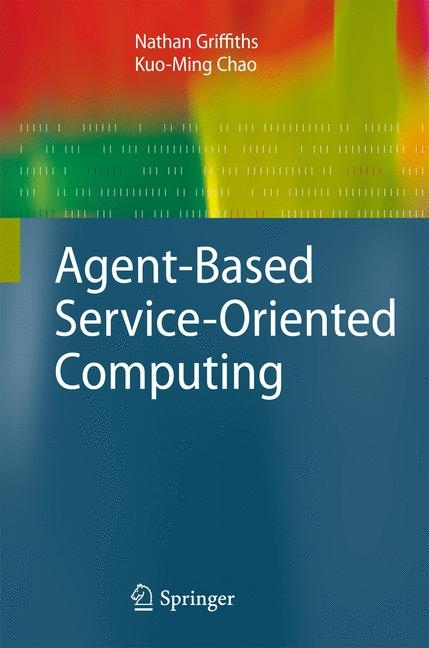
Agent-Based Service-Oriented Computing (eBook)
XIII, 270 Seiten
Springer London (Verlag)
978-1-84996-041-0 (ISBN)
Service-Oriented Computing (SOC) allows software development time to be shortened by the composition of existing services across the Internet. Further exploitation of this revolutionary trend is feasible through automation, thanks to the use of software agents and techniques from distributed artificial intelligence.
This book provides an overview of the related technologies and insight into state-of-the art research results in the field. The topics discussed cover the various stages in the life cycle of service-oriented software development using agent technologies to automate the development process and to manage services in a dynamic environment. The book presents both academic research results and the latest developments from industry.
Researchers from academia and industry, as well as postgraduates, will find this cutting-edge volume indispensable in order to gain understanding of the issues associated with agent-based service-oriented computing along with recent, and likely future technology trends.
Service-Oriented Computing (SOC) allows software development time to be shortened by the composition of existing services across the Internet. Further exploitation of this revolutionary trend is feasible through automation, thanks to the use of software agents and techniques from distributed artificial intelligence.This book provides an overview of the related technologies and insight into state-of-the art research results in the field. The topics discussed cover the various stages in the life cycle of service-oriented software development using agent technologies to automate the development process and to manage services in a dynamic environment. The book presents both academic research results and the latest developments from industry.Researchers from academia and industry, as well as postgraduates, will find this cutting-edge volume indispensable in order to gain understanding of the issues associated with agent-based service-oriented computing along with recent, and likely future technology trends.
1. Introduction
1.1 Distributed Systems
1.2 Software Agent
1.3 Service-Oriented Architecture
1.4 Modelling Methodologies
1.5 Supporting Development Platform
1.6 Agents and SOA Standards
1.7 Overview of Chapters
1.8 Conclusion
2. Service Advertisement and Discovery
2.1 Introduction to Service Advertisement and Discovery
2.2 Basic Technologies
2.3 Web service registry architectures
2.4 Data Structures
2.5 System Requirements
2.6 Advertisement and Discovery Services
2.7 Agents in Service Advertisement and Discovery
2.8 Challenges in Service Advertisement and Discovery
2.9 Summary
3. Multi-Agent Coordination for Service Composition
3.1 Introduction
3.2 Preliminaries
3.3 Related Work
3.4 Architecture of MQSC
3.5 Service Composition Generation
3.6 Service Composition Deployment and Execution
3.7 Case Study
3.8 Conclusion and Future Work
4. Flexible Workflow Management in Service Oriented Environments
4.1 Introduction
4.2 Orchestration and Choreography
4.3 Workflow and Web Services
4.4 The Role of Agents in Service-Based Business Processes
4.5 Dynamic Workflows
4.6 Summary and Outlook
5. Semantics for Service-Oriented Architectures
5.1 Introduction
5.2 Web Services and SOA
5.3 Semantic Web Services
5.4 Semantic Techniques for Automating SOA
5.5 Conclusions and Outlook
6. Dependability in Service-Oriented Computing
6.1 Introduction
6.2 Service-Oriented Architecture
6.3 Models
6.4 Dependability Enhancement in a Service-Oriented Architecture
6.5 Dependability Evaluation
6.6 Case Studies
6.7 Conclusions
7. Consensus Issues for Service Advertisement and Selection
7.1 Introduction
7.2 Existing Solutions for Web Service Selection
7.3 The Proposed QoS-aware Services Selection Model
7.4 Two Numerical Cases
7.5 Discussion
7.6 Conclusion
8. Trust and Reputation
8.1 Introduction
8.2 Trust and Reputation
8.3 Agents and Service-Oriented Computing
8.4 Trust Classes and Ontologies
8.5 Summary
9. QoS-Aware Service Selection
9.1 Introduction
9.2 Service Selection Procedure
9.3 Case Study - Selection of Switching Service
9.4 Performance Evaluation
9.5 The Selection of Switching Services
9.6 Summary
10. Future Directions
10.1 Introduction
10.2 Trust and Reputation
10.3 Contract-based Systems
10.4 Service Accountability
| Erscheint lt. Verlag | 22.1.2010 |
|---|---|
| Reihe/Serie | Advanced Information and Knowledge Processing | Advanced Information and Knowledge Processing |
| Zusatzinfo | XIII, 270 p. 72 illus. |
| Verlagsort | London |
| Sprache | englisch |
| Themenwelt | Mathematik / Informatik ► Informatik ► Netzwerke |
| Mathematik / Informatik ► Informatik ► Programmiersprachen / -werkzeuge | |
| Mathematik / Informatik ► Informatik ► Software Entwicklung | |
| Informatik ► Theorie / Studium ► Künstliche Intelligenz / Robotik | |
| Mathematik / Informatik ► Informatik ► Web / Internet | |
| Wirtschaft ► Betriebswirtschaft / Management ► Wirtschaftsinformatik | |
| Schlagworte | Agents • Artificial Intelligence • Business Process • data structure • Distributed Systems • Evolution • Internet • Modeling • Multi-agents systems • Ontologie • semantic web • Service-Oriented Architecture • service-oriented computing • Service-Oriented Computing/Architecutre • software agent • Web service • Web Services |
| ISBN-10 | 1-84996-041-0 / 1849960410 |
| ISBN-13 | 978-1-84996-041-0 / 9781849960410 |
| Informationen gemäß Produktsicherheitsverordnung (GPSR) | |
| Haben Sie eine Frage zum Produkt? |
 PDF (Wasserzeichen)
DRM: Digitales Wasserzeichen
Dieses eBook enthält ein digitales Wasserzeichen und ist damit für Sie personalisiert. Bei einer missbräuchlichen Weitergabe des eBooks an Dritte ist eine Rückverfolgung an die Quelle möglich.
Dateiformat: PDF (Portable Document Format)
Mit einem festen Seitenlayout eignet sich die PDF besonders für Fachbücher mit Spalten, Tabellen und Abbildungen. Eine PDF kann auf fast allen Geräten angezeigt werden, ist aber für kleine Displays (Smartphone, eReader) nur eingeschränkt geeignet.
Systemvoraussetzungen:
PC/Mac: Mit einem PC oder Mac können Sie dieses eBook lesen. Sie benötigen dafür einen PDF-Viewer - z.B. den Adobe Reader oder Adobe Digital Editions.
eReader: Dieses eBook kann mit (fast) allen eBook-Readern gelesen werden. Mit dem amazon-Kindle ist es aber nicht kompatibel.
Smartphone/Tablet: Egal ob Apple oder Android, dieses eBook können Sie lesen. Sie benötigen dafür einen PDF-Viewer - z.B. die kostenlose Adobe Digital Editions-App.
Buying eBooks from abroad
For tax law reasons we can sell eBooks just within Germany and Switzerland. Regrettably we cannot fulfill eBook-orders from other countries.
aus dem Bereich