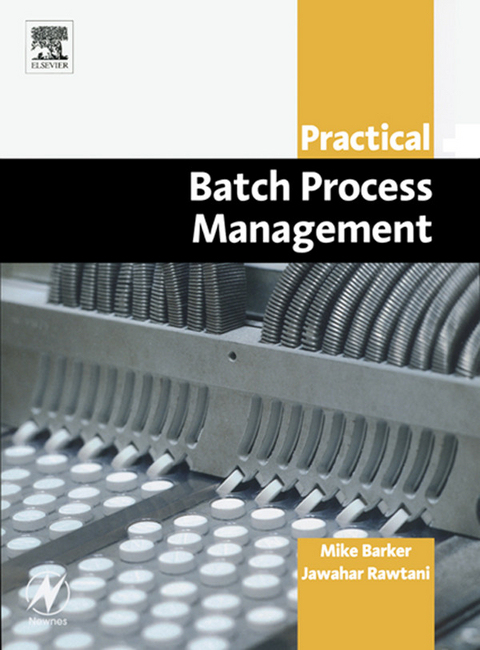
Practical Batch Process Management (eBook)
192 Seiten
Elsevier Science (Verlag)
9780080455433 (ISBN)
Practical Batch Management Systems explains how to utilize the building blocks and arrange the structures of modern batch management systems to produce flexible schemes suitable for automated batch management, with the capability to be reconfigured to use the same plant equipment in different combinations.
It introduces current best practice in the automation of batch processes, including the drive for integration with MES (Manufacturing Execution System) and ERP (Enterprise Resource Planning) products from major IT vendors. References and examples are drawn from DCS / PLC batch control products currently on the market.
- Implement modern batch management systems that are flexible and easily reconfigured
- Integrate batch management with other manufacturing systems including MES and ERP
- Increase productivity through industry best practice
Mike is an accomplished engineer and well known consultant in Southern Africa who has worked in the instrumentation and control world for most of his professional life. He commenced his career in the writing and installation of real time software ranging from Fortran CAD to SCADA systems. He has also worked as an editor of a well known Instrumentation and Control magazine and built it into the leading magazine of its class. Mike recently led a team that designed and engineered a large batch management and control system for a multimillion dollar blue-chip consumer products plant and this has now been successfully running for 12 months. He is an entertaining and knowledgeable instructor with an interest in applying practical proven techniques to problems facing today's engineers and technicians working in this area of expertise. He has presented extensively on IDC Technologies range of Batch Management courses.
Historically batch control systems were designed individually to match a specific arrangement of plant equipment. They lacked the ability to convert to new products without having to modify the control systems, and did not lend themselves to integration with manufacturing management systems. Practical Batch Management Systems explains how to utilize the building blocks and arrange the structures of modern batch management systems to produce flexible schemes suitable for automated batch management, with the capability to be reconfigured to use the same plant equipment in different combinations. It introduces current best practice in the automation of batch processes, including the drive for integration with MES (Manufacturing Execution System) and ERP (Enterprise Resource Planning) products from major IT vendors. References and examples are drawn from DCS / PLC batch control products currently on the market.- Implement modern batch management systems that are flexible and easily reconfigured - Integrate batch management with other manufacturing systems including MES and ERP - Increase productivity through industry best practice
Front cover 1
Contents 6
1. Introduction 11
1.1 Introduction 11
1.2 Identification of batch processes 12
1.3 Background of the need for integrated batch systems 18
1.4 Overview of batch systems engineering 20
1.5 Introduction to standards 24
2. Identify and define physical models 27
2.1 Introduction 27
2.2 Define the physical model 31
2.3 Define tags 34
3. Identify and define process models, actions, operations and stages 36
3.1 Introduction 36
3.2 Process model 37
3.3 Relationship between process model and physical model 38
4. Identify and define procedural models 41
4.1 Introduction 41
4.2 Procedural model 41
4.3 Concept of equipment entities 44
5. Introduction to recipes 47
5.1 Introduction 47
5.2 S88 recipe model 49
5.3 Types of recipes 50
5.4 Building recipe procedures 55
6. Batch manufacturing basics 58
6.1 Introduction 58
6.2 Batch numbering, tracking and reporting 58
6.3 Batch planning and scheduling 60
7. Batch and sequence programming fundamentals 72
7.1 Introduction 72
7.2 Techniques for batch control elements 72
7.3 Implementation 73
7.4 Interaction with continuous process sections 78
8. Practical techniques in sequence control design 80
8.1 Introduction 80
8.2 Programming PLCs/DCS 80
8.3 Practical methods of functional specification 83
8.4 Defining equipment procedures 84
8.5 Phase logic programming 85
8.6 Phase logic interface 88
9. Operator and supervisor interface 96
9.1 Introduction 96
9.2 Display screens for batch management 96
9.3 Guidelines for building user interfaces 97
9.4 Consideration of human and ergonomic factors 99
10. Batch management issues 103
10.1 Introduction 103
10.2 Control activity model 103
10.3 Practical problems in batch management 106
10.4 Implementation of safety issues in batch management 108
11. Batch control technologies 112
11.1 Introduction 112
11.2 Overview of DCS/PLC architecture 112
11.3 Integration of batch control systems to production management and ERP systems 115
11.4 Standards for enterprise/control systems integration 120
11.5 Sending process quality and production reports back to ERP 124
12. Practical software project planning and implementation 126
12.1 Introduction 126
12.2 What to look for in batch software packages 126
12.3 Batch control software products 132
Exercises 142
Apprendix A: Modular approach 161
A. 1 Introduction 161
A. 2 Concepts of modular manufacturing 161
A. 3 Modular approach in batch process manufacturing 162
A. 4 Modularity using ISA S88 standard 163
Appendix B: Case study of batch automation in a biotech manufacturing plant 166
B.1 Introduction 166
B.2 Introduction of manufacturing facility 166
B.3 The manufacturing process 167
B.4 The automation project objectives and requirements 169
B.5 The batch system requirements 169
B.6 The system architecture 173
B.7 The plant startup and validation 174
B.8 Conclusion 175
Solutions 176
Index 185
| Erscheint lt. Verlag | 18.11.2004 |
|---|---|
| Sprache | englisch |
| Themenwelt | Naturwissenschaften ► Chemie ► Technische Chemie |
| Technik ► Bauwesen | |
| Technik ► Umwelttechnik / Biotechnologie | |
| Wirtschaft ► Betriebswirtschaft / Management ► Logistik / Produktion | |
| ISBN-13 | 9780080455433 / 9780080455433 |
| Informationen gemäß Produktsicherheitsverordnung (GPSR) | |
| Haben Sie eine Frage zum Produkt? |
 EPUB (Adobe DRM)
Kopierschutz: Adobe-DRM
Adobe-DRM ist ein Kopierschutz, der das eBook vor Mißbrauch schützen soll. Dabei wird das eBook bereits beim Download auf Ihre persönliche Adobe-ID autorisiert. Lesen können Sie das eBook dann nur auf den Geräten, welche ebenfalls auf Ihre Adobe-ID registriert sind.
Details zum Adobe-DRM
Dateiformat: EPUB (Electronic Publication)
EPUB ist ein offener Standard für eBooks und eignet sich besonders zur Darstellung von Belletristik und Sachbüchern. Der Fließtext wird dynamisch an die Display- und Schriftgröße angepasst. Auch für mobile Lesegeräte ist EPUB daher gut geeignet.
Systemvoraussetzungen:
PC/Mac: Mit einem PC oder Mac können Sie dieses eBook lesen. Sie benötigen eine
eReader: Dieses eBook kann mit (fast) allen eBook-Readern gelesen werden. Mit dem amazon-Kindle ist es aber nicht kompatibel.
Smartphone/Tablet: Egal ob Apple oder Android, dieses eBook können Sie lesen. Sie benötigen eine
Geräteliste und zusätzliche Hinweise
Buying eBooks from abroad
For tax law reasons we can sell eBooks just within Germany and Switzerland. Regrettably we cannot fulfill eBook-orders from other countries.
aus dem Bereich