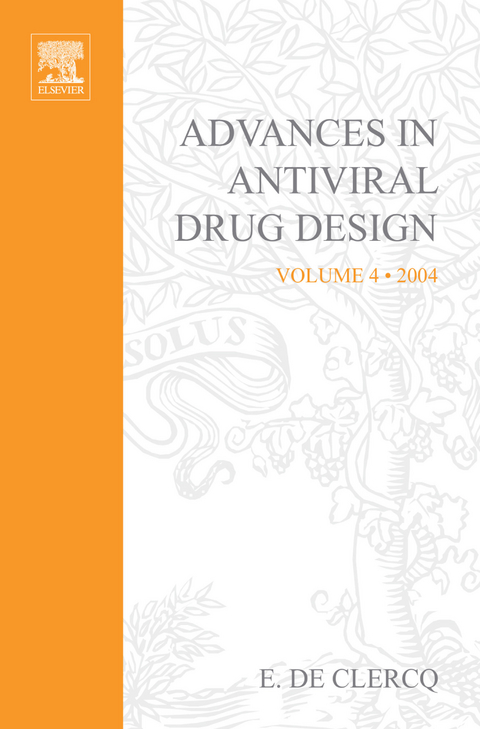
Advances in Antiviral Drug Design (eBook)
230 Seiten
Elsevier Science (Verlag)
978-0-08-052226-5 (ISBN)
First, as the introductory chapter, the different new anti-HIV agents that are now in preclinical or clinical development are reviewed by E. De Clercq. This includes new NRTIs, NNRTIs and PIs, but also HIV entry/fusion inhibitors as well as integrase inhibitors, and some of these agents, such as the NRTI emtricitabine [(-)FTC] and the PI atazanavir, may soon be licensed for clinical use.
Second, high expectations are vested in the potential therapeutic usefulness of inhibitors of HIV integration, a point of no return in the life cycle of HIV, and this approach is highlighted by D.J. Hazuda and S.D. Young.
Third, as all currently available PIs can be described as peptidomimetic, and, therefore, expected to demonstrate overlapping virus-drug resistance and side effect profiles, it would be interesting to see how a non-peptidic protease inhibitor such as tipranavir behaves, and this is covered by D. Mayers, K. Curry, V. Kohlbrenner and S. McCallister.
Fourth, neuraminidase inhibitors such as zanamivir (that has to be inhaled) and oseltamivir (that can be administered via the oral route) have gained a definitive status as antiviral drugs useful for both therapy and prophylaxis of influenza A and B virus infections, as they target a specific influenza viral enzyme, neuraminidase (or sialidase), they may be expected to block newly emerging influenza viruses as well, and the design of neuraminidase inhibitors has received due attention of H. Jin and C.U. Kim.
Fifth, while the major current efforts in antiviral drug development have shifted from herpesviruses towards HIV and hepatitis viruses [hepatitis B virus (HBV), hepatitis C virus (HCV)], it is interesting to note that by switching from the classical five-membered sugar or acyclic nucleoside strategy, J. Wang, M. Froeyen and P. Herdewijn have gone upstream in designing six-membered carbocyclic nucleosides as potential anti-herpesvirus agents.
Sixth, following up on the nucleotide prodrug strategy introduced above under ix, to deliver the biologically active nucleotides inside the cells, C. Meier has elaborated on a particular class of such pronucleotides, namely that of the cyclosaligenyl pronucleotides, an approach that should have far reaching implications for compounds effective against HIV, HBV and other viruses.
The six topics covered in this fourth volume of Advances in Antiviral Drug Design are in the front line of the present endeavors towards the design and development of new therapeutic agents for virus infections. They pertain to the combat against three of the most important viral pathogens of current times: HIV, HBV, influenza virus and herpesviruses.
The fourth volume of Advances in Antiviral Drug Design is keeping up with the recent progress made in the broad field of antiviral drug research and encompasses six specific directions that have opened new avenues for the treatment of HIV and other virus infections.First, as the introductory chapter, the different new anti-HIV agents that are now in preclinical or clinical development are reviewed by E. De Clercq. This includes new NRTIs, NNRTIs and PIs, but also HIV entry/fusion inhibitors as well as integrase inhibitors, and some of these agents, such as the NRTI emtricitabine [(-)FTC] and the PI atazanavir, may soon be licensed for clinical use.Second, high expectations are vested in the potential therapeutic usefulness of inhibitors of HIV integration, a point of no return in the life cycle of HIV, and this approach is highlighted by D.J. Hazuda and S.D. Young.Third, as all currently available PIs can be described as "e;peptidomimetic"e;, and, therefore, expected to demonstrate overlapping virus-drug resistance and side effect profiles, it would be interesting to see how a non-peptidic protease inhibitor such as tipranavir behaves, and this is covered by D. Mayers, K. Curry, V. Kohlbrenner and S. McCallister.Fourth, neuraminidase inhibitors such as zanamivir (that has to be inhaled) and oseltamivir (that can be administered via the oral route) have gained a definitive status as antiviral drugs useful for both therapy and prophylaxis of influenza A and B virus infections; as they target a specific influenza viral enzyme, neuraminidase (or sialidase), they may be expected to block newly emerging influenza viruses as well, and the design of neuraminidase inhibitors has received due attention of H. Jin and C.U. Kim.Fifth, while the major current efforts in antiviral drug development have shifted from herpesviruses towards HIV and hepatitis viruses [hepatitis B virus (HBV), hepatitis C virus (HCV)], it is interesting to note that by switching from the classical five-membered sugar or acyclic nucleoside strategy, J. Wang, M. Froeyen and P. Herdewijn have gone "e;upstream"e; in designing six-membered carbocyclic nucleosides as potential anti-herpesvirus agents.Sixth, following up on the nucleotide prodrug strategy introduced above under ix, to deliver the biologically active nucleotides inside the cells, C. Meier has elaborated on a particular class of such pronucleotides, namely that of the cyclosaligenyl pronucleotides, an approach that should have far reaching implications for compounds effective against HIV, HBV and other viruses.The six topics covered in this fourth volume of Advances in Antiviral Drug Design are in the front line of the present endeavors towards the design and development of new therapeutic agents for virus infections. They pertain to the combat against three of the most important viral pathogens of current times: HIV, HBV, influenza virus and herpesviruses.
Cover 1
CONTENTS 6
LIST OF CONTRIBUTORS 8
PREFACE 10
Chapter 1. NEW ANTI-HIV AGENTS IN PRECLINICAL OR CLINICAL DEVELOPMENT 14
Chapter 2. INHIBITORS OF HUMAN IMMUNODEFICIENCY VIRUS INTEGRATION 76
Chapter 3. NON-PEPTIDIC PROTEASE INHIBITORS (NPPIs): TIPRANAVIR 92
Chapter 4. DESIGN OF NEURAMINIDASE INHIBITORS AS ANTI-INFLUENZA VIRUS AGENTS 112
Chapter 5. SIX-MEMBERED CARBOCYCLIC NUCLEOSIDES 132
Chapter 6. cycloSAL-PRONUCLEOTIDES„DESIGN OF THE CONCEPT, CHEMISTRY, AND ANTIVIRAL ACTIVITY 160
INDEX 228
| Erscheint lt. Verlag | 17.12.2003 |
|---|---|
| Sprache | englisch |
| Themenwelt | Medizin / Pharmazie ► Gesundheitsfachberufe |
| Medizin / Pharmazie ► Medizinische Fachgebiete ► Pharmakologie / Pharmakotherapie | |
| Medizin / Pharmazie ► Pharmazie | |
| Naturwissenschaften ► Biologie ► Genetik / Molekularbiologie | |
| Naturwissenschaften ► Biologie ► Mikrobiologie / Immunologie | |
| Technik ► Umwelttechnik / Biotechnologie | |
| Wirtschaft | |
| ISBN-10 | 0-08-052226-2 / 0080522262 |
| ISBN-13 | 978-0-08-052226-5 / 9780080522265 |
| Informationen gemäß Produktsicherheitsverordnung (GPSR) | |
| Haben Sie eine Frage zum Produkt? |
 PDF (Adobe DRM)
Kopierschutz: Adobe-DRM
Adobe-DRM ist ein Kopierschutz, der das eBook vor Mißbrauch schützen soll. Dabei wird das eBook bereits beim Download auf Ihre persönliche Adobe-ID autorisiert. Lesen können Sie das eBook dann nur auf den Geräten, welche ebenfalls auf Ihre Adobe-ID registriert sind.
Details zum Adobe-DRM
Dateiformat: PDF (Portable Document Format)
Mit einem festen Seitenlayout eignet sich die PDF besonders für Fachbücher mit Spalten, Tabellen und Abbildungen. Eine PDF kann auf fast allen Geräten angezeigt werden, ist aber für kleine Displays (Smartphone, eReader) nur eingeschränkt geeignet.
Systemvoraussetzungen:
PC/Mac: Mit einem PC oder Mac können Sie dieses eBook lesen. Sie benötigen eine
eReader: Dieses eBook kann mit (fast) allen eBook-Readern gelesen werden. Mit dem amazon-Kindle ist es aber nicht kompatibel.
Smartphone/Tablet: Egal ob Apple oder Android, dieses eBook können Sie lesen. Sie benötigen eine
Geräteliste und zusätzliche Hinweise
Buying eBooks from abroad
For tax law reasons we can sell eBooks just within Germany and Switzerland. Regrettably we cannot fulfill eBook-orders from other countries.
aus dem Bereich