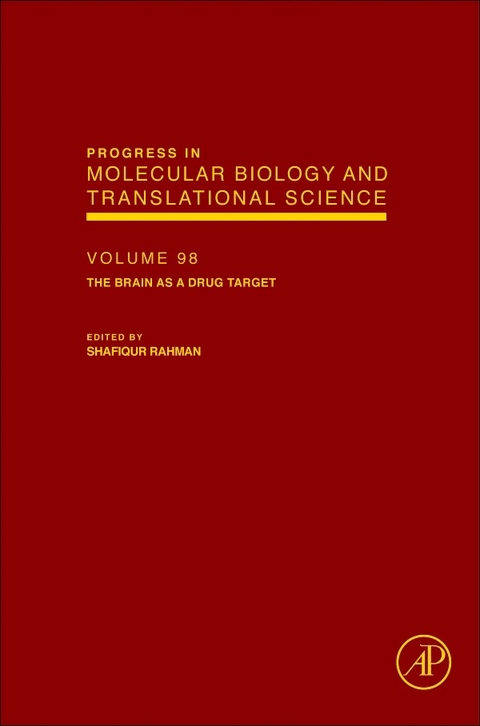
Brain as a Drug Target (eBook)
468 Seiten
Elsevier Science (Verlag)
978-0-12-385507-7 (ISBN)
The brain is protected by the blood-brain barrier and this barrier prevents many drugs from entering the brain. This volume discusses various drug delivery and targeting strategies that are being developed to enhance the transport and distribution of drugs into the brain. - Discusses new discoveries, approaches, and ideas- Contributions from leading scholars and industry experts- Reference guide for researchers involved in molecular biology and related fields
Front Cover 1
Progress in Molecular Biology and Translational Science: The Brain as a Drug Target 4
Copyright 5
Contents 6
Contributors 10
Preface 12
Chapter 1: Monoamine Transporters: Vulnerable and Vital Doorkeepers 16
I. Introduction 17
II. Clinical Benefits: Demonstration of the Medical Roles of Monoamine Transporters 18
III. Preclinical Indications-Behavioral Pharmacology 21
IV. Molecular Study: cDNA Cloning and Structure Activity Relationship 26
V. Protein Regulations 29
VI. Animal Genetics 32
VII. The Transporter Genes as Risk Factors 35
VIII. Perspectives for Medication Development 39
Acknowledgments 42
References 42
Chapter 2: Therapeutic Targets in Alzheimer's Disease and Related Tauopathies 62
I. Introduction to the Disease 63
II. Attempts at Abeta Therapy 68
III. Tau Hypothesis 70
IV. Tau Theraputic Targets 81
V. Concluding Remarks 86
Acknowledgments 87
References 87
Chapter 3: Therapeutic Targets for Neuroprotection and/or Enhancement of Functional Recovery Following Traumatic Brain Injury 100
I. Introduction 101
II. Primary Injury Models 102
III. Receptor-Based Targets for Neuroprotection 104
IV. Targeting Enzymatic Activity for Neuroprotection 119
V. Other Promising Strategies 122
VI. Future Directions for Optimization of Treatment Regimens 129
References 131
Chapter 4: Insulin, Synaptic Function, and Opportunities for Neuroprotection 148
I. Introduction 149
II. Insulin Within the Central Nervous System 150
III. Insulin Receptors Within the Brain 155
IV. Insulin Signaling and Synaptic Function 163
V. Therapeutic Opportunities: Insulin and Neuroprotection 173
VI. General Summary 182
References 183
Chapter 5: Molecular Alterations in Glioblastoma: PotentialTargets for Immunotherapy 202
I. Introduction 203
II. Genetic Alterations in Glioblastoma 205
III. Ags and Biomarkers in Glioblastoma 210
IV. Ag-Specific Immunotherapy for Glioblastoma 217
V. Biomarker-Specific Chemotherapy for Glioblastoma 221
VI. Cytokine-Based Immunotherapy for Glioblastoma 227
VII. Chemoimmunotherapy for Glioblastoma 231
VIII. Tumor-Associated Molecules Influencing Glioblastoma Immunotherapy 233
IX. Conclusions 239
Acknowledgments 241
References 241
Chapter 6: Molecular Signaling and Translational Significance of the Corticotropin Releasing Factor System 250
I. Introduction to the Corticotropin Releasing Factor Peptide Family 251
II. Neural CRF Distribution 252
III. CRF Binding and Signal Transduction 256
IV. Genes and Gene Systems Activated by CRF 259
V. Interactions with Other Neural Circuits 262
VI. Translational Significance of CRF 268
VII. Integrated CRF Function 279
References 282
Chapter 7: Molecular Targets of Alcohol Action: Translational Research for Pharmacotherapy Development and Screening 308
I. Introduction 309
II. Alcohol Abuse and Dependence, Significance, and Treatment Needs 311
III. Preclinical Strategies for Identification of Novel Targets of Alcohol Action 312
IV. Translational Strategies and Need for Continued Biomarkers Development 342
References 346
Chapter 8: Brain Nicotinic Receptors as Emerging Targets for Drug Addiction: Neurobiology to Translational Research 364
I. Introduction 365
II. Brain nAChRs in Nicotine Addiction 366
III. Brain nAChRs in Alcohol Dependence 368
IV. Brain nAChRs in Other Addictive Disorders 370
V. Limitations in nAChR-Based Translational Research 372
VI. Conclusions and Future Perspectives 373
Acknowledgments 373
References 374
Chapter 9: Glutamatergic Neuroplasticity in Cocaine Addiction 382
I. Introduction 383
II. Neurocircuitry of Addiction 384
III. Adaptations in Synaptic Plasticity 388
IV. Glutamate Homeostasis Hypothesis of Cocaine Addiction 393
V. Redox Regulation of Neurons 396
VI. Promise for Glutamate-Mediated Pharmacotherapies for Addiction 399
VII. Conclusion 404
References 404
Chapter 10: Role of the Serotonergic System in Alcohol Dependence: From AnimalModels to Clinics 416
I. Introduction 417
II. The Role of 5-HTT in Alcohol-Directed Neuroadaptation, Intoxication Response, and Potential for Abuse and Dependence 420
III. Serotonergic Receptors: Molecular, Pharmacological, and Physiological Aspects and Their Role in Alcohol Dependence 427
IV. Interactions Between the Serotonergic System and Other Neurotransmitter Systems in the Modulation of Alcohol Consumption 430
V. Serotonergic System as a Potential Therapeutic Target in Alcohol Dependence/Addiction 434
VI. Conclusions 441
Acknowledgments 442
References 442
Index 460
Color Plates 470
| Erscheint lt. Verlag | 22.2.2011 |
|---|---|
| Sprache | englisch |
| Themenwelt | Sachbuch/Ratgeber |
| Medizin / Pharmazie ► Medizinische Fachgebiete ► Neurologie | |
| Medizin / Pharmazie ► Medizinische Fachgebiete ► Pharmakologie / Pharmakotherapie | |
| Medizin / Pharmazie ► Pharmazie | |
| Naturwissenschaften ► Biologie ► Humanbiologie | |
| Naturwissenschaften ► Biologie ► Zoologie | |
| Technik | |
| Wirtschaft | |
| ISBN-10 | 0-12-385507-1 / 0123855071 |
| ISBN-13 | 978-0-12-385507-7 / 9780123855077 |
| Informationen gemäß Produktsicherheitsverordnung (GPSR) | |
| Haben Sie eine Frage zum Produkt? |
 PDF (Adobe DRM)
Kopierschutz: Adobe-DRM
Adobe-DRM ist ein Kopierschutz, der das eBook vor Mißbrauch schützen soll. Dabei wird das eBook bereits beim Download auf Ihre persönliche Adobe-ID autorisiert. Lesen können Sie das eBook dann nur auf den Geräten, welche ebenfalls auf Ihre Adobe-ID registriert sind.
Details zum Adobe-DRM
Dateiformat: PDF (Portable Document Format)
Mit einem festen Seitenlayout eignet sich die PDF besonders für Fachbücher mit Spalten, Tabellen und Abbildungen. Eine PDF kann auf fast allen Geräten angezeigt werden, ist aber für kleine Displays (Smartphone, eReader) nur eingeschränkt geeignet.
Systemvoraussetzungen:
PC/Mac: Mit einem PC oder Mac können Sie dieses eBook lesen. Sie benötigen eine
eReader: Dieses eBook kann mit (fast) allen eBook-Readern gelesen werden. Mit dem amazon-Kindle ist es aber nicht kompatibel.
Smartphone/Tablet: Egal ob Apple oder Android, dieses eBook können Sie lesen. Sie benötigen eine
Geräteliste und zusätzliche Hinweise
Buying eBooks from abroad
For tax law reasons we can sell eBooks just within Germany and Switzerland. Regrettably we cannot fulfill eBook-orders from other countries.
aus dem Bereich